

322
Y. Shi et al.
10.2.2.5 Electrode Geometry
The geometry of the electrode is also the variable which influents the welding process.
Based on the experience gained from GTAW welding, conical tips were only used
in K-TIG welding, but two parameters of the electrode were investigated, including
the diameter of the electrode and tip angle. Tests were done on the 5.6 mm SAF
2205. The threshold current when using an electrode tip angel of 90° was high. It is
about 1.4 times of the threshold current of the 45° tip electrode. Between the angle
of 45° and 60°, almost half of this changing occurred. While diameter of the torch
electrode is decreased from 6.4 to 3.2 mm, threshold current was increased over 10%.
In conclusion, both the increasing of the torch electrode diameters and the decreasing
of the angle of the electrode tip led to a result that the threshold current decreased.
Moreover, the decreasing of the tip angle also reduced the current but with a greater
effect.
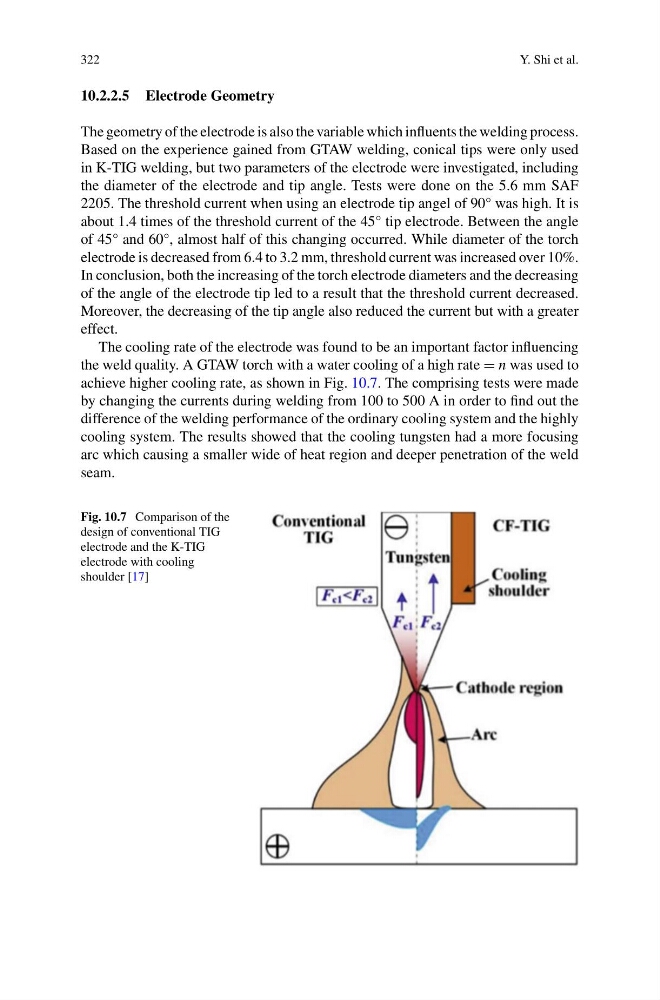
The cooling rate of the electrode was found to be an important factor influencing
the weld quality. A GTAW torch with a water cooling of a high rate = n was used to
achieve higher cooling rate, as shown in Fig. 10.7. The comprising tests were made
by changing the currents during welding from 100 to 500 A in order to find out the
difference of the welding performance of the ordinary cooling system and the highly
cooling system. The results showed that the cooling tungsten had a more focusing
arc which causing a smaller wide of heat region and deeper penetration of the weld
seam.
Fig. 10.7 Comparison of the
design of conventional TIG
electrode and the K-TIG
electrode with cooling
shoulder [17]
Y. Shi et al.
10.2.2.5 Electrode Geometry
The geometry of the electrode is also the variable which influents the welding process.
Based on the experience gained from GTAW welding, conical tips were only used
in K-TIG welding, but two parameters of the electrode were investigated, including
the diameter of the electrode and tip angle. Tests were done on the 5.6 mm SAF
2205. The threshold current when using an electrode tip angel of 90° was high. It is
about 1.4 times of the threshold current of the 45° tip electrode. Between the angle
of 45° and 60°, almost half of this changing occurred. While diameter of the torch
electrode is decreased from 6.4 to 3.2 mm, threshold current was increased over 10%.
In conclusion, both the increasing of the torch electrode diameters and the decreasing
of the angle of the electrode tip led to a result that the threshold current decreased.
Moreover, the decreasing of the tip angle also reduced the current but with a greater
effect.
The cooling rate of the electrode was found to be an important factor influencing
the weld quality. A GTAW torch with a water cooling of a high rate = n was used to
achieve higher cooling rate, as shown in Fig. 10.7. The comprising tests were made
by changing the currents during welding from 100 to 500 A in order to find out the
difference of the welding performance of the ordinary cooling system and the highly
cooling system. The results showed that the cooling tungsten had a more focusing
arc which causing a smaller wide of heat region and deeper penetration of the weld
seam.
Fig. 10.7 Comparison of the
design of conventional TIG
electrode and the K-TIG
electrode with cooling
shoulder [17]