

320
Y. Shi et al.
10.2.2.3 Voltage
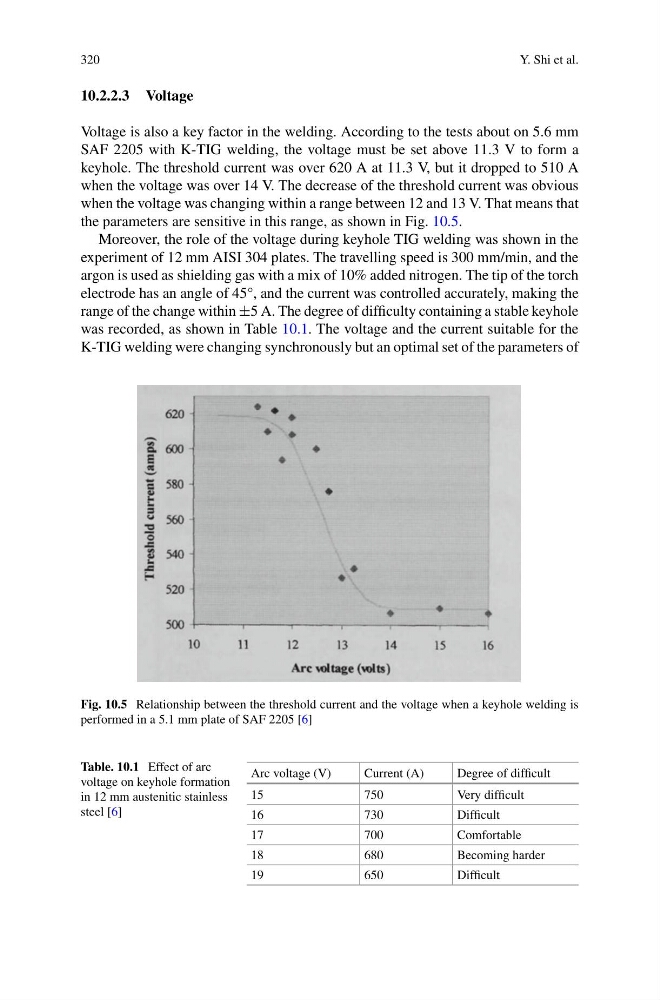
Voltage is also a key factor in the welding. According to the tests about on 5.6 mm
SAF 2205 with K-TIG welding, the voltage must be set above 11.3 V to form a
keyhole. The threshold current was over 620 A at 11.3 V, but it dropped to 510 A
when the voltage was over 14 V. The decrease of the threshold current was obvious
when the voltage was changing within a range between 12 and 13 V. That means that
the parameters are sensitive in this range, as shown in Fig. 10.5.
Moreover, the role of the voltage during keyhole TIG welding was shown in the
experiment of 12 mm AISI 304 plates. The travelling speed is 300 mm/min, and the
argon is used as shielding gas with a mix of 10% added nitrogen. The tip of the torch
electrode has an angle of 45°, and the current was controlled accurately, making the
range of the change within ±5 A. The degree of difficulty containing a stable keyhole
was recorded, as shown in Table 10.1. The voltage and the current suitable for the
K-TIG welding were changing synchronously but an optimal set of the parameters of
Fig. 10.5 Relationship between the threshold current and the voltage when a keyhole welding is
performed in a 5.1 mm plate of SAF 2205 [6]
Table. 10.1 Effect of arc
voltage on keyhole formation
in 12 mm austenitic stainless
steel [6]
Arc voltage (V)
Current (A)
Degree of difficult
15
750
Very difficult
16
730
Difficult
17
700
Comfortable
18
680
Becoming harder
19
650
Difficult
Y. Shi et al.
10.2.2.3 Voltage
Voltage is also a key factor in the welding. According to the tests about on 5.6 mm
SAF 2205 with K-TIG welding, the voltage must be set above 11.3 V to form a
keyhole. The threshold current was over 620 A at 11.3 V, but it dropped to 510 A
when the voltage was over 14 V. The decrease of the threshold current was obvious
when the voltage was changing within a range between 12 and 13 V. That means that
the parameters are sensitive in this range, as shown in Fig. 10.5.
Moreover, the role of the voltage during keyhole TIG welding was shown in the
experiment of 12 mm AISI 304 plates. The travelling speed is 300 mm/min, and the
argon is used as shielding gas with a mix of 10% added nitrogen. The tip of the torch
electrode has an angle of 45°, and the current was controlled accurately, making the
range of the change within ±5 A. The degree of difficulty containing a stable keyhole
was recorded, as shown in Table 10.1. The voltage and the current suitable for the
K-TIG welding were changing synchronously but an optimal set of the parameters of
Fig. 10.5 Relationship between the threshold current and the voltage when a keyhole welding is
performed in a 5.1 mm plate of SAF 2205 [6]
Table. 10.1 Effect of arc
voltage on keyhole formation
in 12 mm austenitic stainless
steel [6]
Arc voltage (V)
Current (A)
Degree of difficult
15
750
Very difficult
16
730
Difficult
17
700
Comfortable
18
680
Becoming harder
19
650
Difficult