

10 A Novel High-Efficiency Keyhole Tungsten Inert Gas …
317
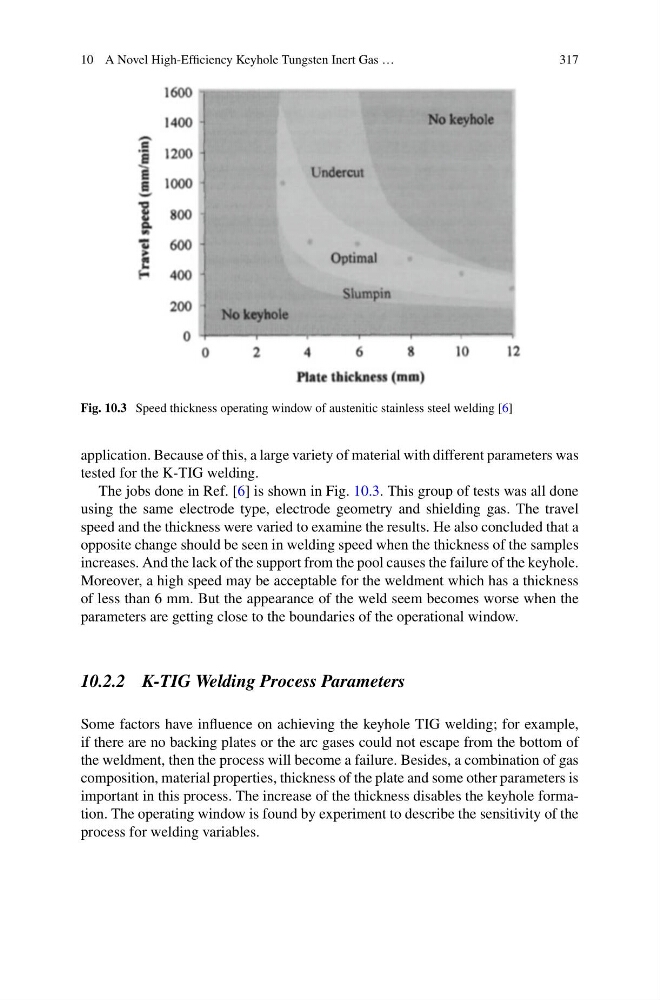
Fig. 10.3 Speed thickness operating window of austenitic stainless steel welding [6]
application. Because of this, a large variety of material with different parameters was
tested for the K-TIG welding.
The jobs done in Ref. [6] is shown in Fig. 10.3. This group of tests was all done
using the same electrode type, electrode geometry and shielding gas. The travel
speed and the thickness were varied to examine the results. He also concluded that a
opposite change should be seen in welding speed when the thickness of the samples
increases. And the lack of the support from the pool causes the failure of the keyhole.
Moreover, a high speed may be acceptable for the weldment which has a thickness
of less than 6 mm. But the appearance of the weld seem becomes worse when the
parameters are getting close to the boundaries of the operational window.
10.2.2 K-TIG Welding Process Parameters
Some factors have influence on achieving the keyhole TIG welding; for example,
if there are no backing plates or the arc gases could not escape from the bottom of
the weldment, then the process will become a failure. Besides, a combination of gas
composition, material properties, thickness of the plate and some other parameters is
important in this process. The increase of the thickness disables the keyhole formation. The operating window is found by experiment to describe the sensitivity of the
process for welding variables.
317
Fig. 10.3 Speed thickness operating window of austenitic stainless steel welding [6]
application. Because of this, a large variety of material with different parameters was
tested for the K-TIG welding.
The jobs done in Ref. [6] is shown in Fig. 10.3. This group of tests was all done
using the same electrode type, electrode geometry and shielding gas. The travel
speed and the thickness were varied to examine the results. He also concluded that a
opposite change should be seen in welding speed when the thickness of the samples
increases. And the lack of the support from the pool causes the failure of the keyhole.
Moreover, a high speed may be acceptable for the weldment which has a thickness
of less than 6 mm. But the appearance of the weld seem becomes worse when the
parameters are getting close to the boundaries of the operational window.
10.2.2 K-TIG Welding Process Parameters
Some factors have influence on achieving the keyhole TIG welding; for example,
if there are no backing plates or the arc gases could not escape from the bottom of
the weldment, then the process will become a failure. Besides, a combination of gas
composition, material properties, thickness of the plate and some other parameters is
important in this process. The increase of the thickness disables the keyhole formation. The operating window is found by experiment to describe the sensitivity of the
process for welding variables.