

308
J. M. Sánchez-Amaya and C. Churiaque
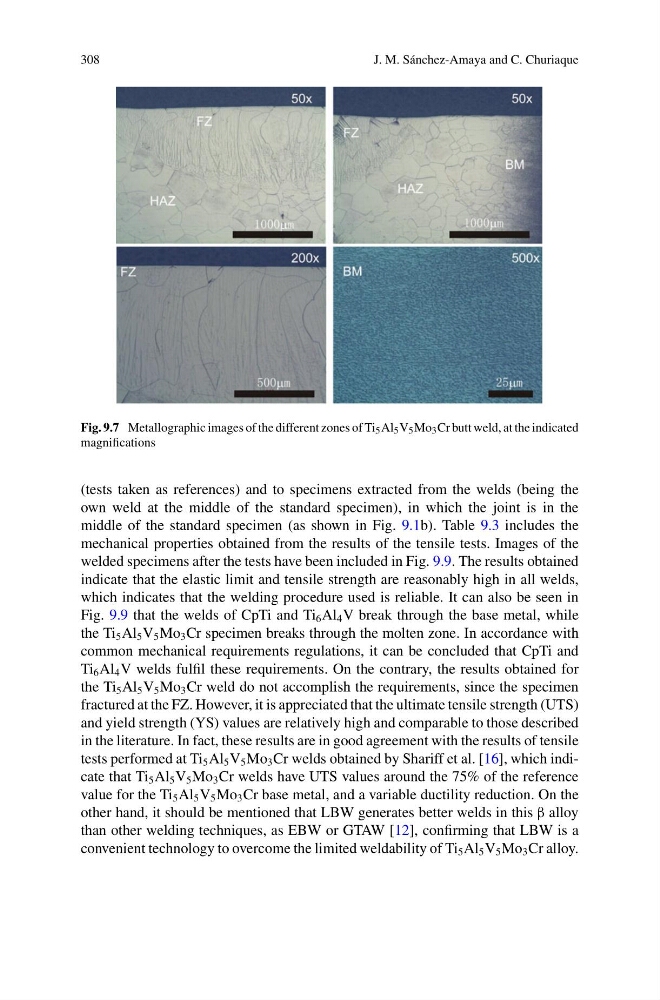
Fig. 9.7 Metallographic images of the different zones of Ti 5 Al 5 V 5 Mo 3 Cr butt weld, at the indicated
magnifications
(tests taken as references) and to specimens extracted from the welds (being the
own weld at the middle of the standard specimen), in which the joint is in the
middle of the standard specimen (as shown in Fig. 9.1b). Table 9.3 includes the
mechanical properties obtained from the results of the tensile tests. Images of the
welded specimens after the tests have been included in Fig. 9.9. The results obtained
indicate that the elastic limit and tensile strength are reasonably high in all welds,
which indicates that the welding procedure used is reliable. It can also be seen in
Fig. 9.9 that the welds of CpTi and Ti 6 Al 4 V break through the base metal, while
the Ti 5 Al 5 V 5 Mo 3 Cr specimen breaks through the molten zone. In accordance with
common mechanical requirements regulations, it can be concluded that CpTi and
Ti 6 Al 4 V welds fulfil these requirements. On the contrary, the results obtained for
the Ti 5 Al 5 V 5 Mo 3 Cr weld do not accomplish the requirements, since the specimen
fractured at the FZ. However, it is appreciated that the ultimate tensile strength (UTS)
and yield strength (YS) values are relatively high and comparable to those described
in the literature. In fact, these results are in good agreement with the results of tensile
tests performed at Ti 5 Al 5 V 5 Mo 3 Cr welds obtained by Shariff et al. [16], which indicate that Ti 5 Al 5 V 5 Mo 3 Cr welds have UTS values around the 75% of the reference
value for the Ti 5 Al 5 V 5 Mo 3 Cr base metal, and a variable ductility reduction. On the
other hand, it should be mentioned that LBW generates better welds in this β alloy
than other welding techniques, as EBW or GTAW [12], confirming that LBW is a
convenient technology to overcome the limited weldability of Ti 5 Al 5 V 5 Mo 3 Cr alloy.
J. M. Sánchez-Amaya and C. Churiaque
Fig. 9.7 Metallographic images of the different zones of Ti 5 Al 5 V 5 Mo 3 Cr butt weld, at the indicated
magnifications
(tests taken as references) and to specimens extracted from the welds (being the
own weld at the middle of the standard specimen), in which the joint is in the
middle of the standard specimen (as shown in Fig. 9.1b). Table 9.3 includes the
mechanical properties obtained from the results of the tensile tests. Images of the
welded specimens after the tests have been included in Fig. 9.9. The results obtained
indicate that the elastic limit and tensile strength are reasonably high in all welds,
which indicates that the welding procedure used is reliable. It can also be seen in
Fig. 9.9 that the welds of CpTi and Ti 6 Al 4 V break through the base metal, while
the Ti 5 Al 5 V 5 Mo 3 Cr specimen breaks through the molten zone. In accordance with
common mechanical requirements regulations, it can be concluded that CpTi and
Ti 6 Al 4 V welds fulfil these requirements. On the contrary, the results obtained for
the Ti 5 Al 5 V 5 Mo 3 Cr weld do not accomplish the requirements, since the specimen
fractured at the FZ. However, it is appreciated that the ultimate tensile strength (UTS)
and yield strength (YS) values are relatively high and comparable to those described
in the literature. In fact, these results are in good agreement with the results of tensile
tests performed at Ti 5 Al 5 V 5 Mo 3 Cr welds obtained by Shariff et al. [16], which indicate that Ti 5 Al 5 V 5 Mo 3 Cr welds have UTS values around the 75% of the reference
value for the Ti 5 Al 5 V 5 Mo 3 Cr base metal, and a variable ductility reduction. On the
other hand, it should be mentioned that LBW generates better welds in this β alloy
than other welding techniques, as EBW or GTAW [12], confirming that LBW is a
convenient technology to overcome the limited weldability of Ti 5 Al 5 V 5 Mo 3 Cr alloy.