

7 Tubular Structures: Welding Difficulty and Potential …
233
welding techniques, thus a narrow or sometimes negligible HAZ is formed which
further enhances its durability [15]. Solid-state welding has got various advantages
in tube welding, such as better surface finish of the welded tube, no residual stress
generation and enhancement of corrosion resistance. These advantages make solidstate joining process effective to fabricate tubes with higher precision and accuracy.
Thus, with the availability of these many variety of welding techniques, selection
of suitable one to produce seamed tubes depends on the application, material and
the quantity of the tube to be produced. A detailed explanation of all these welding
techniques, for tubular structure fabrication, is explained below.
7.2 Welding Techniques Used to Manufacture Tubes
7.2.1 Arc Welding
Various arc welding processes, such as gas metal arc welding (GMAW), gas tungsten
arc welding (GTAW) and submerged arc welding (SAW) are used in manufacturing
tubular components [6, 16, 17]. Among these processes, the most commonly used by
the tube manufacturing industry is the SAW process. SAWed tubes are generally the
most economical solution where application requires high wall thickness to sustain
high internal or external pressure. In SAW, the welding is done with the help of an
arc which is submerged inside the blanket of granular fusible flux. It reduces the
heat loss during welding without any atmospheric contamination of the weld pool.
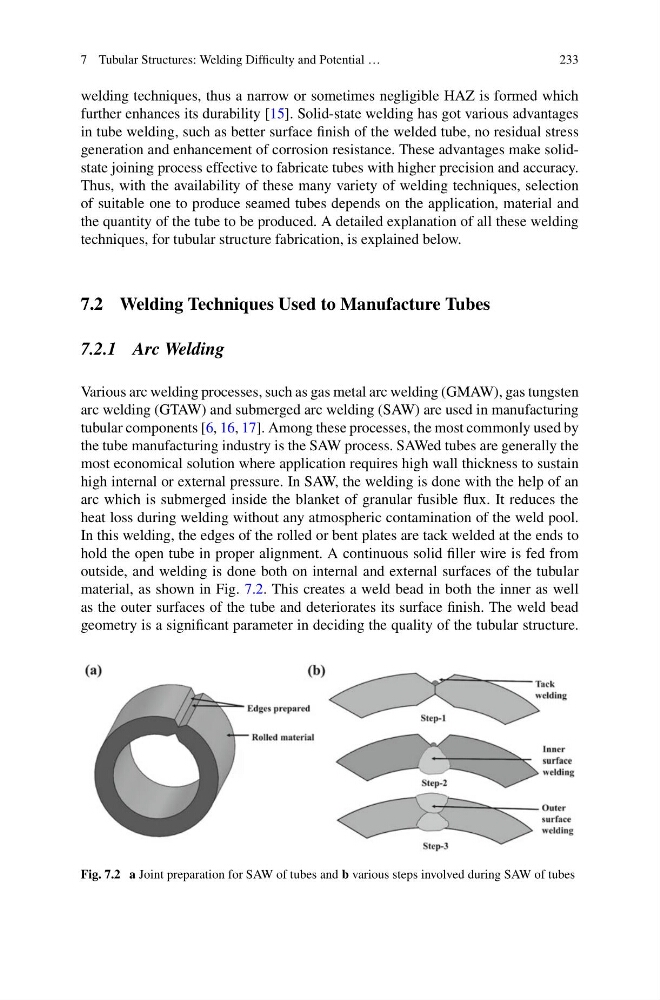
In this welding, the edges of the rolled or bent plates are tack welded at the ends to
hold the open tube in proper alignment. A continuous solid filler wire is fed from
outside, and welding is done both on internal and external surfaces of the tubular
material, as shown in Fig. 7.2. This creates a weld bead in both the inner as well
as the outer surfaces of the tube and deteriorates its surface finish. The weld bead
geometry is a significant parameter in deciding the quality of the tubular structure.
Fig. 7.2 a Joint preparation for SAW of tubes and b various steps involved during SAW of tubes
233
welding techniques, thus a narrow or sometimes negligible HAZ is formed which
further enhances its durability [15]. Solid-state welding has got various advantages
in tube welding, such as better surface finish of the welded tube, no residual stress
generation and enhancement of corrosion resistance. These advantages make solidstate joining process effective to fabricate tubes with higher precision and accuracy.
Thus, with the availability of these many variety of welding techniques, selection
of suitable one to produce seamed tubes depends on the application, material and
the quantity of the tube to be produced. A detailed explanation of all these welding
techniques, for tubular structure fabrication, is explained below.
7.2 Welding Techniques Used to Manufacture Tubes
7.2.1 Arc Welding
Various arc welding processes, such as gas metal arc welding (GMAW), gas tungsten
arc welding (GTAW) and submerged arc welding (SAW) are used in manufacturing
tubular components [6, 16, 17]. Among these processes, the most commonly used by
the tube manufacturing industry is the SAW process. SAWed tubes are generally the
most economical solution where application requires high wall thickness to sustain
high internal or external pressure. In SAW, the welding is done with the help of an
arc which is submerged inside the blanket of granular fusible flux. It reduces the
heat loss during welding without any atmospheric contamination of the weld pool.
In this welding, the edges of the rolled or bent plates are tack welded at the ends to
hold the open tube in proper alignment. A continuous solid filler wire is fed from
outside, and welding is done both on internal and external surfaces of the tubular
material, as shown in Fig. 7.2. This creates a weld bead in both the inner as well
as the outer surfaces of the tube and deteriorates its surface finish. The weld bead
geometry is a significant parameter in deciding the quality of the tubular structure.
Fig. 7.2 a Joint preparation for SAW of tubes and b various steps involved during SAW of tubes