

12
S. K. Das et al.
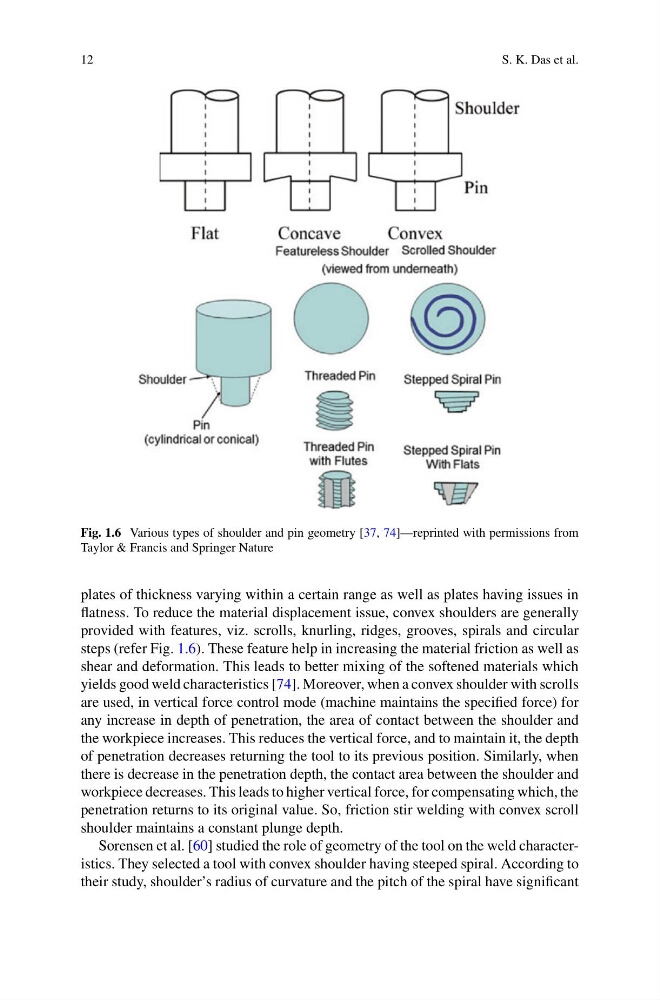
Fig. 1.6 Various types of shoulder and pin geometry [37, 74]—reprinted with permissions from
Taylor & Francis and Springer Nature
plates of thickness varying within a certain range as well as plates having issues in
flatness. To reduce the material displacement issue, convex shoulders are generally
provided with features, viz. scrolls, knurling, ridges, grooves, spirals and circular
steps (refer Fig. 1.6). These feature help in increasing the material friction as well as
shear and deformation. This leads to better mixing of the softened materials which
yields good weld characteristics [74]. Moreover, when a convex shoulder with scrolls
are used, in vertical force control mode (machine maintains the specified force) for
any increase in depth of penetration, the area of contact between the shoulder and
the workpiece increases. This reduces the vertical force, and to maintain it, the depth
of penetration decreases returning the tool to its previous position. Similarly, when
there is decrease in the penetration depth, the contact area between the shoulder and
workpiece decreases. This leads to higher vertical force, for compensating which, the
penetration returns to its original value. So, friction stir welding with convex scroll
shoulder maintains a constant plunge depth.
Sorensen et al. [60] studied the role of geometry of the tool on the weld characteristics. They selected a tool with convex shoulder having steeped spiral. According to
their study, shoulder’s radius of curvature and the pitch of the spiral have significant
S. K. Das et al.
Fig. 1.6 Various types of shoulder and pin geometry [37, 74]—reprinted with permissions from
Taylor & Francis and Springer Nature
plates of thickness varying within a certain range as well as plates having issues in
flatness. To reduce the material displacement issue, convex shoulders are generally
provided with features, viz. scrolls, knurling, ridges, grooves, spirals and circular
steps (refer Fig. 1.6). These feature help in increasing the material friction as well as
shear and deformation. This leads to better mixing of the softened materials which
yields good weld characteristics [74]. Moreover, when a convex shoulder with scrolls
are used, in vertical force control mode (machine maintains the specified force) for
any increase in depth of penetration, the area of contact between the shoulder and
the workpiece increases. This reduces the vertical force, and to maintain it, the depth
of penetration decreases returning the tool to its previous position. Similarly, when
there is decrease in the penetration depth, the contact area between the shoulder and
workpiece decreases. This leads to higher vertical force, for compensating which, the
penetration returns to its original value. So, friction stir welding with convex scroll
shoulder maintains a constant plunge depth.
Sorensen et al. [60] studied the role of geometry of the tool on the weld characteristics. They selected a tool with convex shoulder having steeped spiral. According to
their study, shoulder’s radius of curvature and the pitch of the spiral have significant