

6 Microstructure and Texture in Welding: A Case Study on Friction Stir Welding
203
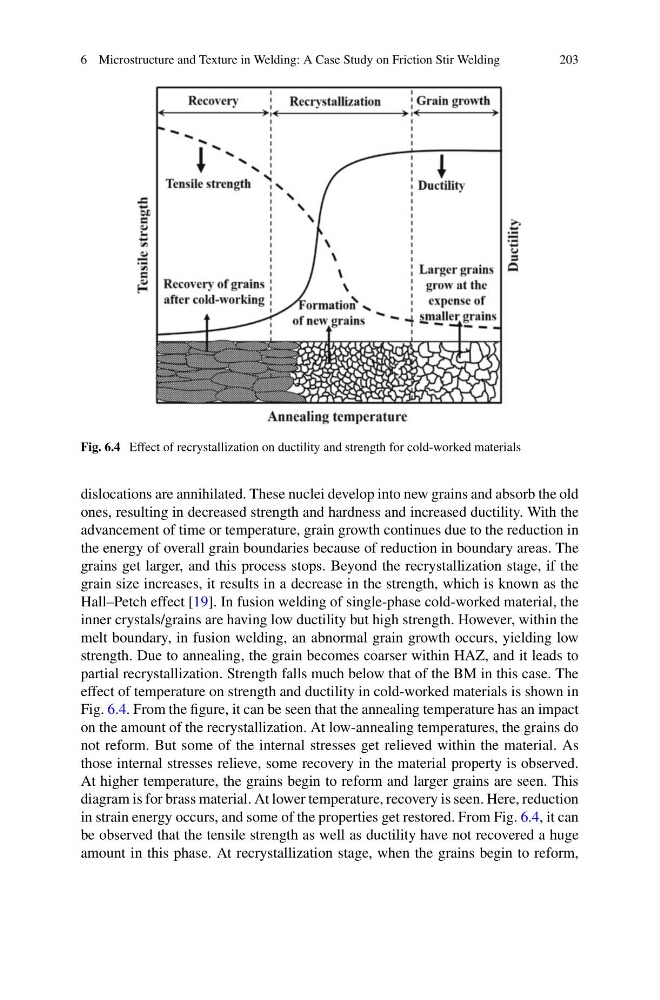
Fig. 6.4 Effect of recrystallization on ductility and strength for cold-worked materials
dislocations are annihilated. These nuclei develop into new grains and absorb the old
ones, resulting in decreased strength and hardness and increased ductility. With the
advancement of time or temperature, grain growth continues due to the reduction in
the energy of overall grain boundaries because of reduction in boundary areas. The
grains get larger, and this process stops. Beyond the recrystallization stage, if the
grain size increases, it results in a decrease in the strength, which is known as the
Hall–Petch effect [19]. In fusion welding of single-phase cold-worked material, the
inner crystals/grains are having low ductility but high strength. However, within the
melt boundary, in fusion welding, an abnormal grain growth occurs, yielding low
strength. Due to annealing, the grain becomes coarser within HAZ, and it leads to
partial recrystallization. Strength falls much below that of the BM in this case. The
effect of temperature on strength and ductility in cold-worked materials is shown in
Fig. 6.4. From the figure, it can be seen that the annealing temperature has an impact
on the amount of the recrystallization. At low-annealing temperatures, the grains do
not reform. But some of the internal stresses get relieved within the material. As
those internal stresses relieve, some recovery in the material property is observed.
At higher temperature, the grains begin to reform and larger grains are seen. This
diagram is for brass material. At lower temperature, recovery is seen. Here, reduction
in strain energy occurs, and some of the properties get restored. From Fig. 6.4, it can
be observed that the tensile strength as well as ductility have not recovered a huge
amount in this phase. At recrystallization stage, when the grains begin to reform,
203
Fig. 6.4 Effect of recrystallization on ductility and strength for cold-worked materials
dislocations are annihilated. These nuclei develop into new grains and absorb the old
ones, resulting in decreased strength and hardness and increased ductility. With the
advancement of time or temperature, grain growth continues due to the reduction in
the energy of overall grain boundaries because of reduction in boundary areas. The
grains get larger, and this process stops. Beyond the recrystallization stage, if the
grain size increases, it results in a decrease in the strength, which is known as the
Hall–Petch effect [19]. In fusion welding of single-phase cold-worked material, the
inner crystals/grains are having low ductility but high strength. However, within the
melt boundary, in fusion welding, an abnormal grain growth occurs, yielding low
strength. Due to annealing, the grain becomes coarser within HAZ, and it leads to
partial recrystallization. Strength falls much below that of the BM in this case. The
effect of temperature on strength and ductility in cold-worked materials is shown in
Fig. 6.4. From the figure, it can be seen that the annealing temperature has an impact
on the amount of the recrystallization. At low-annealing temperatures, the grains do
not reform. But some of the internal stresses get relieved within the material. As
those internal stresses relieve, some recovery in the material property is observed.
At higher temperature, the grains begin to reform and larger grains are seen. This
diagram is for brass material. At lower temperature, recovery is seen. Here, reduction
in strain energy occurs, and some of the properties get restored. From Fig. 6.4, it can
be observed that the tensile strength as well as ductility have not recovered a huge
amount in this phase. At recrystallization stage, when the grains begin to reform,