

200
S. S. Nayak et al.
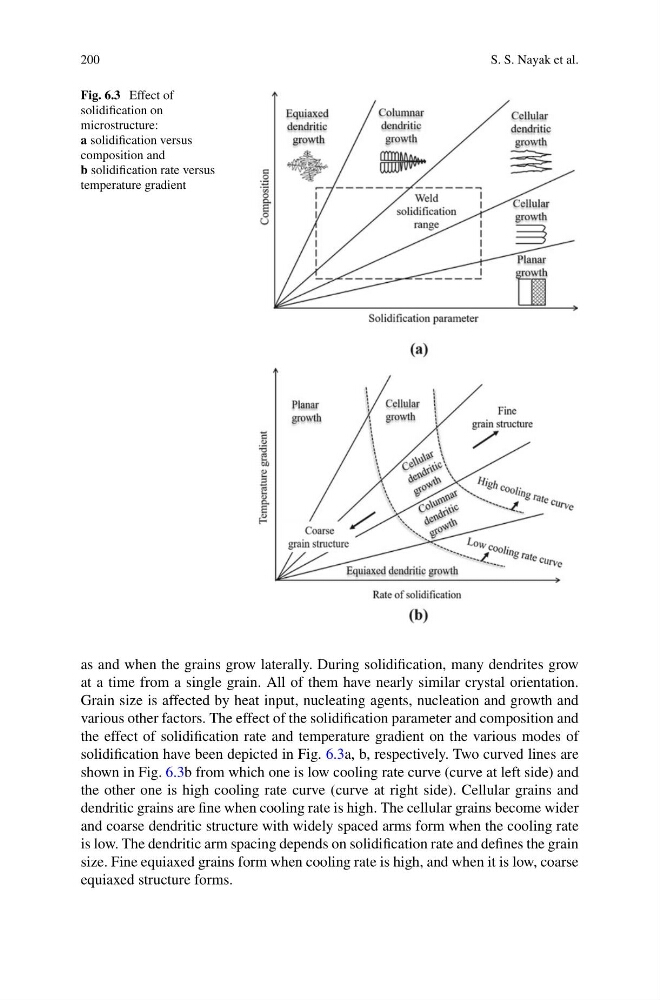
Fig. 6.3 Effect of
solidification on
microstructure:
a solidification versus
composition and
b solidification rate versus
temperature gradient
as and when the grains grow laterally. During solidification, many dendrites grow
at a time from a single grain. All of them have nearly similar crystal orientation.
Grain size is affected by heat input, nucleating agents, nucleation and growth and
various other factors. The effect of the solidification parameter and composition and
the effect of solidification rate and temperature gradient on the various modes of
solidification have been depicted in Fig. 6.3a, b, respectively. Two curved lines are
shown in Fig. 6.3b from which one is low cooling rate curve (curve at left side) and
the other one is high cooling rate curve (curve at right side). Cellular grains and
dendritic grains are fine when cooling rate is high. The cellular grains become wider
and coarse dendritic structure with widely spaced arms form when the cooling rate
is low. The dendritic arm spacing depends on solidification rate and defines the grain
size. Fine equiaxed grains form when cooling rate is high, and when it is low, coarse
equiaxed structure forms.
S. S. Nayak et al.
Fig. 6.3 Effect of
solidification on
microstructure:
a solidification versus
composition and
b solidification rate versus
temperature gradient
as and when the grains grow laterally. During solidification, many dendrites grow
at a time from a single grain. All of them have nearly similar crystal orientation.
Grain size is affected by heat input, nucleating agents, nucleation and growth and
various other factors. The effect of the solidification parameter and composition and
the effect of solidification rate and temperature gradient on the various modes of
solidification have been depicted in Fig. 6.3a, b, respectively. Two curved lines are
shown in Fig. 6.3b from which one is low cooling rate curve (curve at left side) and
the other one is high cooling rate curve (curve at right side). Cellular grains and
dendritic grains are fine when cooling rate is high. The cellular grains become wider
and coarse dendritic structure with widely spaced arms form when the cooling rate
is low. The dendritic arm spacing depends on solidification rate and defines the grain
size. Fine equiaxed grains form when cooling rate is high, and when it is low, coarse
equiaxed structure forms.