

196
S. S. Nayak et al.
6.2.1.1 Regions of a Fusion Weld
There are three distinct microstructural regions in a fusion weld. Those are fusion
zone (FZ), heat affected zone (HAZ) and base metal (BM). FZ comprises of a mixture
of BM and filler metal, which is similar to BM in homogeneous welding, different
in case of heterogeneous welding. Sometimes FZ is a mixture of the two BMs only
in case of autogeneous welds. In HAZ, melting does not occur. Heat generated
out of welding itself or any post-weld heat treatment (PWHT) affects HAZ. BM,
which is beyond the HAZ, mostly stays unaffected. Fusion weld microstructural
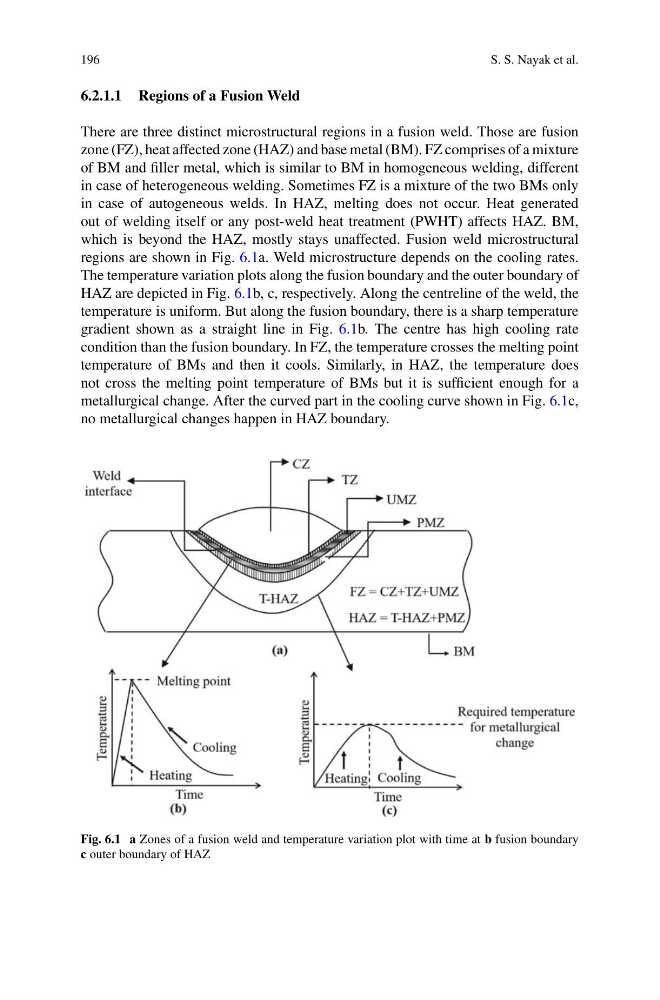
regions are shown in Fig. 6.1a. Weld microstructure depends on the cooling rates.
The temperature variation plots along the fusion boundary and the outer boundary of
HAZ are depicted in Fig. 6.1b, c, respectively. Along the centreline of the weld, the
temperature is uniform. But along the fusion boundary, there is a sharp temperature
gradient shown as a straight line in Fig. 6.1b. The centre has high cooling rate
condition than the fusion boundary. In FZ, the temperature crosses the melting point
temperature of BMs and then it cools. Similarly, in HAZ, the temperature does
not cross the melting point temperature of BMs but it is sufficient enough for a
metallurgical change. After the curved part in the cooling curve shown in Fig. 6.1c,
no metallurgical changes happen in HAZ boundary.
Fig. 6.1 a Zones of a fusion weld and temperature variation plot with time at b fusion boundary
c outer boundary of HAZ
S. S. Nayak et al.
6.2.1.1 Regions of a Fusion Weld
There are three distinct microstructural regions in a fusion weld. Those are fusion
zone (FZ), heat affected zone (HAZ) and base metal (BM). FZ comprises of a mixture
of BM and filler metal, which is similar to BM in homogeneous welding, different
in case of heterogeneous welding. Sometimes FZ is a mixture of the two BMs only
in case of autogeneous welds. In HAZ, melting does not occur. Heat generated
out of welding itself or any post-weld heat treatment (PWHT) affects HAZ. BM,
which is beyond the HAZ, mostly stays unaffected. Fusion weld microstructural
regions are shown in Fig. 6.1a. Weld microstructure depends on the cooling rates.
The temperature variation plots along the fusion boundary and the outer boundary of
HAZ are depicted in Fig. 6.1b, c, respectively. Along the centreline of the weld, the
temperature is uniform. But along the fusion boundary, there is a sharp temperature
gradient shown as a straight line in Fig. 6.1b. The centre has high cooling rate
condition than the fusion boundary. In FZ, the temperature crosses the melting point
temperature of BMs and then it cools. Similarly, in HAZ, the temperature does
not cross the melting point temperature of BMs but it is sufficient enough for a
metallurgical change. After the curved part in the cooling curve shown in Fig. 6.1c,
no metallurgical changes happen in HAZ boundary.
Fig. 6.1 a Zones of a fusion weld and temperature variation plot with time at b fusion boundary
c outer boundary of HAZ