

108
N. Bhardwaj et al.
Q total =
2
3
π
σ yield
√
3
ω
R
3
sh − R
3
pin
(1 + tan α) + R
3
pin + 3R
2
pin H pin
.
(3.52)
(b) Sliding condition
τ contact = τ friction = μp,
(3.53)
where p denotes the axial contact pressure. From Eq. (3.49) using Eq. (3.53)
Q total =
2
3
πμpω
R
3
sh − R
3
pin
(1 + tan α) + R
3
pin + 3R
2
pin H pin
.
(3.54)
Considering a flat tool (α = 0) and p =
F
A projected
, where A projected = π R
2
sh is the
projected area where pressure is applicable; Eq. (3.54) can be further simplified as
Q total =
2
3
μFω
R sh + 3
R
2
pin H pin
R
2
sh
.
(3.55)
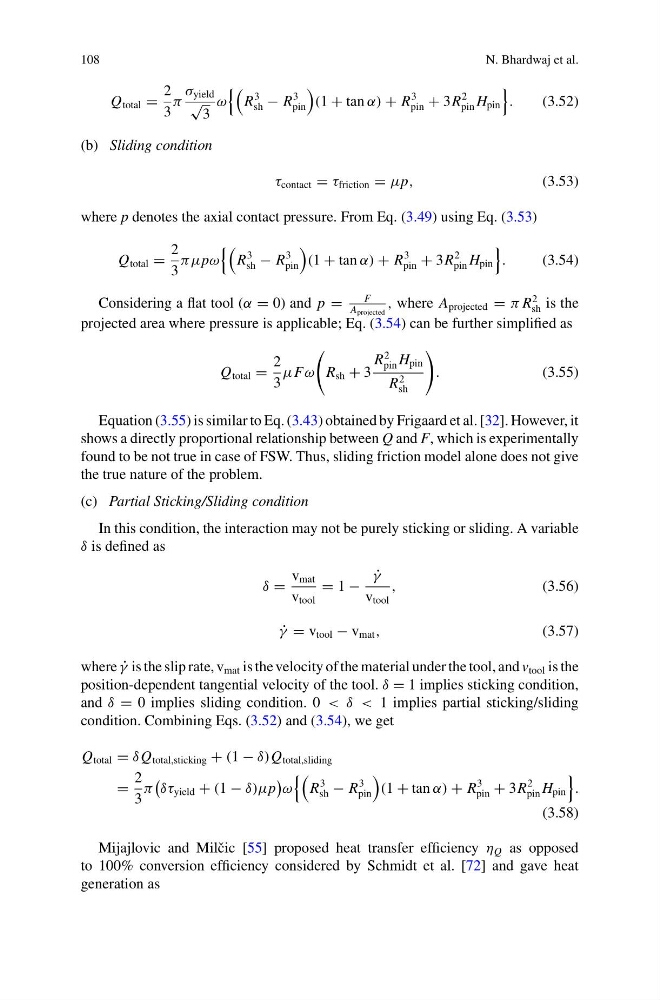
Equation (3.55) is similar to Eq. (3.43) obtained by Frigaard et al. [32]. However, it
shows a directly proportional relationship between Q and F, which is experimentally
found to be not true in case of FSW. Thus, sliding friction model alone does not give
the true nature of the problem.
(c) Partial Sticking/Sliding condition
In this condition, the interaction may not be purely sticking or sliding. A variable
δ is defined as
δ =
v mat
v tool
= 1 −
˙
γ
v tool
,
(3.56)
˙
γ = v tool − v mat ,
(3.57)
where ˙
γ is the slip rate, v mat is the velocity of the material under the tool, and v tool is the
position-dependent tangential velocity of the tool. δ = 1 implies sticking condition,
and δ = 0 implies sliding condition. 0 < δ < 1 implies partial sticking/sliding
condition. Combining Eqs. (3.52) and (3.54), we get
Q total = δ Q total,sticking + (1 − δ)Q total,sliding
=
2
3
π
δτ yield + (1 − δ)μp
ω
R
3
sh − R
3
pin
(1 + tan α) + R
3
pin + 3R
2
pin H pin
.
(3.58)
Mijajlovic and Milˇ cic [55] proposed heat transfer efficiency η Q as opposed
to 100% conversion efficiency considered by Schmidt et al. [72] and gave heat
generation as
N. Bhardwaj et al.
Q total =
2
3
π
σ yield
√
3
ω
R
3
sh − R
3
pin
(1 + tan α) + R
3
pin + 3R
2
pin H pin
.
(3.52)
(b) Sliding condition
τ contact = τ friction = μp,
(3.53)
where p denotes the axial contact pressure. From Eq. (3.49) using Eq. (3.53)
Q total =
2
3
πμpω
R
3
sh − R
3
pin
(1 + tan α) + R
3
pin + 3R
2
pin H pin
.
(3.54)
Considering a flat tool (α = 0) and p =
F
A projected
, where A projected = π R
2
sh is the
projected area where pressure is applicable; Eq. (3.54) can be further simplified as
Q total =
2
3
μFω
R sh + 3
R
2
pin H pin
R
2
sh
.
(3.55)
Equation (3.55) is similar to Eq. (3.43) obtained by Frigaard et al. [32]. However, it
shows a directly proportional relationship between Q and F, which is experimentally
found to be not true in case of FSW. Thus, sliding friction model alone does not give
the true nature of the problem.
(c) Partial Sticking/Sliding condition
In this condition, the interaction may not be purely sticking or sliding. A variable
δ is defined as
δ =
v mat
v tool
= 1 −
˙
γ
v tool
,
(3.56)
˙
γ = v tool − v mat ,
(3.57)
where ˙
γ is the slip rate, v mat is the velocity of the material under the tool, and v tool is the
position-dependent tangential velocity of the tool. δ = 1 implies sticking condition,
and δ = 0 implies sliding condition. 0 < δ < 1 implies partial sticking/sliding
condition. Combining Eqs. (3.52) and (3.54), we get
Q total = δ Q total,sticking + (1 − δ)Q total,sliding
=
2
3
π
δτ yield + (1 − δ)μp
ω
R
3
sh − R
3
pin
(1 + tan α) + R
3
pin + 3R
2
pin H pin
.
(3.58)
Mijajlovic and Milˇ cic [55] proposed heat transfer efficiency η Q as opposed
to 100% conversion efficiency considered by Schmidt et al. [72] and gave heat
generation as