

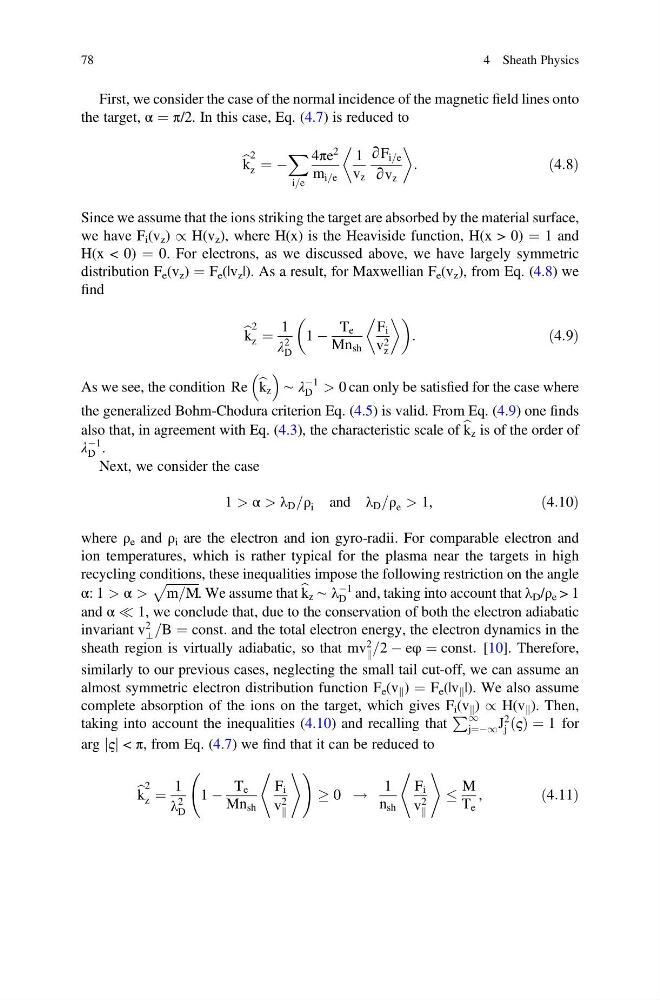
First, we consider the case of the normal incidence of the magnetic field lines onto
the target, α ¼ π/2. In this case, Eq. (4.7) is reduced to
b k
2
z ¼ À
X
i=e
4πe
2
m i=e
1
v z
∂F i=e
∂v z
(
)
:
ð4:8Þ
Since we assume that the ions striking the target are absorbed by the material surface,
we have F i (v z ) / H(v z ), where H(x) is the Heaviside function, H(x > 0) ¼ 1 and
H(x < 0) ¼ 0. For electrons, as we discussed above, we have largely symmetric
distribution F e (v z ) ¼ F e (|v z |). As a result, for Maxwellian F e (v z ), from Eq. (4.8) we
find
b k
2
z ¼
1
λ
2
D
1 À
T e
Mn sh
F i
v 2
z
( )
:
ð4:9Þ
As we see, the condition Re b k z
∼ λ
À1
D > 0 can only be satisfied for the case where
the generalized Bohm-Chodura criterion Eq. (4.5) is valid. From Eq. (4.9) one finds
also that, in agreement with Eq. (4.3), the characteristic scale of b k z is of the order of
λ
À1
D .
Next, we consider the case
1 > α > λ D =ρ i and λ D =ρ e > 1,
ð4:10Þ
where ρ e and ρ i are the electron and ion gyro-radii. For comparable electron and
ion temperatures, which is rather typical for the plasma near the targets in high
recycling conditions, these inequalities impose the following restriction on the angle
α: 1 > α >
ffiffiffiffiffiffiffiffiffiffi ffi
m=M
p
. We assume that b k z ∼ λ
À1
D and, taking into account that λ D /ρ e > 1
and α ( 1, we conclude that, due to the conservation of both the electron adiabatic
invariant v
2
⊥ =B ¼ const: and the total electron energy, the electron dynamics in the
sheath region is virtually adiabatic, so that mv
2
k =2 À eφ ¼ const: [10]. Therefore,
similarly to our previous cases, neglecting the small tail cut-off, we can assume an
almost symmetric electron distribution function F e (v k ) ¼ F e (|v k |). We also assume
complete absorption of the ions on the target, which gives F i (v k ) / H(v k ). Then,
taking into account the inequalities (4.10) and recalling that
P 1
j¼À1 J
2
j ς
ð Þ ¼ 1 for
arg jςj < π, from Eq. (4.7) we find that it can be reduced to
b k
2
z ¼
1
λ
2
D
1 À
T e
Mn sh
*
F i
v 2
k
+!
! 0 !
1
n sh
*
F i
v 2
k
+
M
T e
,
ð4:11Þ
78
4 Sheath Physics
the target, α ¼ π/2. In this case, Eq. (4.7) is reduced to
b k
2
z ¼ À
X
i=e
4πe
2
m i=e
1
v z
∂F i=e
∂v z
(
)
:
ð4:8Þ
Since we assume that the ions striking the target are absorbed by the material surface,
we have F i (v z ) / H(v z ), where H(x) is the Heaviside function, H(x > 0) ¼ 1 and
H(x < 0) ¼ 0. For electrons, as we discussed above, we have largely symmetric
distribution F e (v z ) ¼ F e (|v z |). As a result, for Maxwellian F e (v z ), from Eq. (4.8) we
find
b k
2
z ¼
1
λ
2
D
1 À
T e
Mn sh
F i
v 2
z
( )
:
ð4:9Þ
As we see, the condition Re b k z
∼ λ
À1
D > 0 can only be satisfied for the case where
the generalized Bohm-Chodura criterion Eq. (4.5) is valid. From Eq. (4.9) one finds
also that, in agreement with Eq. (4.3), the characteristic scale of b k z is of the order of
λ
À1
D .
Next, we consider the case
1 > α > λ D =ρ i and λ D =ρ e > 1,
ð4:10Þ
where ρ e and ρ i are the electron and ion gyro-radii. For comparable electron and
ion temperatures, which is rather typical for the plasma near the targets in high
recycling conditions, these inequalities impose the following restriction on the angle
α: 1 > α >
ffiffiffiffiffiffiffiffiffiffi ffi
m=M
p
. We assume that b k z ∼ λ
À1
D and, taking into account that λ D /ρ e > 1
and α ( 1, we conclude that, due to the conservation of both the electron adiabatic
invariant v
2
⊥ =B ¼ const: and the total electron energy, the electron dynamics in the
sheath region is virtually adiabatic, so that mv
2
k =2 À eφ ¼ const: [10]. Therefore,
similarly to our previous cases, neglecting the small tail cut-off, we can assume an
almost symmetric electron distribution function F e (v k ) ¼ F e (|v k |). We also assume
complete absorption of the ions on the target, which gives F i (v k ) / H(v k ). Then,
taking into account the inequalities (4.10) and recalling that
P 1
j¼À1 J
2
j ς
ð Þ ¼ 1 for
arg jςj < π, from Eq. (4.7) we find that it can be reduced to
b k
2
z ¼
1
λ
2
D
1 À
T e
Mn sh
*
F i
v 2
k
+!
! 0 !
1
n sh
*
F i
v 2
k
+
M
T e
,
ð4:11Þ
78
4 Sheath Physics