

stress but produces a vacancy, which “frees” the space and promotes absorption of
more helium atoms into the cluster. Further amassment of the cluster with “kicking
off” the tungsten atoms from the lattice, which is called “trap mutation” (e.g. see
[55–58]), is often considered to be the mechanism of helium nano-bubble growth in
many metals (e.g. see [24] and the references therein).
Since, unlike helium, the interstitial hydrogen clusters do not exhibit self-trapping
effects, it is widely believed that the origin of hydrogen trapping (which could finally
result in the formation of hydrogen nano-bubbles [59] or relatively large blisters [6])
is associated with lattice defects.
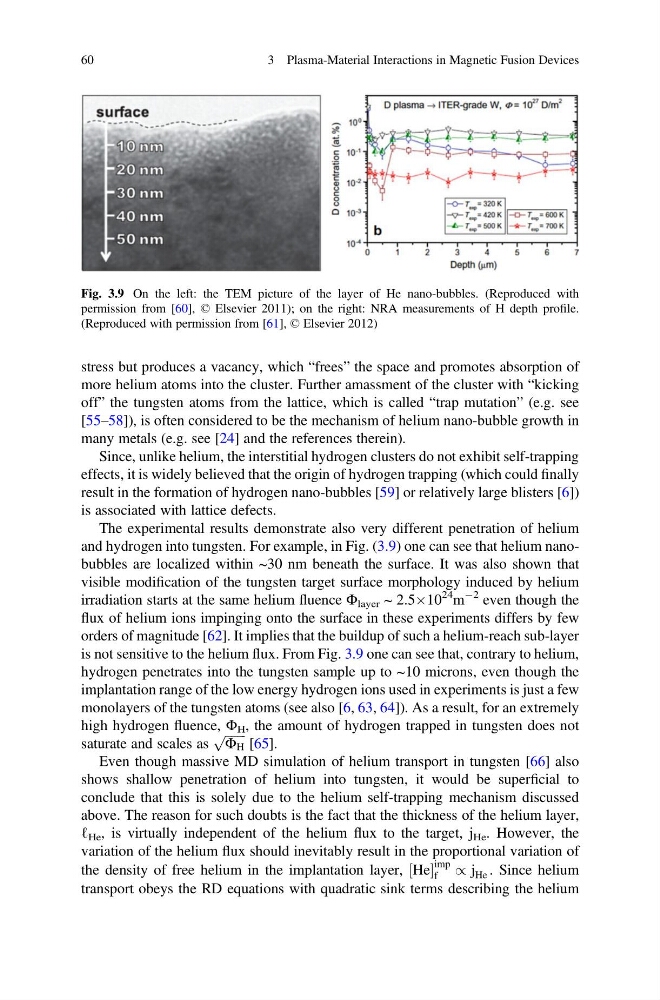
The experimental results demonstrate also very different penetration of helium
and hydrogen into tungsten. For example, in Fig. (3.9) one can see that helium nanobubbles are localized within ~30 nm beneath the surface. It was also shown that
visible modification of the tungsten target surface morphology induced by helium
irradiation starts at the same helium fluence Φ layer ~ 2.5Â10
24 m
À2 even though the
flux of helium ions impinging onto the surface in these experiments differs by few
orders of magnitude [62]. It implies that the buildup of such a helium-reach sub-layer
is not sensitive to the helium flux. From Fig. 3.9 one can see that, contrary to helium,
hydrogen penetrates into the tungsten sample up to ~10 microns, even though the
implantation range of the low energy hydrogen ions used in experiments is just a few
monolayers of the tungsten atoms (see also [6, 63, 64]). As a result, for an extremely
high hydrogen fluence, Φ H , the amount of hydrogen trapped in tungsten does not
saturate and scales as
ffiffiffiffiffiffi ffi
Φ H
p
[65].
Even though massive MD simulation of helium transport in tungsten [66] also
shows shallow penetration of helium into tungsten, it would be superficial to
conclude that this is solely due to the helium self-trapping mechanism discussed
above. The reason for such doubts is the fact that the thickness of the helium layer,
ℓ He , is virtually independent of the helium flux to the target, j He . However, the
variation of the helium flux should inevitably result in the proportional variation of
the density of free helium in the implantation layer, He
½
imp
f
/ j He . Since helium
transport obeys the RD equations with quadratic sink terms describing the helium
Fig. 3.9 On the left: the TEM picture of the layer of He nano-bubbles. (Reproduced with
permission from [60], © Elsevier 2011); on the right: NRA measurements of H depth profile.
(Reproduced with permission from [61], © Elsevier 2012)
60
3 Plasma-Material Interactions in Magnetic Fusion Devices
more helium atoms into the cluster. Further amassment of the cluster with “kicking
off” the tungsten atoms from the lattice, which is called “trap mutation” (e.g. see
[55–58]), is often considered to be the mechanism of helium nano-bubble growth in
many metals (e.g. see [24] and the references therein).
Since, unlike helium, the interstitial hydrogen clusters do not exhibit self-trapping
effects, it is widely believed that the origin of hydrogen trapping (which could finally
result in the formation of hydrogen nano-bubbles [59] or relatively large blisters [6])
is associated with lattice defects.
The experimental results demonstrate also very different penetration of helium
and hydrogen into tungsten. For example, in Fig. (3.9) one can see that helium nanobubbles are localized within ~30 nm beneath the surface. It was also shown that
visible modification of the tungsten target surface morphology induced by helium
irradiation starts at the same helium fluence Φ layer ~ 2.5Â10
24 m
À2 even though the
flux of helium ions impinging onto the surface in these experiments differs by few
orders of magnitude [62]. It implies that the buildup of such a helium-reach sub-layer
is not sensitive to the helium flux. From Fig. 3.9 one can see that, contrary to helium,
hydrogen penetrates into the tungsten sample up to ~10 microns, even though the
implantation range of the low energy hydrogen ions used in experiments is just a few
monolayers of the tungsten atoms (see also [6, 63, 64]). As a result, for an extremely
high hydrogen fluence, Φ H , the amount of hydrogen trapped in tungsten does not
saturate and scales as
ffiffiffiffiffiffi ffi
Φ H
p
[65].
Even though massive MD simulation of helium transport in tungsten [66] also
shows shallow penetration of helium into tungsten, it would be superficial to
conclude that this is solely due to the helium self-trapping mechanism discussed
above. The reason for such doubts is the fact that the thickness of the helium layer,
ℓ He , is virtually independent of the helium flux to the target, j He . However, the
variation of the helium flux should inevitably result in the proportional variation of
the density of free helium in the implantation layer, He
½
imp
f
/ j He . Since helium
transport obeys the RD equations with quadratic sink terms describing the helium
Fig. 3.9 On the left: the TEM picture of the layer of He nano-bubbles. (Reproduced with
permission from [60], © Elsevier 2011); on the right: NRA measurements of H depth profile.
(Reproduced with permission from [61], © Elsevier 2012)
60
3 Plasma-Material Interactions in Magnetic Fusion Devices