

low-temperature plasmas is large, the V-T relaxation is usually slow and the V-V
exchange dominates. In this case, the distribution of molecules over vibrational
states tends towards the Treanor function [65], which is characterized by an overpopulation of highly excited states in comparison to the Boltzmann distribution.
However, electron impact dissociation of H 2 (v), which increases with increasing v,
together with other chemical reactions involving vibrationally excited molecules,
occurring in edge plasmas, deplete the population of excited vibrational states with
relatively high v.
Among the chemical reactions involving vibrationally excited molecules in the
edge plasmas, the most important for our further consideration are the dissociative
attachment (DA):
H 2 v
ð Þ þ e ! H
À
þ H,
ð2:27Þ
and ion conversion (IC):
H 2 v
ð Þ þ H
þ
! H
þ
2 þ H:
ð2:28Þ
Both of these processes are endothermic and, therefore, the cross-sections and the
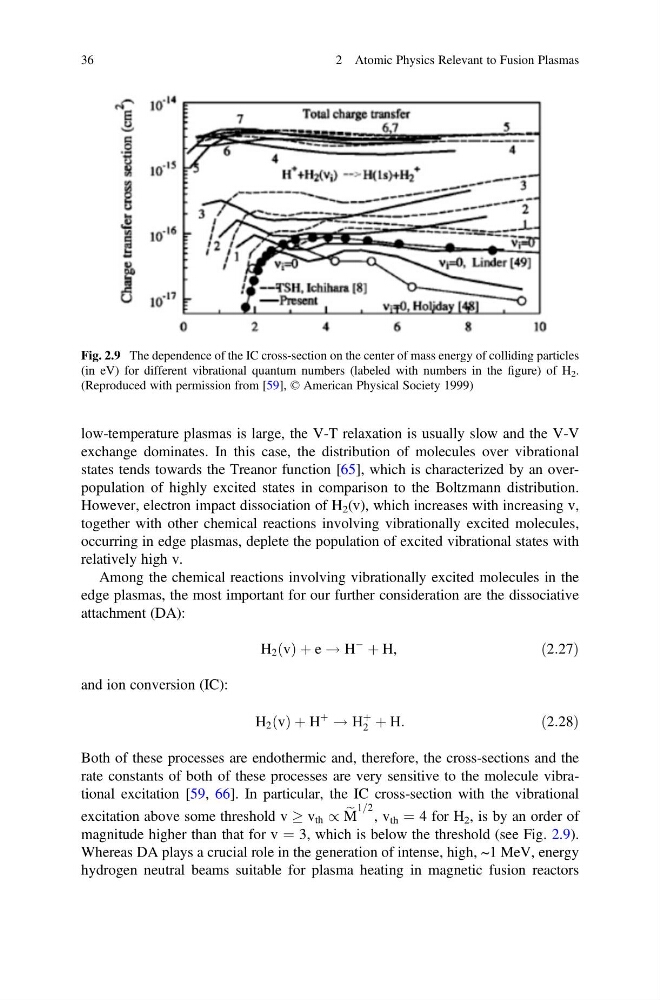
rate constants of both of these processes are very sensitive to the molecule vibrational excitation [59, 66]. In particular, the IC cross-section with the vibrational
excitation above some threshold v ! v th / e
M
1=2 , v th ¼ 4 for H 2 , is by an order of
magnitude higher than that for v ¼ 3, which is below the threshold (see Fig. 2.9).
Whereas DA plays a crucial role in the generation of intense, high, ~1 MeV, energy
hydrogen neutral beams suitable for plasma heating in magnetic fusion reactors
Fig. 2.9 The dependence of the IC cross-section on the center of mass energy of colliding particles
(in eV) for different vibrational quantum numbers (labeled with numbers in the figure) of H 2 .
(Reproduced with permission from [59], © American Physical Society 1999)
36
2 Atomic Physics Relevant to Fusion Plasmas
exchange dominates. In this case, the distribution of molecules over vibrational
states tends towards the Treanor function [65], which is characterized by an overpopulation of highly excited states in comparison to the Boltzmann distribution.
However, electron impact dissociation of H 2 (v), which increases with increasing v,
together with other chemical reactions involving vibrationally excited molecules,
occurring in edge plasmas, deplete the population of excited vibrational states with
relatively high v.
Among the chemical reactions involving vibrationally excited molecules in the
edge plasmas, the most important for our further consideration are the dissociative
attachment (DA):
H 2 v
ð Þ þ e ! H
À
þ H,
ð2:27Þ
and ion conversion (IC):
H 2 v
ð Þ þ H
þ
! H
þ
2 þ H:
ð2:28Þ
Both of these processes are endothermic and, therefore, the cross-sections and the
rate constants of both of these processes are very sensitive to the molecule vibrational excitation [59, 66]. In particular, the IC cross-section with the vibrational
excitation above some threshold v ! v th / e
M
1=2 , v th ¼ 4 for H 2 , is by an order of
magnitude higher than that for v ¼ 3, which is below the threshold (see Fig. 2.9).
Whereas DA plays a crucial role in the generation of intense, high, ~1 MeV, energy
hydrogen neutral beams suitable for plasma heating in magnetic fusion reactors
Fig. 2.9 The dependence of the IC cross-section on the center of mass energy of colliding particles
(in eV) for different vibrational quantum numbers (labeled with numbers in the figure) of H 2 .
(Reproduced with permission from [59], © American Physical Society 1999)
36
2 Atomic Physics Relevant to Fusion Plasmas