

intensity at the same plasma temperature implies the increase of the atomic hydrogen
density. In addition, in Fig. 2.4b we see that the intensity of Ly α decreases also with
increasing D α intensity, implying Ly α radiation trapping. These results are consistent
with the expression (2.22), which predicts that the trapping effects become more
pronounced with increasing hydrogen density.
So far, in this subsection, we did not distinguish between the hydrogen isotopes.
However, in practice, the expression (2.1) has some correction ~m e /M nucl caused
by the finite electron to the nucleus, M nucl , mass ratio. It causes the isotopedependent shift, Δω nucl % ω 0 (m e /M nucl ) ~ 3Â10
À4
ω 0 , of the resonance frequencies
ω 0 . However, for typical neutral hydrogen temperature ~few eV we have
Δω D ~ 3Â10
À5
ω 0 ( Δω nucl . This implies small overlapping of corresponding line
shapes a(ω) of different isotopes and weak interference of their line radiation
transport. However, at high plasma density, Stark broadening could exceed the
Doppler one and overlapping of the lines could be much stronger.
In our estimates related to both absorption length of line radiation and interference of line radiation emitted by different hydrogen isotopes, we have used rather
crude models where the details of the line shape a(ω) were ignored. As a matter of
fact, in these models, we focused on the transport of photons corresponding to the
“center” of the line. However, for the case where the photons having the frequency
close to the line center are trapped and, therefore, their transport is inhibited, the
main contribution to energy transport via line radiation will come from the “wings”
of the line shape [12, 49, 50]. To include the impact of different line broadening
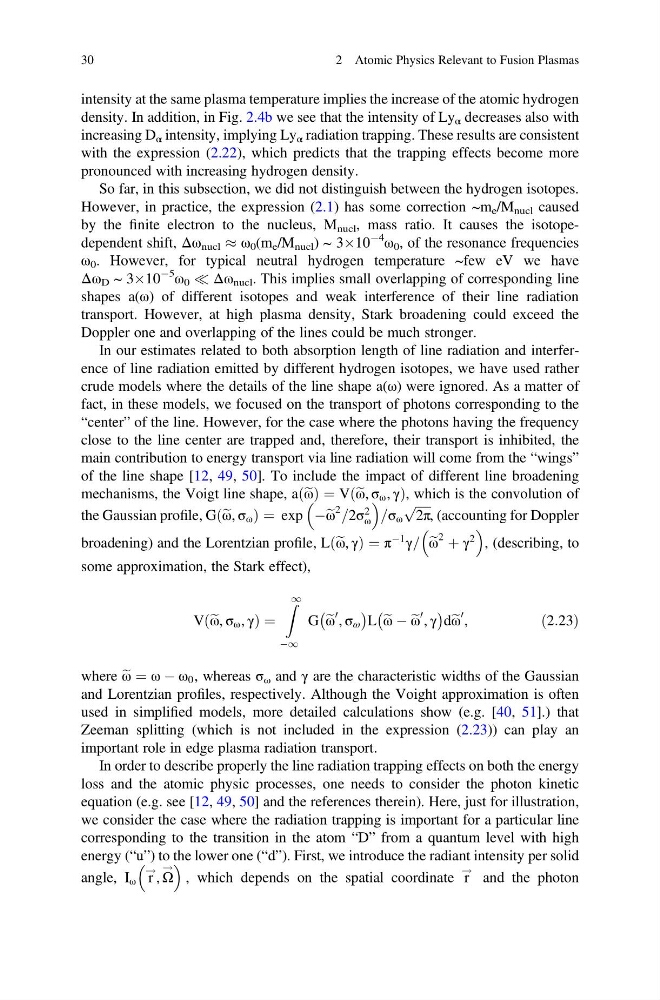
mechanisms, the Voigt line shape, a e
ω
ð Þ ¼ V e
ω, σ ω , γ
ð
Þ, which is the convolution of
the Gaussian profile, G e
ω, σ ω
ð
Þ¼ exp Àe ω
2 =2σ
2
ω
=σ ω
ffiffiffiffiffi
2π
p
, (accounting for Doppler
broadening) and the Lorentzian profile, L e
ω, γ
ð
Þ ¼ π
À1
γ= e
ω
2 þ γ
2
, (describing, to
some approximation, the Stark effect),
V e
ω, σ ω , γ
ð
Þ¼
Z 1
À1
G e
ω
0 , σ ω
À
Á
L e
ω À e
ω
0 , γ
À
Á
de ω
0 ,
ð2:23Þ
where e
ω ¼ ω À ω 0 , whereas σ ω and γ are the characteristic widths of the Gaussian
and Lorentzian profiles, respectively. Although the Voight approximation is often
used in simplified models, more detailed calculations show (e.g. [40, 51].) that
Zeeman splitting (which is not included in the expression (2.23)) can play an
important role in edge plasma radiation transport.
In order to describe properly the line radiation trapping effects on both the energy
loss and the atomic physic processes, one needs to consider the photon kinetic
equation (e.g. see [12, 49, 50] and the references therein). Here, just for illustration,
we consider the case where the radiation trapping is important for a particular line
corresponding to the transition in the atom “D” from a quantum level with high
energy (“u”) to the lower one (“d”). First, we introduce the radiant intensity per solid
angle, I ω r
! , Ω
!
, which depends on the spatial coordinate r
! and the photon
30
2 Atomic Physics Relevant to Fusion Plasmas
density. In addition, in Fig. 2.4b we see that the intensity of Ly α decreases also with
increasing D α intensity, implying Ly α radiation trapping. These results are consistent
with the expression (2.22), which predicts that the trapping effects become more
pronounced with increasing hydrogen density.
So far, in this subsection, we did not distinguish between the hydrogen isotopes.
However, in practice, the expression (2.1) has some correction ~m e /M nucl caused
by the finite electron to the nucleus, M nucl , mass ratio. It causes the isotopedependent shift, Δω nucl % ω 0 (m e /M nucl ) ~ 3Â10
À4
ω 0 , of the resonance frequencies
ω 0 . However, for typical neutral hydrogen temperature ~few eV we have
Δω D ~ 3Â10
À5
ω 0 ( Δω nucl . This implies small overlapping of corresponding line
shapes a(ω) of different isotopes and weak interference of their line radiation
transport. However, at high plasma density, Stark broadening could exceed the
Doppler one and overlapping of the lines could be much stronger.
In our estimates related to both absorption length of line radiation and interference of line radiation emitted by different hydrogen isotopes, we have used rather
crude models where the details of the line shape a(ω) were ignored. As a matter of
fact, in these models, we focused on the transport of photons corresponding to the
“center” of the line. However, for the case where the photons having the frequency
close to the line center are trapped and, therefore, their transport is inhibited, the
main contribution to energy transport via line radiation will come from the “wings”
of the line shape [12, 49, 50]. To include the impact of different line broadening
mechanisms, the Voigt line shape, a e
ω
ð Þ ¼ V e
ω, σ ω , γ
ð
Þ, which is the convolution of
the Gaussian profile, G e
ω, σ ω
ð
Þ¼ exp Àe ω
2 =2σ
2
ω
=σ ω
ffiffiffiffiffi
2π
p
, (accounting for Doppler
broadening) and the Lorentzian profile, L e
ω, γ
ð
Þ ¼ π
À1
γ= e
ω
2 þ γ
2
, (describing, to
some approximation, the Stark effect),
V e
ω, σ ω , γ
ð
Þ¼
Z 1
À1
G e
ω
0 , σ ω
À
Á
L e
ω À e
ω
0 , γ
À
Á
de ω
0 ,
ð2:23Þ
where e
ω ¼ ω À ω 0 , whereas σ ω and γ are the characteristic widths of the Gaussian
and Lorentzian profiles, respectively. Although the Voight approximation is often
used in simplified models, more detailed calculations show (e.g. [40, 51].) that
Zeeman splitting (which is not included in the expression (2.23)) can play an
important role in edge plasma radiation transport.
In order to describe properly the line radiation trapping effects on both the energy
loss and the atomic physic processes, one needs to consider the photon kinetic
equation (e.g. see [12, 49, 50] and the references therein). Here, just for illustration,
we consider the case where the radiation trapping is important for a particular line
corresponding to the transition in the atom “D” from a quantum level with high
energy (“u”) to the lower one (“d”). First, we introduce the radiant intensity per solid
angle, I ω r
! , Ω
!
, which depends on the spatial coordinate r
! and the photon
30
2 Atomic Physics Relevant to Fusion Plasmas