

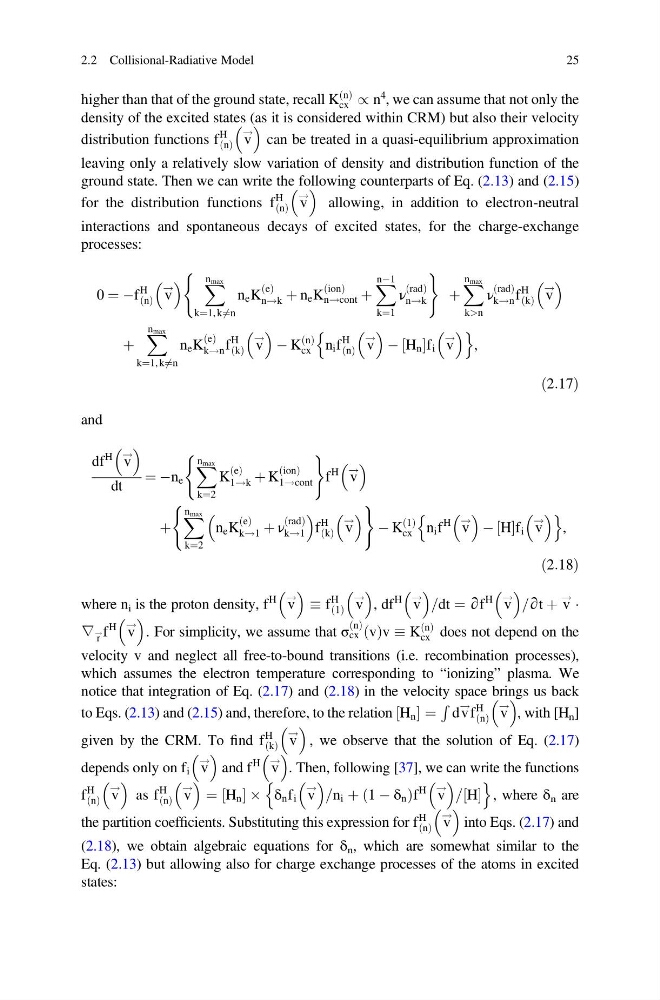
higher than that of the ground state, recall K
n
ð Þ
cx / n
4
, we can assume that not only the
density of the excited states (as it is considered within CRM) but also their velocity
distribution functions f
H
n
ð Þ v
!
can be treated in a quasi-equilibrium approximation
leaving only a relatively slow variation of density and distribution function of the
ground state. Then we can write the following counterparts of Eq. (2.13) and (2.15)
for the distribution functions f
H
n
ð Þ v
!
allowing, in addition to electron-neutral
interactions and spontaneous decays of excited states, for the charge-exchange
processes:
0 ¼ Àf
H
n
ð Þ v
!
X n max
k¼1, k6 ¼n
n e K
e
ð Þ
n!k þ n e K
ion
ð Þ
n!cont þ
X nÀ1
k¼1
ν
rad
ð Þ
n!k
(
)
þ
X n max
k>n
ν
rad
ð Þ
k!n f
H
k
ð Þ v
!
þ
X n max
k¼1, k6 ¼n
n e K
e
ð Þ
k!n f
H
k
ð Þ v
!
À K
n
ð Þ
cx n i f
H
n
ð Þ v
!
À H n
½ f i v
!
n
o
,
ð2:17Þ
and
df
H v
!
dt
¼ Àn e
X n max
k¼2
K
e
ð Þ
1!k þ K
ion
ð Þ
1!cont
(
)
f
H v
!
þ
X n max
k¼2
n e K
e
ð Þ
k!1 þ ν
rad
ð Þ
k!1
f
H
k
ð Þ v
!
(
)
À K
1
ð Þ
cx n i f
H v
!
À H
½ f i v
!
n
o
,
ð2:18Þ
where n i is the proton density, f
H v
!
f
H
1
ð Þ v
!
, df
H v
!
=dt ¼ ∂f
H v
!
=∂t þ v
! Á
∇ r
! f
H v
!
. For simplicity, we assume that σ
n
ð Þ
cx v
ð Þv K
n
ð Þ
cx does not depend on the
velocity v and neglect all free-to-bound transitions (i.e. recombination processes),
which assumes the electron temperature corresponding to “ionizing” plasma. We
notice that integration of Eq. (2.17) and (2.18) in the velocity space brings us back
to Eqs. (2.13) and (2.15) and, therefore, to the relation H n
½ ¼
R
dv
!
f
H
n
ð Þ v
!
, with [H n ]
given by the CRM. To find f
H
k
ð Þ v
!
, we observe that the solution of Eq. (2.17)
depends only on f i v
!
and f
H v
!
. Then, following [37], we can write the functions
f
H
n
ð Þ v
!
as f
H
n
ð Þ v
!
¼ H n
½ Â δ n f i v
!
=n i þ 1 À δ n
ð
Þf
H v
!
= H
½
n
o
, where δ n are
the partition coefficients. Substituting this expression for f
H
n
ð Þ v
!
into Eqs. (2.17) and
(2.18), we obtain algebraic equations for δ n , which are somewhat similar to the
Eq. (2.13) but allowing also for charge exchange processes of the atoms in excited
states:
2.2 Collisional-Radiative Model
25
n
ð Þ
cx / n
4
, we can assume that not only the
density of the excited states (as it is considered within CRM) but also their velocity
distribution functions f
H
n
ð Þ v
!
can be treated in a quasi-equilibrium approximation
leaving only a relatively slow variation of density and distribution function of the
ground state. Then we can write the following counterparts of Eq. (2.13) and (2.15)
for the distribution functions f
H
n
ð Þ v
!
allowing, in addition to electron-neutral
interactions and spontaneous decays of excited states, for the charge-exchange
processes:
0 ¼ Àf
H
n
ð Þ v
!
X n max
k¼1, k6 ¼n
n e K
e
ð Þ
n!k þ n e K
ion
ð Þ
n!cont þ
X nÀ1
k¼1
ν
rad
ð Þ
n!k
(
)
þ
X n max
k>n
ν
rad
ð Þ
k!n f
H
k
ð Þ v
!
þ
X n max
k¼1, k6 ¼n
n e K
e
ð Þ
k!n f
H
k
ð Þ v
!
À K
n
ð Þ
cx n i f
H
n
ð Þ v
!
À H n
½ f i v
!
n
o
,
ð2:17Þ
and
df
H v
!
dt
¼ Àn e
X n max
k¼2
K
e
ð Þ
1!k þ K
ion
ð Þ
1!cont
(
)
f
H v
!
þ
X n max
k¼2
n e K
e
ð Þ
k!1 þ ν
rad
ð Þ
k!1
f
H
k
ð Þ v
!
(
)
À K
1
ð Þ
cx n i f
H v
!
À H
½ f i v
!
n
o
,
ð2:18Þ
where n i is the proton density, f
H v
!
f
H
1
ð Þ v
!
, df
H v
!
=dt ¼ ∂f
H v
!
=∂t þ v
! Á
∇ r
! f
H v
!
. For simplicity, we assume that σ
n
ð Þ
cx v
ð Þv K
n
ð Þ
cx does not depend on the
velocity v and neglect all free-to-bound transitions (i.e. recombination processes),
which assumes the electron temperature corresponding to “ionizing” plasma. We
notice that integration of Eq. (2.17) and (2.18) in the velocity space brings us back
to Eqs. (2.13) and (2.15) and, therefore, to the relation H n
½ ¼
R
dv
!
f
H
n
ð Þ v
!
, with [H n ]
given by the CRM. To find f
H
k
ð Þ v
!
, we observe that the solution of Eq. (2.17)
depends only on f i v
!
and f
H v
!
. Then, following [37], we can write the functions
f
H
n
ð Þ v
!
as f
H
n
ð Þ v
!
¼ H n
½ Â δ n f i v
!
=n i þ 1 À δ n
ð
Þf
H v
!
= H
½
n
o
, where δ n are
the partition coefficients. Substituting this expression for f
H
n
ð Þ v
!
into Eqs. (2.17) and
(2.18), we obtain algebraic equations for δ n , which are somewhat similar to the
Eq. (2.13) but allowing also for charge exchange processes of the atoms in excited
states:
2.2 Collisional-Radiative Model
25