

measurable. Therefore, one needs to find a constraint that would represent N tot and
be physically meaningful and measurable, in order to allow comparisons with the
experiment. In practice, the electron density at some point at the separatrix n sep is
often chosen as such a constraint [19, 62, 63]. Since n sep cannot be used directly as
the boundary condition (the separatrix lies inside the computational area), the
constraint n sep ¼ n
Ã
sep where n
Ã
sep is the required value of n sep , is met by adjusting
some other parameters, such as the particle flux from the core, the gas puffing rate or
the cross-field transport coefficients. If the latter are fixed, the density control in the
code run looks similar to that in the experiment. However, having n sep as the target in
the control system can result in artificial “bifurcations” in the code or sudden jump of
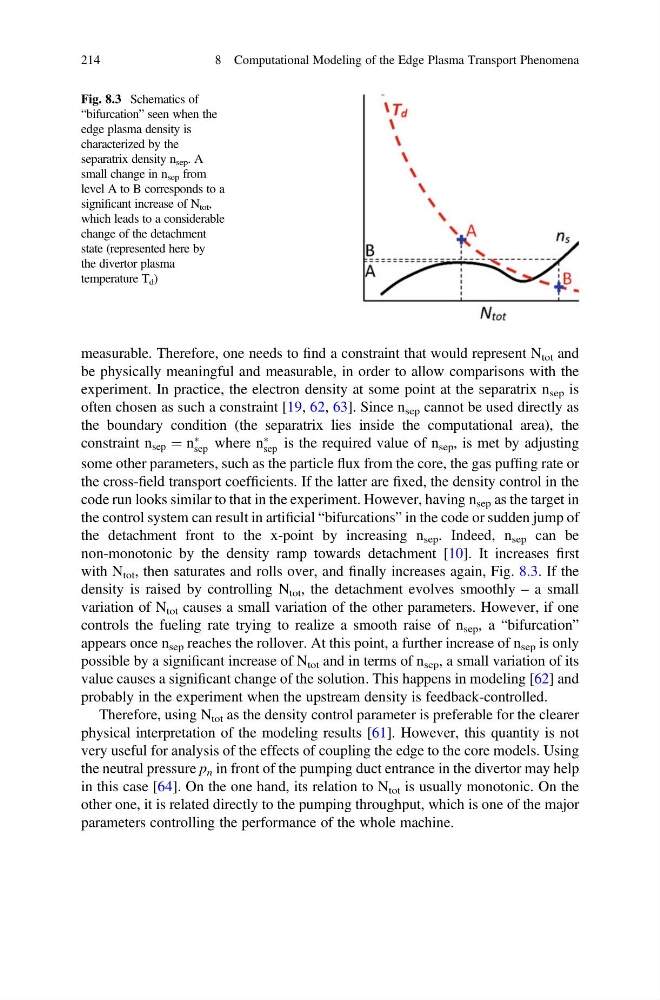
the detachment front to the x-point by increasing n sep . Indeed, n sep can be
non-monotonic by the density ramp towards detachment [10]. It increases first
with N tot , then saturates and rolls over, and finally increases again, Fig. 8.3. If the
density is raised by controlling N tot , the detachment evolves smoothly – a small
variation of N tot causes a small variation of the other parameters. However, if one
controls the fueling rate trying to realize a smooth raise of n sep , a “bifurcation”
appears once n sep reaches the rollover. At this point, a further increase of n sep is only
possible by a significant increase of N tot and in terms of n sep , a small variation of its
value causes a significant change of the solution. This happens in modeling [62] and
probably in the experiment when the upstream density is feedback-controlled.
Therefore, using N tot as the density control parameter is preferable for the clearer
physical interpretation of the modeling results [61]. However, this quantity is not
very useful for analysis of the effects of coupling the edge to the core models. Using
the neutral pressure p n in front of the pumping duct entrance in the divertor may help
in this case [64]. On the one hand, its relation to N tot is usually monotonic. On the
other one, it is related directly to the pumping throughput, which is one of the major
parameters controlling the performance of the whole machine.
Fig. 8.3 Schematics of
“bifurcation” seen when the
edge plasma density is
characterized by the
separatrix density n sep . A
small change in n sep from
level A to B corresponds to a
significant increase of N tot ,
which leads to a considerable
change of the detachment
state (represented here by
the divertor plasma
temperature T d )
214
8 Computational Modeling of the Edge Plasma Transport Phenomena
be physically meaningful and measurable, in order to allow comparisons with the
experiment. In practice, the electron density at some point at the separatrix n sep is
often chosen as such a constraint [19, 62, 63]. Since n sep cannot be used directly as
the boundary condition (the separatrix lies inside the computational area), the
constraint n sep ¼ n
Ã
sep where n
Ã
sep is the required value of n sep , is met by adjusting
some other parameters, such as the particle flux from the core, the gas puffing rate or
the cross-field transport coefficients. If the latter are fixed, the density control in the
code run looks similar to that in the experiment. However, having n sep as the target in
the control system can result in artificial “bifurcations” in the code or sudden jump of
the detachment front to the x-point by increasing n sep . Indeed, n sep can be
non-monotonic by the density ramp towards detachment [10]. It increases first
with N tot , then saturates and rolls over, and finally increases again, Fig. 8.3. If the
density is raised by controlling N tot , the detachment evolves smoothly – a small
variation of N tot causes a small variation of the other parameters. However, if one
controls the fueling rate trying to realize a smooth raise of n sep , a “bifurcation”
appears once n sep reaches the rollover. At this point, a further increase of n sep is only
possible by a significant increase of N tot and in terms of n sep , a small variation of its
value causes a significant change of the solution. This happens in modeling [62] and
probably in the experiment when the upstream density is feedback-controlled.
Therefore, using N tot as the density control parameter is preferable for the clearer
physical interpretation of the modeling results [61]. However, this quantity is not
very useful for analysis of the effects of coupling the edge to the core models. Using
the neutral pressure p n in front of the pumping duct entrance in the divertor may help
in this case [64]. On the one hand, its relation to N tot is usually monotonic. On the
other one, it is related directly to the pumping throughput, which is one of the major
parameters controlling the performance of the whole machine.
Fig. 8.3 Schematics of
“bifurcation” seen when the
edge plasma density is
characterized by the
separatrix density n sep . A
small change in n sep from
level A to B corresponds to a
significant increase of N tot ,
which leads to a considerable
change of the detachment
state (represented here by
the divertor plasma
temperature T d )
214
8 Computational Modeling of the Edge Plasma Transport Phenomena