

In simplified analytic consideration of the magnetic shear effects, the following
model for the magnetic field it is often used:
B
! ¼ B e
!
z þ e
!
y
x
L s
,
ð7:89Þ
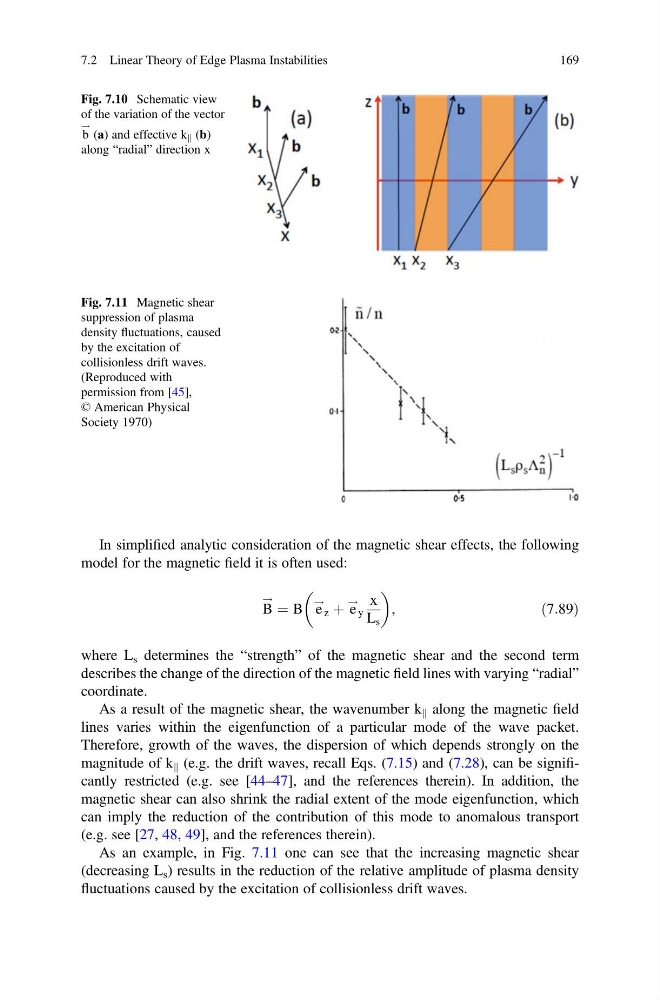
where L s determines the “strength” of the magnetic shear and the second term
describes the change of the direction of the magnetic field lines with varying “radial”
coordinate.
As a result of the magnetic shear, the wavenumber k k along the magnetic field
lines varies within the eigenfunction of a particular mode of the wave packet.
Therefore, growth of the waves, the dispersion of which depends strongly on the
magnitude of k k (e.g. the drift waves, recall Eqs. (7.15) and (7.28), can be significantly restricted (e.g. see [44–47], and the references therein). In addition, the
magnetic shear can also shrink the radial extent of the mode eigenfunction, which
can imply the reduction of the contribution of this mode to anomalous transport
(e.g. see [27, 48, 49], and the references therein).
As an example, in Fig. 7.11 one can see that the increasing magnetic shear
(decreasing L s ) results in the reduction of the relative amplitude of plasma density
fluctuations caused by the excitation of collisionless drift waves.
Fig. 7.10 Schematic view
of the variation of the vector
b
!
(a) and effective k k (b)
along “radial” direction x
Fig. 7.11 Magnetic shear
suppression of plasma
density fluctuations, caused
by the excitation of
collisionless drift waves.
(Reproduced with
permission from [45],
© American Physical
Society 1970)
7.2 Linear Theory of Edge Plasma Instabilities
169
model for the magnetic field it is often used:
B
! ¼ B e
!
z þ e
!
y
x
L s
,
ð7:89Þ
where L s determines the “strength” of the magnetic shear and the second term
describes the change of the direction of the magnetic field lines with varying “radial”
coordinate.
As a result of the magnetic shear, the wavenumber k k along the magnetic field
lines varies within the eigenfunction of a particular mode of the wave packet.
Therefore, growth of the waves, the dispersion of which depends strongly on the
magnitude of k k (e.g. the drift waves, recall Eqs. (7.15) and (7.28), can be significantly restricted (e.g. see [44–47], and the references therein). In addition, the
magnetic shear can also shrink the radial extent of the mode eigenfunction, which
can imply the reduction of the contribution of this mode to anomalous transport
(e.g. see [27, 48, 49], and the references therein).
As an example, in Fig. 7.11 one can see that the increasing magnetic shear
(decreasing L s ) results in the reduction of the relative amplitude of plasma density
fluctuations caused by the excitation of collisionless drift waves.
Fig. 7.10 Schematic view
of the variation of the vector
b
!
(a) and effective k k (b)
along “radial” direction x
Fig. 7.11 Magnetic shear
suppression of plasma
density fluctuations, caused
by the excitation of
collisionless drift waves.
(Reproduced with
permission from [45],
© American Physical
Society 1970)
7.2 Linear Theory of Edge Plasma Instabilities
169