

As we see, different modes of plasma waves, coming virtually from the same set
of the equations, correspond to different relations of the plasma and wave parameters. In the tokamak environment, these modes often either co-exist or are “separated” by a relatively small variation of the plasma parameters. As a result, a much
more sophisticated theoretical analysis and numerical simulations, which go well
beyond our basic survey, are needed to adequately describe them.
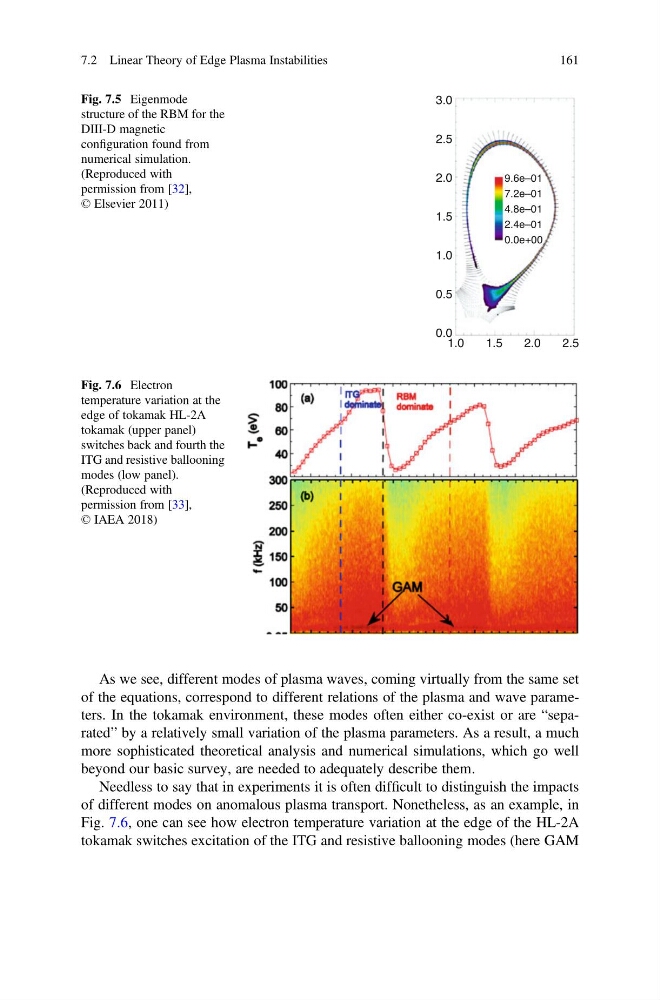
Needless to say that in experiments it is often difficult to distinguish the impacts
of different modes on anomalous plasma transport. Nonetheless, as an example, in
Fig. 7.6, one can see how electron temperature variation at the edge of the HL-2A
tokamak switches excitation of the ITG and resistive ballooning modes (here GAM
1.0
0.0
0.5
1.0
1.5
2.0
2.5
9.6e–01
7.2e–01
4.8e–01
2.4e–01
0.0e+00
3.0
1.5
2.0
2.5
Fig. 7.5 Eigenmode
structure of the RBM for the
DIII-D magnetic
configuration found from
numerical simulation.
(Reproduced with
permission from [32],
© Elsevier 2011)
Fig. 7.6 Electron
temperature variation at the
edge of tokamak HL-2A
tokamak (upper panel)
switches back and fourth the
ITG and resistive ballooning
modes (low panel).
(Reproduced with
permission from [33],
© IAEA 2018)
7.2 Linear Theory of Edge Plasma Instabilities
161
of the equations, correspond to different relations of the plasma and wave parameters. In the tokamak environment, these modes often either co-exist or are “separated” by a relatively small variation of the plasma parameters. As a result, a much
more sophisticated theoretical analysis and numerical simulations, which go well
beyond our basic survey, are needed to adequately describe them.
Needless to say that in experiments it is often difficult to distinguish the impacts
of different modes on anomalous plasma transport. Nonetheless, as an example, in
Fig. 7.6, one can see how electron temperature variation at the edge of the HL-2A
tokamak switches excitation of the ITG and resistive ballooning modes (here GAM
1.0
0.0
0.5
1.0
1.5
2.0
2.5
9.6e–01
7.2e–01
4.8e–01
2.4e–01
0.0e+00
3.0
1.5
2.0
2.5
Fig. 7.5 Eigenmode
structure of the RBM for the
DIII-D magnetic
configuration found from
numerical simulation.
(Reproduced with
permission from [32],
© Elsevier 2011)
Fig. 7.6 Electron
temperature variation at the
edge of tokamak HL-2A
tokamak (upper panel)
switches back and fourth the
ITG and resistive ballooning
modes (low panel).
(Reproduced with
permission from [33],
© IAEA 2018)
7.2 Linear Theory of Edge Plasma Instabilities
161