

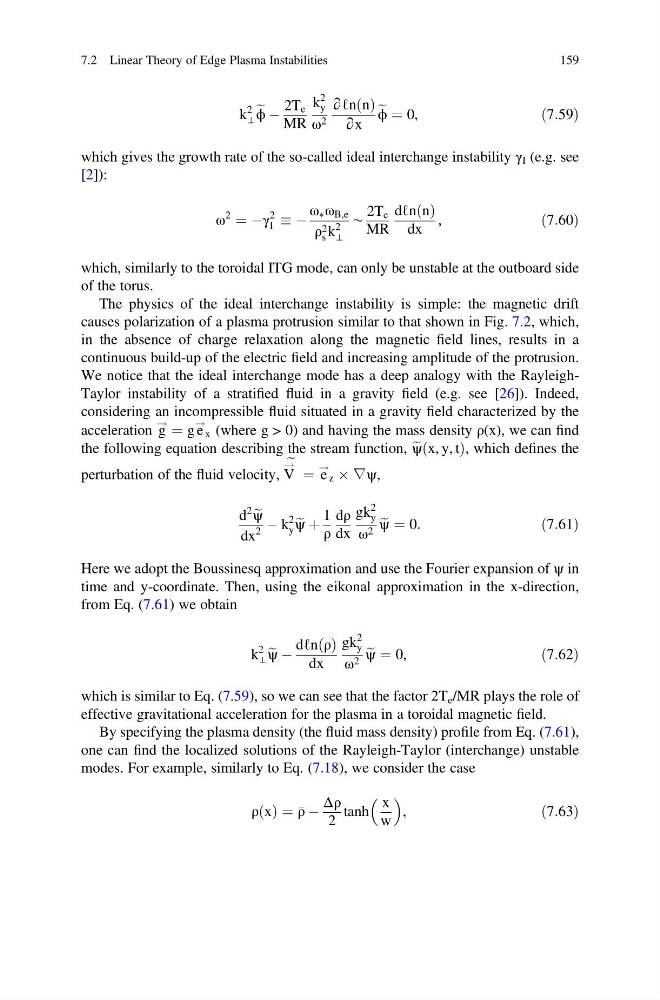
k
2
⊥
e
ϕ À
2T e
MR
k
2
y
ω 2
∂ℓn n
ð Þ
∂x
e
ϕ ¼ 0,
ð7:59Þ
which gives the growth rate of the so-called ideal interchange instability γ I (e.g. see
[2]):
ω
2
¼ Àγ
2
I À
ω Ã ω B,e
ρ 2
s k
2
⊥
∼
2T e
MR
dℓn n
ð Þ
dx
,
ð7:60Þ
which, similarly to the toroidal ITG mode, can only be unstable at the outboard side
of the torus.
The physics of the ideal interchange instability is simple: the magnetic drift
causes polarization of a plasma protrusion similar to that shown in Fig. 7.2, which,
in the absence of charge relaxation along the magnetic field lines, results in a
continuous build-up of the electric field and increasing amplitude of the protrusion.
We notice that the ideal interchange mode has a deep analogy with the RayleighTaylor instability of a stratified fluid in a gravity field (e.g. see [26]). Indeed,
considering an incompressible fluid situated in a gravity field characterized by the
acceleration g
! ¼ g e
!
x (where g > 0) and having the mass density ρ(x), we can find
the following equation describing the stream function, e
ψ x, y, t
ð
Þ, which defines the
perturbation of the fluid velocity,
e
V
! ¼ e
!
z  ∇ψ,
d
2
e
ψ
dx
2
À k
2
y e
ψ þ
1
ρ
dρ
dx
gk
2
y
ω 2 e
ψ ¼ 0:
ð7:61Þ
Here we adopt the Boussinesq approximation and use the Fourier expansion of ψ in
time and y-coordinate. Then, using the eikonal approximation in the x-direction,
from Eq. (7.61) we obtain
k
2
⊥ e
ψ À
dℓn ρ
ð Þ
dx
gk
2
y
ω 2 e
ψ ¼ 0,
ð7:62Þ
which is similar to Eq. (7.59), so we can see that the factor 2T e /MR plays the role of
effective gravitational acceleration for the plasma in a toroidal magnetic field.
By specifying the plasma density (the fluid mass density) profile from Eq. (7.61),
one can find the localized solutions of the Rayleigh-Taylor (interchange) unstable
modes. For example, similarly to Eq. (7.18), we consider the case
ρðxÞ ¼ ρ À
Δρ
2
tanh
x
w
,
ð7:63Þ
7.2 Linear Theory of Edge Plasma Instabilities
159
2
⊥
e
ϕ À
2T e
MR
k
2
y
ω 2
∂ℓn n
ð Þ
∂x
e
ϕ ¼ 0,
ð7:59Þ
which gives the growth rate of the so-called ideal interchange instability γ I (e.g. see
[2]):
ω
2
¼ Àγ
2
I À
ω Ã ω B,e
ρ 2
s k
2
⊥
∼
2T e
MR
dℓn n
ð Þ
dx
,
ð7:60Þ
which, similarly to the toroidal ITG mode, can only be unstable at the outboard side
of the torus.
The physics of the ideal interchange instability is simple: the magnetic drift
causes polarization of a plasma protrusion similar to that shown in Fig. 7.2, which,
in the absence of charge relaxation along the magnetic field lines, results in a
continuous build-up of the electric field and increasing amplitude of the protrusion.
We notice that the ideal interchange mode has a deep analogy with the RayleighTaylor instability of a stratified fluid in a gravity field (e.g. see [26]). Indeed,
considering an incompressible fluid situated in a gravity field characterized by the
acceleration g
! ¼ g e
!
x (where g > 0) and having the mass density ρ(x), we can find
the following equation describing the stream function, e
ψ x, y, t
ð
Þ, which defines the
perturbation of the fluid velocity,
e
V
! ¼ e
!
z  ∇ψ,
d
2
e
ψ
dx
2
À k
2
y e
ψ þ
1
ρ
dρ
dx
gk
2
y
ω 2 e
ψ ¼ 0:
ð7:61Þ
Here we adopt the Boussinesq approximation and use the Fourier expansion of ψ in
time and y-coordinate. Then, using the eikonal approximation in the x-direction,
from Eq. (7.61) we obtain
k
2
⊥ e
ψ À
dℓn ρ
ð Þ
dx
gk
2
y
ω 2 e
ψ ¼ 0,
ð7:62Þ
which is similar to Eq. (7.59), so we can see that the factor 2T e /MR plays the role of
effective gravitational acceleration for the plasma in a toroidal magnetic field.
By specifying the plasma density (the fluid mass density) profile from Eq. (7.61),
one can find the localized solutions of the Rayleigh-Taylor (interchange) unstable
modes. For example, similarly to Eq. (7.18), we consider the case
ρðxÞ ¼ ρ À
Δρ
2
tanh
x
w
,
ð7:63Þ
7.2 Linear Theory of Edge Plasma Instabilities
159