

7.2.6 Interchange and Resistive Interchange Modes
Apart from the impact on the ITG instability, the magnetic drift also brings new
features to the instability of the collisional drift waves we have considered for the
case of a constant magnetic field (see Eqs. (7.32 and 7.35). To asses them, we will
again use a local coordinate system (x,y,z), where x, y, and z are in the radial,
poloidal, and B
!
directions respectively.
However, this time, instead of finding expressions for the electron and ion density
perturbations and then using the quasi-neutrality condition, we will employ the
so-called vorticity equation, which is widely used, in particular, in nonlinear simulations of plasma turbulence. The vorticity equation actually follows from the quasineutrality condition written in the form ∇ Á J
! ¼ 0, where J
!
is the electric current in
the plasma. In highly magnetized plasmas, the cross-field plasma current produced
by fluctuating plasma parameters is only due to the ion inertia,
e
J
!
inert
⊥ (e.g. recall the
expression (7.10)), and diamagnetic current,
e
J
!
dia
⊥ , associated with the electron/ion
diamagnetic fluxes (7.44). We notice that i) the E
! Â B
!
drift velocities, which are the
same for electrons and ions, do not contribute to cross-field electric current in a
quasi-neutral plasma, and ii) ∇ Á
e
J
!
dia
⊥ 6 ¼ 0 only for the case where B
!
is not constant
(e.g. recall expression (7.45)).
For the case of the cold ion approximation, neglecting the variation of the
magnetic field, from Eqs. (7.8 and 7.9) we find
∇ Á J
! inert
⊥ ¼ Àe∇ Á n
∂
∂t
þ V
!
E
! ÂB
! Á ∇
c∇e φ
BΩ Bi
&
'
,
ð7:53Þ
whereas from Eq. (7.45) we have
350
–150
–100
–50
0
50
100
150
400
R/ρ s
Z/ρ
s
450 500 550 600 650
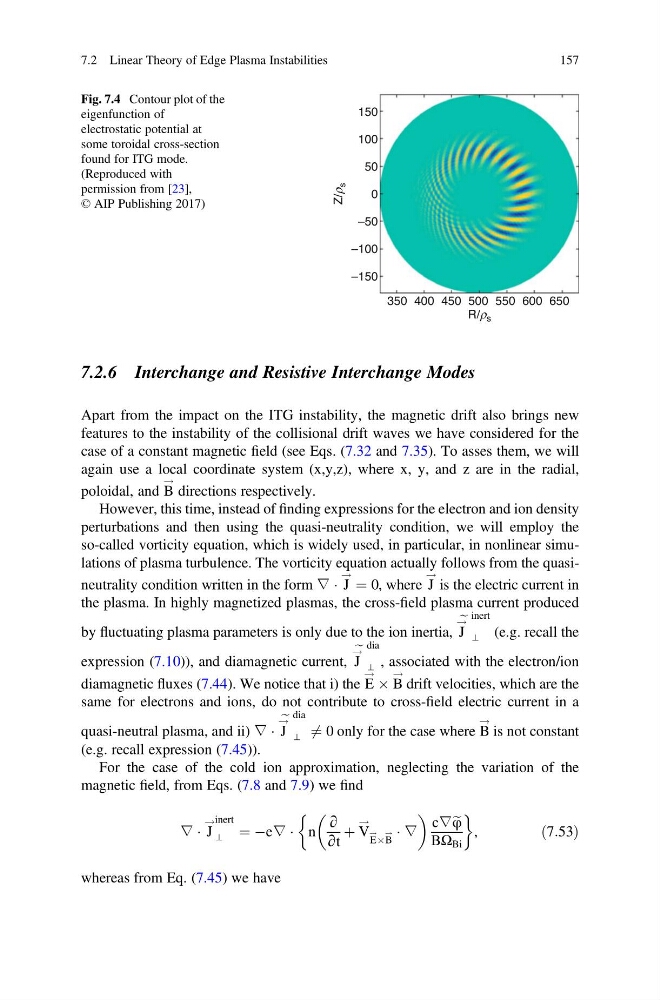
Fig. 7.4 Contour plot of the
eigenfunction of
electrostatic potential at
some toroidal cross-section
found for ITG mode.
(Reproduced with
permission from [23],
© AIP Publishing 2017)
7.2 Linear Theory of Edge Plasma Instabilities
157
Apart from the impact on the ITG instability, the magnetic drift also brings new
features to the instability of the collisional drift waves we have considered for the
case of a constant magnetic field (see Eqs. (7.32 and 7.35). To asses them, we will
again use a local coordinate system (x,y,z), where x, y, and z are in the radial,
poloidal, and B
!
directions respectively.
However, this time, instead of finding expressions for the electron and ion density
perturbations and then using the quasi-neutrality condition, we will employ the
so-called vorticity equation, which is widely used, in particular, in nonlinear simulations of plasma turbulence. The vorticity equation actually follows from the quasineutrality condition written in the form ∇ Á J
! ¼ 0, where J
!
is the electric current in
the plasma. In highly magnetized plasmas, the cross-field plasma current produced
by fluctuating plasma parameters is only due to the ion inertia,
e
J
!
inert
⊥ (e.g. recall the
expression (7.10)), and diamagnetic current,
e
J
!
dia
⊥ , associated with the electron/ion
diamagnetic fluxes (7.44). We notice that i) the E
! Â B
!
drift velocities, which are the
same for electrons and ions, do not contribute to cross-field electric current in a
quasi-neutral plasma, and ii) ∇ Á
e
J
!
dia
⊥ 6 ¼ 0 only for the case where B
!
is not constant
(e.g. recall expression (7.45)).
For the case of the cold ion approximation, neglecting the variation of the
magnetic field, from Eqs. (7.8 and 7.9) we find
∇ Á J
! inert
⊥ ¼ Àe∇ Á n
∂
∂t
þ V
!
E
! ÂB
! Á ∇
c∇e φ
BΩ Bi
&
'
,
ð7:53Þ
whereas from Eq. (7.45) we have
350
–150
–100
–50
0
50
100
150
400
R/ρ s
Z/ρ
s
450 500 550 600 650
Fig. 7.4 Contour plot of the
eigenfunction of
electrostatic potential at
some toroidal cross-section
found for ITG mode.
(Reproduced with
permission from [23],
© AIP Publishing 2017)
7.2 Linear Theory of Edge Plasma Instabilities
157