

7.2 Linear Theory of Edge Plasma Instabilities
7.2.1 Collisionless Drift Waves
We start our consideration with the simplest physical picture of collisionless drift
waves in plasma embedded into a constant magnetic field, B
! ¼ B e
!
z (where e
!
z is the
unit vector in the z-direction). These waves are characterized by the frequency, ω,
which is much lower than the ion gyrofrequency, Ω Bi , so the charged particle motion
across the magnetic field is largely described by the E
! Â B
!
drift. In addition, we
consider such wave vectors, k
!
, that the phase velocity of the wave along the
magnetic field lines, ω/k k , satisfies the following inequalities.
V Ti < ω=k k < V Te ,
ð7:1Þ
where k k ¼ k
! Á B
! = B is the wave vector component along the magnetic field,
whereas V Te ¼
ffiffiffiffiffiffiffiffiffiffiffi
T e =m
p
and V Ti ¼
ffiffiffiffiffiffiffiffiffiffiffi
T i =M
p
are the electron and ion thermal
velocities, respectively. As a result, in this case, we largely can ignore the effects
of the Landau resonances of the wave with both electrons and ions, which can play
an important role in collisionless or weakly collisional plasmas.
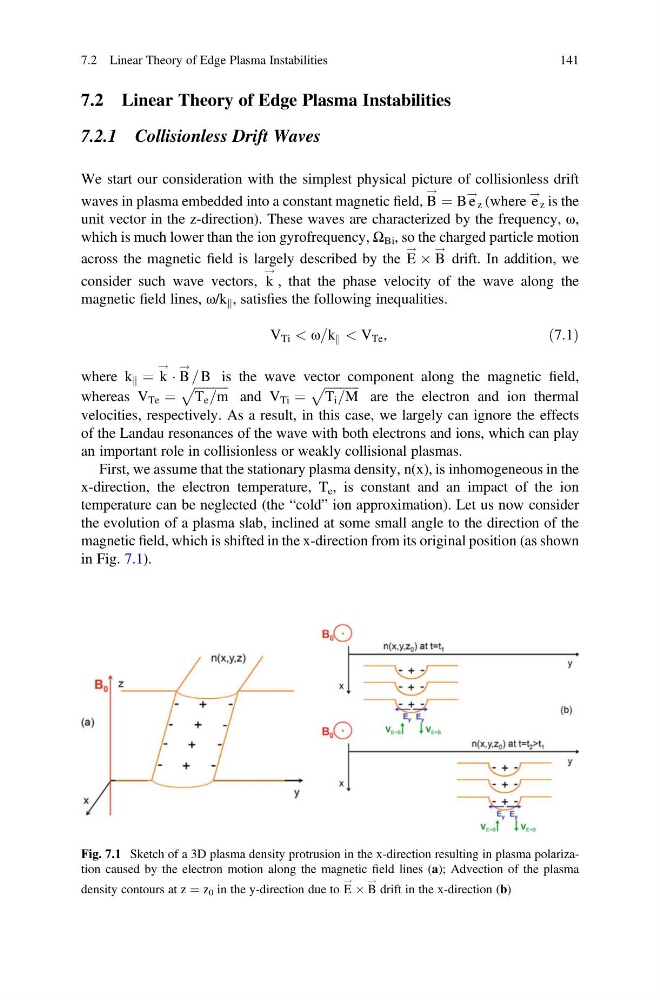
First, we assume that the stationary plasma density, n(x), is inhomogeneous in the
x-direction, the electron temperature, T e , is constant and an impact of the ion
temperature can be neglected (the “cold” ion approximation). Let us now consider
the evolution of a plasma slab, inclined at some small angle to the direction of the
magnetic field, which is shifted in the x-direction from its original position (as shown
in Fig. 7.1).
Fig. 7.1 Sketch of a 3D plasma density protrusion in the x-direction resulting in plasma polarization caused by the electron motion along the magnetic field lines (a); Advection of the plasma
density contours at z ¼ z 0 in the y-direction due to E
! Â B
!
drift in the x-direction (b)
7.2 Linear Theory of Edge Plasma Instabilities
141
7.2.1 Collisionless Drift Waves
We start our consideration with the simplest physical picture of collisionless drift
waves in plasma embedded into a constant magnetic field, B
! ¼ B e
!
z (where e
!
z is the
unit vector in the z-direction). These waves are characterized by the frequency, ω,
which is much lower than the ion gyrofrequency, Ω Bi , so the charged particle motion
across the magnetic field is largely described by the E
! Â B
!
drift. In addition, we
consider such wave vectors, k
!
, that the phase velocity of the wave along the
magnetic field lines, ω/k k , satisfies the following inequalities.
V Ti < ω=k k < V Te ,
ð7:1Þ
where k k ¼ k
! Á B
! = B is the wave vector component along the magnetic field,
whereas V Te ¼
ffiffiffiffiffiffiffiffiffiffiffi
T e =m
p
and V Ti ¼
ffiffiffiffiffiffiffiffiffiffiffi
T i =M
p
are the electron and ion thermal
velocities, respectively. As a result, in this case, we largely can ignore the effects
of the Landau resonances of the wave with both electrons and ions, which can play
an important role in collisionless or weakly collisional plasmas.
First, we assume that the stationary plasma density, n(x), is inhomogeneous in the
x-direction, the electron temperature, T e , is constant and an impact of the ion
temperature can be neglected (the “cold” ion approximation). Let us now consider
the evolution of a plasma slab, inclined at some small angle to the direction of the
magnetic field, which is shifted in the x-direction from its original position (as shown
in Fig. 7.1).
Fig. 7.1 Sketch of a 3D plasma density protrusion in the x-direction resulting in plasma polarization caused by the electron motion along the magnetic field lines (a); Advection of the plasma
density contours at z ¼ z 0 in the y-direction due to E
! Â B
!
drift in the x-direction (b)
7.2 Linear Theory of Edge Plasma Instabilities
141