

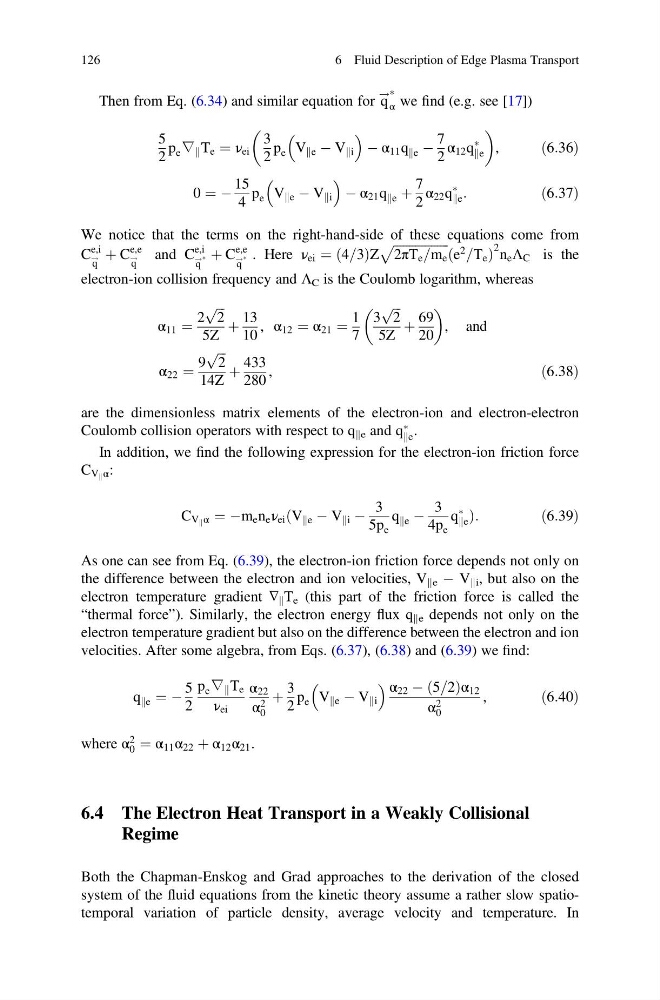
Then from Eq. (6.34) and similar equation for q
! Ã
α we find (e.g. see [17])
5
2
p e ∇ k T e ¼ ν ei
3
2
p e
V ke À V ki
À α 11 q ke À
7
2
α 12 q
Ã
ke
,
ð6:36Þ
0 ¼ À
15
4
p e
V ke À V ki
À α 21 q ke þ
7
2
α 22 q
Ã
ke :
ð6:37Þ
We notice that the terms on the right-hand-side of these equations come from
C
e,i
q
! þ C
e,e
q
!
and C
e,i
q
!Ã þ C
e,e
q
!Ã . Here ν ei ¼ 4=3
ð
ÞZ
ffiffiffiffiffiffiffiffiffiffiffiffiffiffiffiffiffi ffi
2πT e =m e
p
e
2
=T e
ð
Þ
2 n e Λ C is the
electron-ion collision frequency and Λ C is the Coulomb logarithm, whereas
α 11 ¼
2
ffiffi ffi
2
p
5Z
þ
13
10
, α 12 ¼ α 21 ¼
1
7
3
ffiffi ffi
2
p
5Z
þ
69
20
, and
α 22 ¼
9
ffiffi ffi
2
p
14Z
þ
433
280
,
ð6:38Þ
are the dimensionless matrix elements of the electron-ion and electron-electron
Coulomb collision operators with respect to q ke and q
Ã
ke .
In addition, we find the following expression for the electron-ion friction force
C V k α :
C V k α ¼ Àm e n e ν ei ðV ke À V ki À
3
5p e
q ke À
3
4p e
q
Ã
ke Þ:
ð6:39Þ
As one can see from Eq. (6.39), the electron-ion friction force depends not only on
the difference between the electron and ion velocities, V ke À V ki , but also on the
electron temperature gradient ∇ k T e (this part of the friction force is called the
“thermal force”). Similarly, the electron energy flux q ke depends not only on the
electron temperature gradient but also on the difference between the electron and ion
velocities. After some algebra, from Eqs. (6.37), (6.38) and (6.39) we find:
q ke ¼ À
5
2
p e ∇ k T e
ν ei
α 22
α 2
0
þ
3
2
p e
V ke À V ki
α 22 À ð5=2Þα 12
α 2
0
,
ð6:40Þ
where α
2
0 ¼ α 11 α 22 þ α 12 α 21 .
6.4 The Electron Heat Transport in a Weakly Collisional
Regime
Both the Chapman-Enskog and Grad approaches to the derivation of the closed
system of the fluid equations from the kinetic theory assume a rather slow spatiotemporal variation of particle density, average velocity and temperature. In
126
6 Fluid Description of Edge Plasma Transport
! Ã
α we find (e.g. see [17])
5
2
p e ∇ k T e ¼ ν ei
3
2
p e
V ke À V ki
À α 11 q ke À
7
2
α 12 q
Ã
ke
,
ð6:36Þ
0 ¼ À
15
4
p e
V ke À V ki
À α 21 q ke þ
7
2
α 22 q
Ã
ke :
ð6:37Þ
We notice that the terms on the right-hand-side of these equations come from
C
e,i
q
! þ C
e,e
q
!
and C
e,i
q
!Ã þ C
e,e
q
!Ã . Here ν ei ¼ 4=3
ð
ÞZ
ffiffiffiffiffiffiffiffiffiffiffiffiffiffiffiffiffi ffi
2πT e =m e
p
e
2
=T e
ð
Þ
2 n e Λ C is the
electron-ion collision frequency and Λ C is the Coulomb logarithm, whereas
α 11 ¼
2
ffiffi ffi
2
p
5Z
þ
13
10
, α 12 ¼ α 21 ¼
1
7
3
ffiffi ffi
2
p
5Z
þ
69
20
, and
α 22 ¼
9
ffiffi ffi
2
p
14Z
þ
433
280
,
ð6:38Þ
are the dimensionless matrix elements of the electron-ion and electron-electron
Coulomb collision operators with respect to q ke and q
Ã
ke .
In addition, we find the following expression for the electron-ion friction force
C V k α :
C V k α ¼ Àm e n e ν ei ðV ke À V ki À
3
5p e
q ke À
3
4p e
q
Ã
ke Þ:
ð6:39Þ
As one can see from Eq. (6.39), the electron-ion friction force depends not only on
the difference between the electron and ion velocities, V ke À V ki , but also on the
electron temperature gradient ∇ k T e (this part of the friction force is called the
“thermal force”). Similarly, the electron energy flux q ke depends not only on the
electron temperature gradient but also on the difference between the electron and ion
velocities. After some algebra, from Eqs. (6.37), (6.38) and (6.39) we find:
q ke ¼ À
5
2
p e ∇ k T e
ν ei
α 22
α 2
0
þ
3
2
p e
V ke À V ki
α 22 À ð5=2Þα 12
α 2
0
,
ð6:40Þ
where α
2
0 ¼ α 11 α 22 þ α 12 α 21 .
6.4 The Electron Heat Transport in a Weakly Collisional
Regime
Both the Chapman-Enskog and Grad approaches to the derivation of the closed
system of the fluid equations from the kinetic theory assume a rather slow spatiotemporal variation of particle density, average velocity and temperature. In
126
6 Fluid Description of Edge Plasma Transport