

16 Ian Scoones, Peter Newell and Melissa Leach
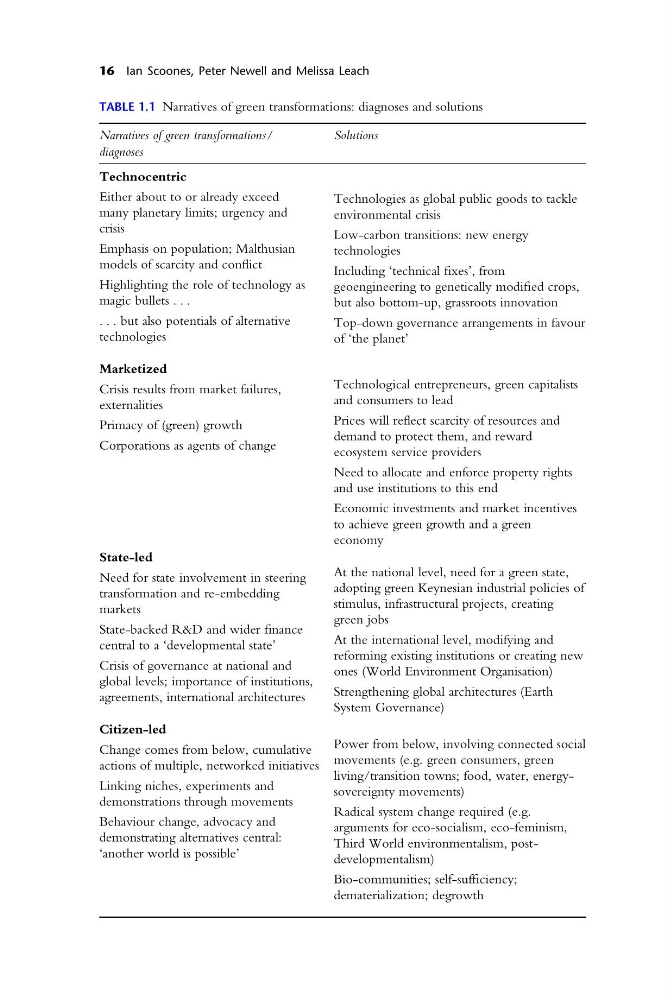
TABLE 1.1 Narratives of green transformations: diagnoses and solutions
Narratives of green transformations/
Solutions
diagnoses
Technocentric
Either about to or already exceed
many planetary limits; urgency and
crisis
Emphasis on population; Malthusian
models of scarcity and conflict
Highlighting the role of technology as
magic bullets . . .
. . . but also potentials of alternative
technologies
Marketized
Crisis results from market failures,
externalities
Primacy of (green) growth
Corporations as agents of change
State-led
Need for state involvement in steering
transformation and re-embedding
markets
State-backed R&D and wider finance
central to a ‘developmental state’
Crisis of governance at national and
global levels; importance of institutions,
agreements, international architectures
Citizen-led
Change comes from below, cumulative
actions of multiple, networked initiatives
Linking niches, experiments and
demonstrations through movements
Behaviour change, advocacy and
demonstrating alternatives central:
‘another world is possible’
Technologies as global public goods to tackle
environmental crisis
Low-carbon transitions: new energy
technologies
Including ‘technical fixes’, from
geoengineering to genetically modified crops,
but also bottom-up, grassroots innovation
Top-down governance arrangements in favour
of ‘the planet’
Technological entrepreneurs, green capitalists
and consumers to lead
Prices will reflect scarcity of resources and
demand to protect them, and reward
ecosystem service providers
Need to allocate and enforce property rights
and use institutions to this end
Economic investments and market incentives
to achieve green growth and a green
economy
At the national level, need for a green state,
adopting green Keynesian industrial policies of
stimulus, infrastructural projects, creating
green jobs
At the international level, modifying and
reforming existing institutions or creating new
ones (World Environment Organisation)
Strengthening global architectures (Earth
System Governance)
Power from below, involving connected social
movements (e.g. green consumers, green
living/transition towns; food, water, energysovereignty movements)
Radical system change required (e.g.
arguments for eco-socialism, eco-feminism,
Third World environmentalism, postdevelopmentalism)
Bio-communities; self-sufficiency;
dematerialization; degrowth
TABLE 1.1 Narratives of green transformations: diagnoses and solutions
Narratives of green transformations/
Solutions
diagnoses
Technocentric
Either about to or already exceed
many planetary limits; urgency and
crisis
Emphasis on population; Malthusian
models of scarcity and conflict
Highlighting the role of technology as
magic bullets . . .
. . . but also potentials of alternative
technologies
Marketized
Crisis results from market failures,
externalities
Primacy of (green) growth
Corporations as agents of change
State-led
Need for state involvement in steering
transformation and re-embedding
markets
State-backed R&D and wider finance
central to a ‘developmental state’
Crisis of governance at national and
global levels; importance of institutions,
agreements, international architectures
Citizen-led
Change comes from below, cumulative
actions of multiple, networked initiatives
Linking niches, experiments and
demonstrations through movements
Behaviour change, advocacy and
demonstrating alternatives central:
‘another world is possible’
Technologies as global public goods to tackle
environmental crisis
Low-carbon transitions: new energy
technologies
Including ‘technical fixes’, from
geoengineering to genetically modified crops,
but also bottom-up, grassroots innovation
Top-down governance arrangements in favour
of ‘the planet’
Technological entrepreneurs, green capitalists
and consumers to lead
Prices will reflect scarcity of resources and
demand to protect them, and reward
ecosystem service providers
Need to allocate and enforce property rights
and use institutions to this end
Economic investments and market incentives
to achieve green growth and a green
economy
At the national level, need for a green state,
adopting green Keynesian industrial policies of
stimulus, infrastructural projects, creating
green jobs
At the international level, modifying and
reforming existing institutions or creating new
ones (World Environment Organisation)
Strengthening global architectures (Earth
System Governance)
Power from below, involving connected social
movements (e.g. green consumers, green
living/transition towns; food, water, energysovereignty movements)
Radical system change required (e.g.
arguments for eco-socialism, eco-feminism,
Third World environmentalism, postdevelopmentalism)
Bio-communities; self-sufficiency;
dematerialization; degrowth