

emissions, which is seen as impossible.
4 The answer is not to make growth ‘green’,
therefore, but to restrict it, or even to reduce economic activity.
5
While calls for limits to growth can be made on purely environmental grounds,
they are more commonly linked to social justice. In a world of limits to global
growth, a more equitable distribution of income and wealth requires redistribution
– it cannot be achieved by ‘trickle-down’, even in principle. Tim Jackson (2009)
shows how much harder it would be to reduce carbon emission to sustainable levels
while also addressing global inequality. To reach sustainable emissions levels by
2050, while raising global income levels to the EU 2007 average level, requires a
55-fold reduction in carbon intensity, compared with a 21-fold reduction if
patterns of inequality remain unchanged.
Arguments in favour of redistribution are not restricted to the more radical views
of green transformation. To address climate change at the global level, many argue
for the creation of a global carbon market, where countries trade their carbon
emission rights, potentially creating a mechanism to transfer finance from rich to
poor countries. The level of transfers, however, would be determined by the way
national emission rights are allocated. At one extreme, some propose ‘grand -
fathering’, with rights allocated in line with the current pattern of emissions
(Bovens, 2011). At the other end of the spectrum, others suggest that emissions
are allocated on an equal per capita basis, or progressively moved towards this.
6
Under this framework, low-income countries would generally receive more
permits than they needed, allowing them to sell these to richer countries, creating
large annual cash transfers, or a mechanism for global redistribution.
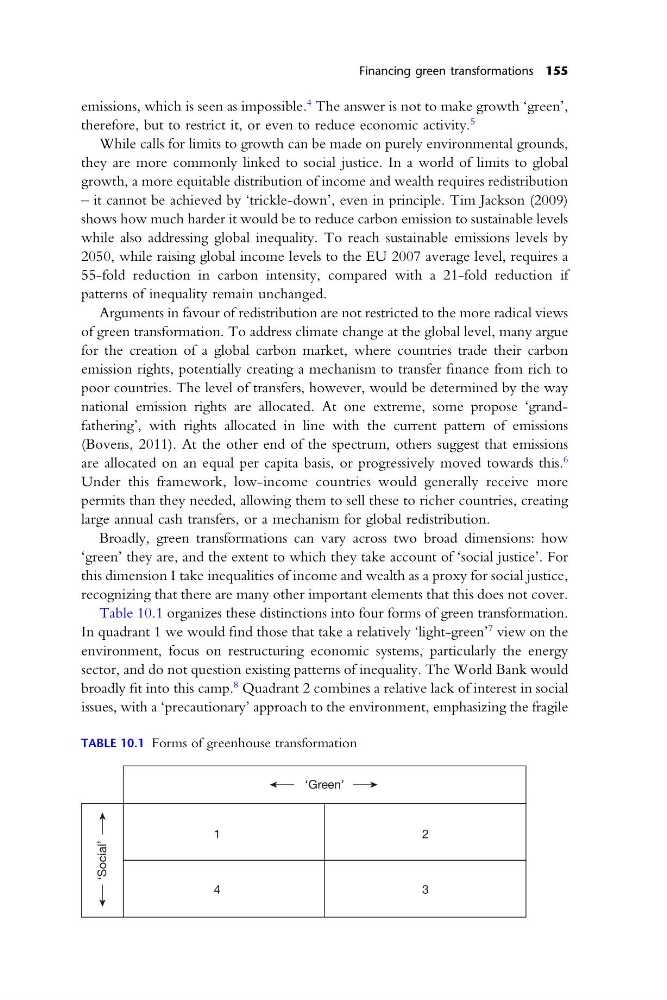
Broadly, green transformations can vary across two broad dimensions: how
‘green’ they are, and the extent to which they take account of ‘social justice’. For
this dimension I take inequalities of income and wealth as a proxy for social justice,
recognizing that there are many other important elements that this does not cover.
Table 10.1 organizes these distinctions into four forms of green transformation.
In quadrant 1 we would find those that take a relatively ‘light-green’
7 view on the
environment, focus on restructuring economic systems, particularly the energy
sector, and do not question existing patterns of inequality. The World Bank would
broadly fit into this camp.
8 Quadrant 2 combines a relative lack of interest in social
issues, with a ‘precautionary’ approach to the environment, emphasizing the fragile
Financing green transformations 155
‘Social’
1
3
2
4
‘Green’
TABLE 10.1 Forms of greenhouse transformation
4 The answer is not to make growth ‘green’,
therefore, but to restrict it, or even to reduce economic activity.
5
While calls for limits to growth can be made on purely environmental grounds,
they are more commonly linked to social justice. In a world of limits to global
growth, a more equitable distribution of income and wealth requires redistribution
– it cannot be achieved by ‘trickle-down’, even in principle. Tim Jackson (2009)
shows how much harder it would be to reduce carbon emission to sustainable levels
while also addressing global inequality. To reach sustainable emissions levels by
2050, while raising global income levels to the EU 2007 average level, requires a
55-fold reduction in carbon intensity, compared with a 21-fold reduction if
patterns of inequality remain unchanged.
Arguments in favour of redistribution are not restricted to the more radical views
of green transformation. To address climate change at the global level, many argue
for the creation of a global carbon market, where countries trade their carbon
emission rights, potentially creating a mechanism to transfer finance from rich to
poor countries. The level of transfers, however, would be determined by the way
national emission rights are allocated. At one extreme, some propose ‘grand -
fathering’, with rights allocated in line with the current pattern of emissions
(Bovens, 2011). At the other end of the spectrum, others suggest that emissions
are allocated on an equal per capita basis, or progressively moved towards this.
6
Under this framework, low-income countries would generally receive more
permits than they needed, allowing them to sell these to richer countries, creating
large annual cash transfers, or a mechanism for global redistribution.
Broadly, green transformations can vary across two broad dimensions: how
‘green’ they are, and the extent to which they take account of ‘social justice’. For
this dimension I take inequalities of income and wealth as a proxy for social justice,
recognizing that there are many other important elements that this does not cover.
Table 10.1 organizes these distinctions into four forms of green transformation.
In quadrant 1 we would find those that take a relatively ‘light-green’
7 view on the
environment, focus on restructuring economic systems, particularly the energy
sector, and do not question existing patterns of inequality. The World Bank would
broadly fit into this camp.
8 Quadrant 2 combines a relative lack of interest in social
issues, with a ‘precautionary’ approach to the environment, emphasizing the fragile
Financing green transformations 155
‘Social’
1
3
2
4
‘Green’
TABLE 10.1 Forms of greenhouse transformation