

1.9 Why Is a Chemical Toxic?
21
1.9 Why Is a Chemical Toxic?
Dangerous chemicals for human health must first come into contact with, or enter
that person’s body, and must have a biological effect on the body itself. As a result, it
is necessary that (i) the organism is exposed to a toxic compound, that (ii) this toxic
compound enters it, and that (iii) the organism absorbs a sufficient quantity able to
disturb its functioning. It should be noted that the majority of toxins must generally
enter the organism to produce harmful effects, except those causing local effects.
The main four routes of entry are (Hellman 2003; Silbergeld 1998; Stellman
1998):
• Inhalation (breathing)
• Skin contact
• The digestive system (ingestion or diet)
• Injections.
With reference to food and beverage environments, the most probable routes
should exclude the ingestion and injections.
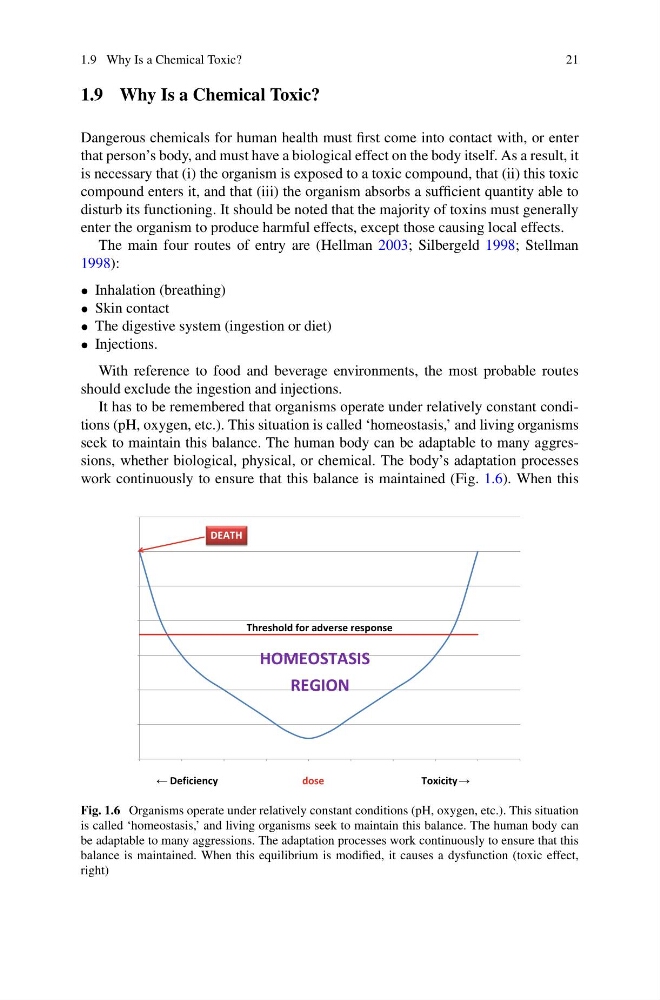
It has to be remembered that organisms operate under relatively constant conditions (pH, oxygen, etc.). This situation is called ‘homeostasis,’ and living organisms
seek to maintain this balance. The human body can be adaptable to many aggressions, whether biological, physical, or chemical. The body’s adaptation processes
work continuously to ensure that this balance is maintained (Fig. 1.6). When this
Threshold for adverse response
DEATH
← Deficiency
dose
Toxicity →
HOMEOSTASIS
REGION
Fig. 1.6 Organisms operate under relatively constant conditions (pH, oxygen, etc.). This situation
is called ‘homeostasis,’ and living organisms seek to maintain this balance. The human body can
be adaptable to many aggressions. The adaptation processes work continuously to ensure that this
balance is maintained. When this equilibrium is modified, it causes a dysfunction (toxic effect,
right)
21
1.9 Why Is a Chemical Toxic?
Dangerous chemicals for human health must first come into contact with, or enter
that person’s body, and must have a biological effect on the body itself. As a result, it
is necessary that (i) the organism is exposed to a toxic compound, that (ii) this toxic
compound enters it, and that (iii) the organism absorbs a sufficient quantity able to
disturb its functioning. It should be noted that the majority of toxins must generally
enter the organism to produce harmful effects, except those causing local effects.
The main four routes of entry are (Hellman 2003; Silbergeld 1998; Stellman
1998):
• Inhalation (breathing)
• Skin contact
• The digestive system (ingestion or diet)
• Injections.
With reference to food and beverage environments, the most probable routes
should exclude the ingestion and injections.
It has to be remembered that organisms operate under relatively constant conditions (pH, oxygen, etc.). This situation is called ‘homeostasis,’ and living organisms
seek to maintain this balance. The human body can be adaptable to many aggressions, whether biological, physical, or chemical. The body’s adaptation processes
work continuously to ensure that this balance is maintained (Fig. 1.6). When this
Threshold for adverse response
DEATH
← Deficiency
dose
Toxicity →
HOMEOSTASIS
REGION
Fig. 1.6 Organisms operate under relatively constant conditions (pH, oxygen, etc.). This situation
is called ‘homeostasis,’ and living organisms seek to maintain this balance. The human body can
be adaptable to many aggressions. The adaptation processes work continuously to ensure that this
balance is maintained. When this equilibrium is modified, it causes a dysfunction (toxic effect,
right)