

1.8 Toxicity of the Chemical
19
Table 1.2 Examples of toxic
effects on certain biological
tissues and systems
Targeted system and related
organs
Clinical effect or sign
Eye
Irritation and corrosion
Skin
Irritation, corrosion,
dermatosis
Digestive system
Irritation and corrosion
Cardiovascular system
Abnormal heart rate
Central nervous system
Depression (nausea,
vomiting, etc.)
Peripheral nervous system
Neuropathy
Respiratory system
Irritation, corrosion, dyspnea
(shortness of breath)
Blood system
Carboxyhemoglobinemia
Urinary system
Very dark urine and blood in
the urines
(1) The threshold of irreversible effects (concentration beyond which permanent
sequelae could appear on people)
(2) The threshold of the first lethal effects (concentration beyond which deaths
could be observed in 1% of the population)
(3) The threshold of significant lethal effects (concentration threshold above which
deaths could be observed in 5% of the population).
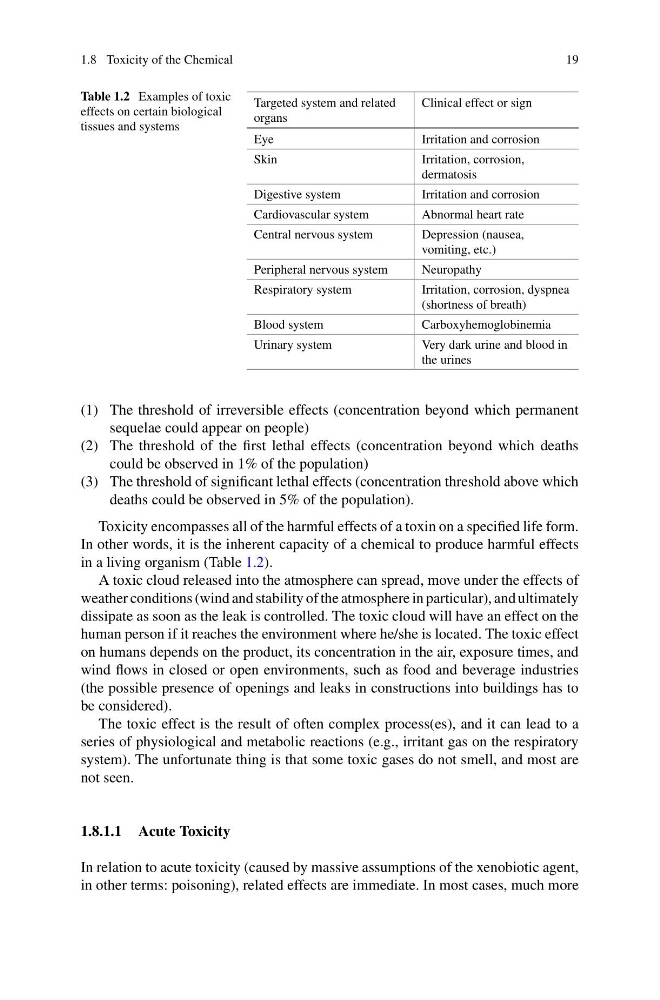
Toxicity encompasses all of the harmful effects of a toxin on a specified life form.
In other words, it is the inherent capacity of a chemical to produce harmful effects
in a living organism (Table 1.2).
A toxic cloud released into the atmosphere can spread, move under the effects of
weather conditions (wind and stability of the atmosphere in particular), and ultimately
dissipate as soon as the leak is controlled. The toxic cloud will have an effect on the
human person if it reaches the environment where he/she is located. The toxic effect
on humans depends on the product, its concentration in the air, exposure times, and
wind flows in closed or open environments, such as food and beverage industries
(the possible presence of openings and leaks in constructions into buildings has to
be considered).
The toxic effect is the result of often complex process(es), and it can lead to a
series of physiological and metabolic reactions (e.g., irritant gas on the respiratory
system). The unfortunate thing is that some toxic gases do not smell, and most are
not seen.
1.8.1.1 Acute Toxicity
In relation to acute toxicity (caused by massive assumptions of the xenobiotic agent,
in other terms: poisoning), related effects are immediate. In most cases, much more
19
Table 1.2 Examples of toxic
effects on certain biological
tissues and systems
Targeted system and related
organs
Clinical effect or sign
Eye
Irritation and corrosion
Skin
Irritation, corrosion,
dermatosis
Digestive system
Irritation and corrosion
Cardiovascular system
Abnormal heart rate
Central nervous system
Depression (nausea,
vomiting, etc.)
Peripheral nervous system
Neuropathy
Respiratory system
Irritation, corrosion, dyspnea
(shortness of breath)
Blood system
Carboxyhemoglobinemia
Urinary system
Very dark urine and blood in
the urines
(1) The threshold of irreversible effects (concentration beyond which permanent
sequelae could appear on people)
(2) The threshold of the first lethal effects (concentration beyond which deaths
could be observed in 1% of the population)
(3) The threshold of significant lethal effects (concentration threshold above which
deaths could be observed in 5% of the population).
Toxicity encompasses all of the harmful effects of a toxin on a specified life form.
In other words, it is the inherent capacity of a chemical to produce harmful effects
in a living organism (Table 1.2).
A toxic cloud released into the atmosphere can spread, move under the effects of
weather conditions (wind and stability of the atmosphere in particular), and ultimately
dissipate as soon as the leak is controlled. The toxic cloud will have an effect on the
human person if it reaches the environment where he/she is located. The toxic effect
on humans depends on the product, its concentration in the air, exposure times, and
wind flows in closed or open environments, such as food and beverage industries
(the possible presence of openings and leaks in constructions into buildings has to
be considered).
The toxic effect is the result of often complex process(es), and it can lead to a
series of physiological and metabolic reactions (e.g., irritant gas on the respiratory
system). The unfortunate thing is that some toxic gases do not smell, and most are
not seen.
1.8.1.1 Acute Toxicity
In relation to acute toxicity (caused by massive assumptions of the xenobiotic agent,
in other terms: poisoning), related effects are immediate. In most cases, much more