

7.5 Calibration Frames
87
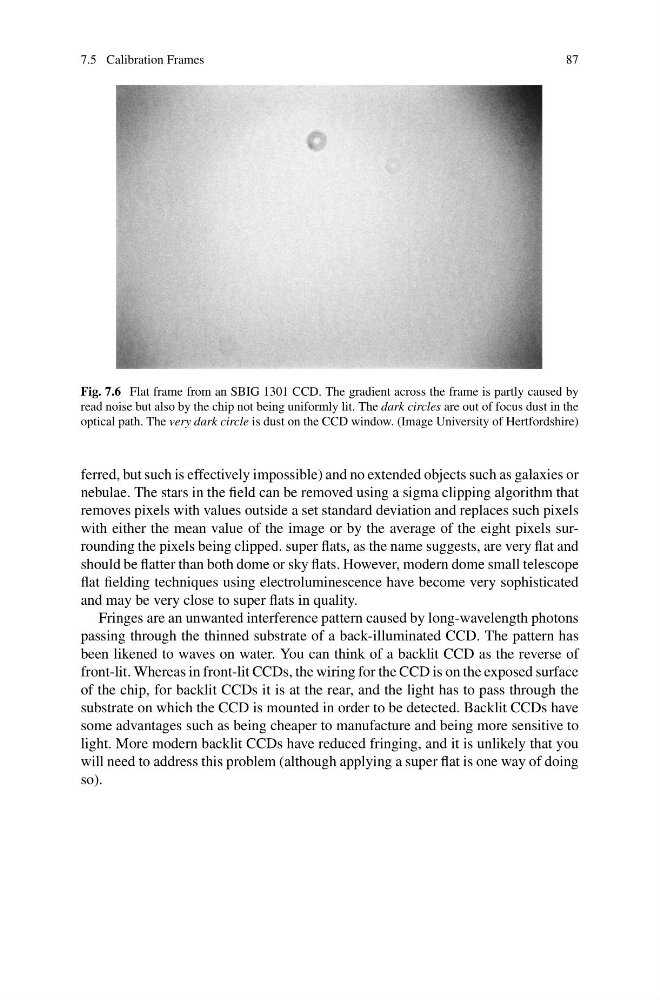
Fig. 7.6 Flat frame from an SBIG 1301 CCD. The gradient across the frame is partly caused by
read noise but also by the chip not being uniformly lit. The dark circles are out of focus dust in the
optical path. The very dark circle is dust on the CCD window. (Image University of Hertfordshire)
ferred, but such is effectively impossible) and no extended objects such as galaxies or
nebulae. The stars in the field can be removed using a sigma clipping algorithm that
removes pixels with values outside a set standard deviation and replaces such pixels
with either the mean value of the image or by the average of the eight pixels surrounding the pixels being clipped. super flats, as the name suggests, are very flat and
should be flatter than both dome or sky flats. However, modern dome small telescope
flat fielding techniques using electroluminescence have become very sophisticated
and may be very close to super flats in quality.
Fringes are an unwanted interference pattern caused by long-wavelength photons
passing through the thinned substrate of a back-illuminated CCD. The pattern has
been likened to waves on water. You can think of a backlit CCD as the reverse of
front-lit. Whereas in front-lit CCDs, the wiring for the CCD is on the exposed surface
of the chip, for backlit CCDs it is at the rear, and the light has to pass through the
substrate on which the CCD is mounted in order to be detected. Backlit CCDs have
some advantages such as being cheaper to manufacture and being more sensitive to
light. More modern backlit CCDs have reduced fringing, and it is unlikely that you
will need to address this problem (although applying a super flat is one way of doing
so).
87
Fig. 7.6 Flat frame from an SBIG 1301 CCD. The gradient across the frame is partly caused by
read noise but also by the chip not being uniformly lit. The dark circles are out of focus dust in the
optical path. The very dark circle is dust on the CCD window. (Image University of Hertfordshire)
ferred, but such is effectively impossible) and no extended objects such as galaxies or
nebulae. The stars in the field can be removed using a sigma clipping algorithm that
removes pixels with values outside a set standard deviation and replaces such pixels
with either the mean value of the image or by the average of the eight pixels surrounding the pixels being clipped. super flats, as the name suggests, are very flat and
should be flatter than both dome or sky flats. However, modern dome small telescope
flat fielding techniques using electroluminescence have become very sophisticated
and may be very close to super flats in quality.
Fringes are an unwanted interference pattern caused by long-wavelength photons
passing through the thinned substrate of a back-illuminated CCD. The pattern has
been likened to waves on water. You can think of a backlit CCD as the reverse of
front-lit. Whereas in front-lit CCDs, the wiring for the CCD is on the exposed surface
of the chip, for backlit CCDs it is at the rear, and the light has to pass through the
substrate on which the CCD is mounted in order to be detected. Backlit CCDs have
some advantages such as being cheaper to manufacture and being more sensitive to
light. More modern backlit CCDs have reduced fringing, and it is unlikely that you
will need to address this problem (although applying a super flat is one way of doing
so).