

80
7 The Astronomical Detector
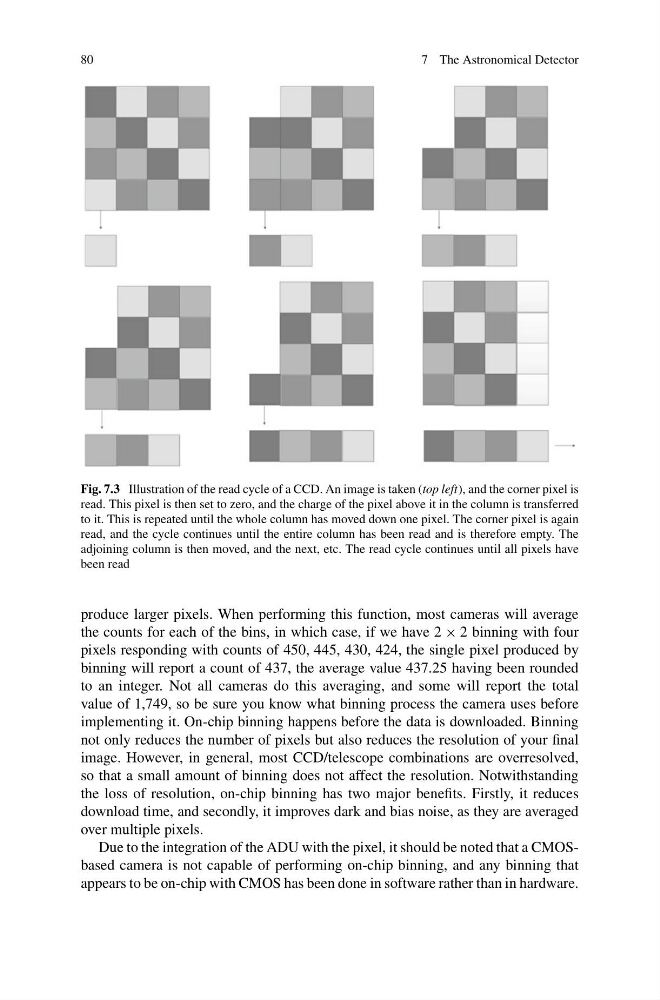
Fig. 7.3 Illustration of the read cycle of a CCD. An image is taken (top left), and the corner pixel is
read. This pixel is then set to zero, and the charge of the pixel above it in the column is transferred
to it. This is repeated until the whole column has moved down one pixel. The corner pixel is again
read, and the cycle continues until the entire column has been read and is therefore empty. The
adjoining column is then moved, and the next, etc. The read cycle continues until all pixels have
been read
produce larger pixels. When performing this function, most cameras will average
the counts for each of the bins, in which case, if we have 2 × 2 binning with four
pixels responding with counts of 450, 445, 430, 424, the single pixel produced by
binning will report a count of 437, the average value 437.25 having been rounded
to an integer. Not all cameras do this averaging, and some will report the total
value of 1,749, so be sure you know what binning process the camera uses before
implementing it. On-chip binning happens before the data is downloaded. Binning
not only reduces the number of pixels but also reduces the resolution of your final
image. However, in general, most CCD/telescope combinations are overresolved,
so that a small amount of binning does not affect the resolution. Notwithstanding
the loss of resolution, on-chip binning has two major benefits. Firstly, it reduces
download time, and secondly, it improves dark and bias noise, as they are averaged
over multiple pixels.
Due to the integration of the ADU with the pixel, it should be noted that a CMOSbased camera is not capable of performing on-chip binning, and any binning that
appears to be on-chip with CMOS has been done in software rather than in hardware.
7 The Astronomical Detector
Fig. 7.3 Illustration of the read cycle of a CCD. An image is taken (top left), and the corner pixel is
read. This pixel is then set to zero, and the charge of the pixel above it in the column is transferred
to it. This is repeated until the whole column has moved down one pixel. The corner pixel is again
read, and the cycle continues until the entire column has been read and is therefore empty. The
adjoining column is then moved, and the next, etc. The read cycle continues until all pixels have
been read
produce larger pixels. When performing this function, most cameras will average
the counts for each of the bins, in which case, if we have 2 × 2 binning with four
pixels responding with counts of 450, 445, 430, 424, the single pixel produced by
binning will report a count of 437, the average value 437.25 having been rounded
to an integer. Not all cameras do this averaging, and some will report the total
value of 1,749, so be sure you know what binning process the camera uses before
implementing it. On-chip binning happens before the data is downloaded. Binning
not only reduces the number of pixels but also reduces the resolution of your final
image. However, in general, most CCD/telescope combinations are overresolved,
so that a small amount of binning does not affect the resolution. Notwithstanding
the loss of resolution, on-chip binning has two major benefits. Firstly, it reduces
download time, and secondly, it improves dark and bias noise, as they are averaged
over multiple pixels.
Due to the integration of the ADU with the pixel, it should be noted that a CMOSbased camera is not capable of performing on-chip binning, and any binning that
appears to be on-chip with CMOS has been done in software rather than in hardware.