

78
7 The Astronomical Detector
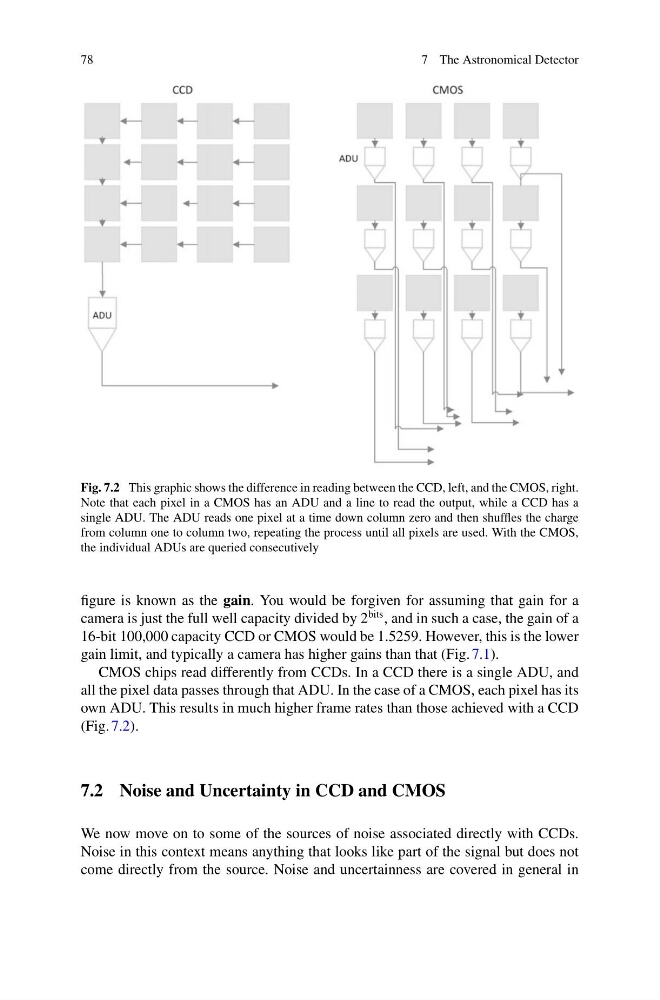
Fig. 7.2 This graphic shows the difference in reading between the CCD, left, and the CMOS, right.
Note that each pixel in a CMOS has an ADU and a line to read the output, while a CCD has a
single ADU. The ADU reads one pixel at a time down column zero and then shuffles the charge
from column one to column two, repeating the process until all pixels are used. With the CMOS,
the individual ADUs are queried consecutively
figure is known as the gain. You would be forgiven for assuming that gain for a
camera is just the full well capacity divided by 2
bits , and in such a case, the gain of a
16-bit 100,000 capacity CCD or CMOS would be 1.5259. However, this is the lower
gain limit, and typically a camera has higher gains than that (Fig. 7.1).
CMOS chips read differently from CCDs. In a CCD there is a single ADU, and
all the pixel data passes through that ADU. In the case of a CMOS, each pixel has its
own ADU. This results in much higher frame rates than those achieved with a CCD
(Fig. 7.2).
7.2 Noise and Uncertainty in CCD and CMOS
We now move on to some of the sources of noise associated directly with CCDs.
Noise in this context means anything that looks like part of the signal but does not
come directly from the source. Noise and uncertainness are covered in general in
7 The Astronomical Detector
Fig. 7.2 This graphic shows the difference in reading between the CCD, left, and the CMOS, right.
Note that each pixel in a CMOS has an ADU and a line to read the output, while a CCD has a
single ADU. The ADU reads one pixel at a time down column zero and then shuffles the charge
from column one to column two, repeating the process until all pixels are used. With the CMOS,
the individual ADUs are queried consecutively
figure is known as the gain. You would be forgiven for assuming that gain for a
camera is just the full well capacity divided by 2
bits , and in such a case, the gain of a
16-bit 100,000 capacity CCD or CMOS would be 1.5259. However, this is the lower
gain limit, and typically a camera has higher gains than that (Fig. 7.1).
CMOS chips read differently from CCDs. In a CCD there is a single ADU, and
all the pixel data passes through that ADU. In the case of a CMOS, each pixel has its
own ADU. This results in much higher frame rates than those achieved with a CCD
(Fig. 7.2).
7.2 Noise and Uncertainty in CCD and CMOS
We now move on to some of the sources of noise associated directly with CCDs.
Noise in this context means anything that looks like part of the signal but does not
come directly from the source. Noise and uncertainness are covered in general in