

58
5 Spheres and Coordinates
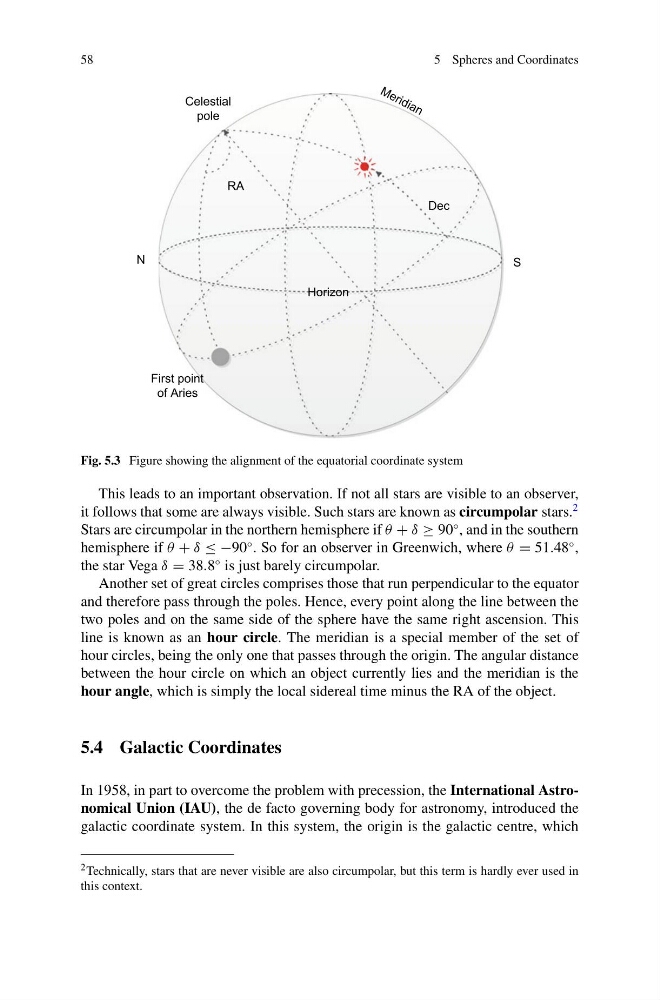
Fig. 5.3 Figure showing the alignment of the equatorial coordinate system
This leads to an important observation. If not all stars are visible to an observer,
it follows that some are always visible. Such stars are known as circumpolar stars.
2
Stars are circumpolar in the northern hemisphere if θ + δ ≥ 90
◦ , and in the southern
hemisphere if θ + δ ≤ −90
◦ . So for an observer in Greenwich, where θ = 51.48
◦ ,
the star Vega δ = 38.8
◦ is just barely circumpolar.
Another set of great circles comprises those that run perpendicular to the equator
and therefore pass through the poles. Hence, every point along the line between the
two poles and on the same side of the sphere have the same right ascension. This
line is known as an hour circle. The meridian is a special member of the set of
hour circles, being the only one that passes through the origin. The angular distance
between the hour circle on which an object currently lies and the meridian is the
hour angle, which is simply the local sidereal time minus the RA of the object.
5.4 Galactic Coordinates
In 1958, in part to overcome the problem with precession, the International Astronomical Union (IAU), the de facto governing body for astronomy, introduced the
galactic coordinate system. In this system, the origin is the galactic centre, which
2 Technically, stars that are never visible are also circumpolar, but this term is hardly ever used in
this context.
5 Spheres and Coordinates
Fig. 5.3 Figure showing the alignment of the equatorial coordinate system
This leads to an important observation. If not all stars are visible to an observer,
it follows that some are always visible. Such stars are known as circumpolar stars.
2
Stars are circumpolar in the northern hemisphere if θ + δ ≥ 90
◦ , and in the southern
hemisphere if θ + δ ≤ −90
◦ . So for an observer in Greenwich, where θ = 51.48
◦ ,
the star Vega δ = 38.8
◦ is just barely circumpolar.
Another set of great circles comprises those that run perpendicular to the equator
and therefore pass through the poles. Hence, every point along the line between the
two poles and on the same side of the sphere have the same right ascension. This
line is known as an hour circle. The meridian is a special member of the set of
hour circles, being the only one that passes through the origin. The angular distance
between the hour circle on which an object currently lies and the meridian is the
hour angle, which is simply the local sidereal time minus the RA of the object.
5.4 Galactic Coordinates
In 1958, in part to overcome the problem with precession, the International Astronomical Union (IAU), the de facto governing body for astronomy, introduced the
galactic coordinate system. In this system, the origin is the galactic centre, which
2 Technically, stars that are never visible are also circumpolar, but this term is hardly ever used in
this context.