

56
5 Spheres and Coordinates
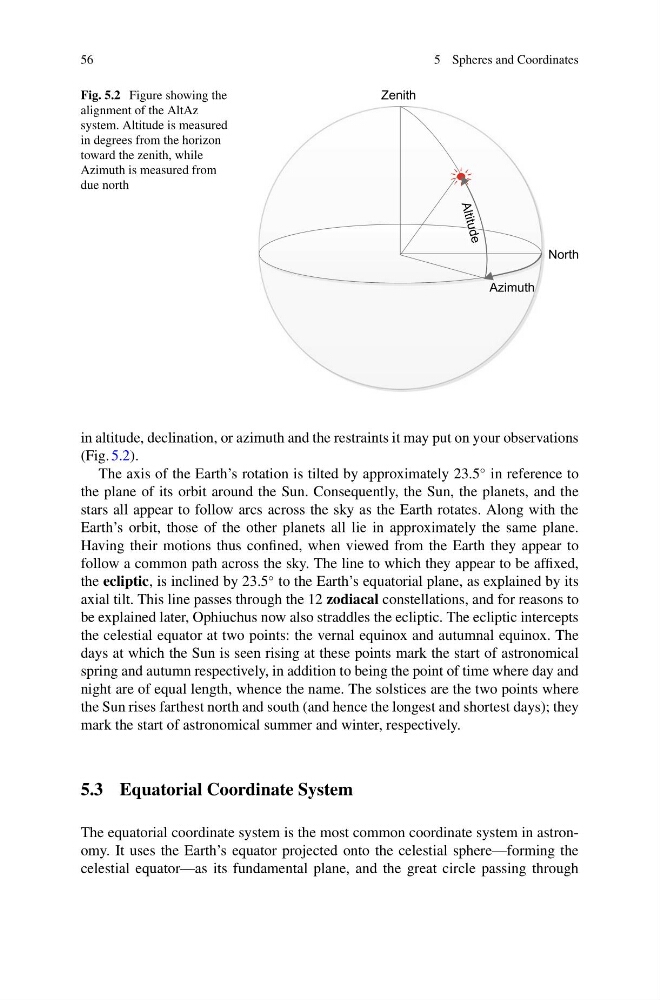
Fig. 5.2 Figure showing the
alignment of the AltAz
system. Altitude is measured
in degrees from the horizon
toward the zenith, while
Azimuth is measured from
due north
in altitude, declination, or azimuth and the restraints it may put on your observations
(Fig. 5.2).
The axis of the Earth’s rotation is tilted by approximately 23.5
◦ in reference to
the plane of its orbit around the Sun. Consequently, the Sun, the planets, and the
stars all appear to follow arcs across the sky as the Earth rotates. Along with the
Earth’s orbit, those of the other planets all lie in approximately the same plane.
Having their motions thus confined, when viewed from the Earth they appear to
follow a common path across the sky. The line to which they appear to be affixed,
the ecliptic, is inclined by 23.5
◦ to the Earth’s equatorial plane, as explained by its
axial tilt. This line passes through the 12 zodiacal constellations, and for reasons to
be explained later, Ophiuchus now also straddles the ecliptic. The ecliptic intercepts
the celestial equator at two points: the vernal equinox and autumnal equinox. The
days at which the Sun is seen rising at these points mark the start of astronomical
spring and autumn respectively, in addition to being the point of time where day and
night are of equal length, whence the name. The solstices are the two points where
the Sun rises farthest north and south (and hence the longest and shortest days); they
mark the start of astronomical summer and winter, respectively.
5.3 Equatorial Coordinate System
The equatorial coordinate system is the most common coordinate system in astronomy. It uses the Earth’s equator projected onto the celestial sphere—forming the
celestial equator—as its fundamental plane, and the great circle passing through
5 Spheres and Coordinates
Fig. 5.2 Figure showing the
alignment of the AltAz
system. Altitude is measured
in degrees from the horizon
toward the zenith, while
Azimuth is measured from
due north
in altitude, declination, or azimuth and the restraints it may put on your observations
(Fig. 5.2).
The axis of the Earth’s rotation is tilted by approximately 23.5
◦ in reference to
the plane of its orbit around the Sun. Consequently, the Sun, the planets, and the
stars all appear to follow arcs across the sky as the Earth rotates. Along with the
Earth’s orbit, those of the other planets all lie in approximately the same plane.
Having their motions thus confined, when viewed from the Earth they appear to
follow a common path across the sky. The line to which they appear to be affixed,
the ecliptic, is inclined by 23.5
◦ to the Earth’s equatorial plane, as explained by its
axial tilt. This line passes through the 12 zodiacal constellations, and for reasons to
be explained later, Ophiuchus now also straddles the ecliptic. The ecliptic intercepts
the celestial equator at two points: the vernal equinox and autumnal equinox. The
days at which the Sun is seen rising at these points mark the start of astronomical
spring and autumn respectively, in addition to being the point of time where day and
night are of equal length, whence the name. The solstices are the two points where
the Sun rises farthest north and south (and hence the longest and shortest days); they
mark the start of astronomical summer and winter, respectively.
5.3 Equatorial Coordinate System
The equatorial coordinate system is the most common coordinate system in astronomy. It uses the Earth’s equator projected onto the celestial sphere—forming the
celestial equator—as its fundamental plane, and the great circle passing through