

14
2 The Nature of Light
The instrumental flux is specific to a given instrument and its setup, since it
depends on exposure times, aperture sizes, and the optics being used. In order to turn
an instrumental flux back into a physical one, corrections have to be made for all
of these factors and also for the relevant atmospheric parameters under which the
observation occurred. We will return to this in the chapter on photometry.
2.4 The Magnitude Scale
Instruments typically return their raw observational results in the form of counts per
second—that is, the total number of photon strikes on the receiving area divided by
the time taken for the observation. (There are some exceptions—radio astronomy
uses a non-SI unit called the Jansky, which we will discuss later.) However, in the
vast majority of cases, you will be using so-called magnitudes. The magnitude scale
is a logarithmic one that has been in use since antiquity.
In the nineteenth century, the magnitude system was quantified and put onto a
rigorous, empirical footing. It was discovered that the scale is actually logarithmic,
and the scale was calibrated so that a difference of five magnitudes is equivalent to a
difference of one hundred in the intensity of flux. Perhaps surprisingly, it turned out
that for most stars, Hipparchus’s assessments were actually roughly correct.
We now know that Hipparchus’s system was actually a bit off. The brightest star
in the night sky, Sirius, has a magnitude of −1.46, and 15 other stars are brighter than
magnitude 1. Also, the modern system has been extended to include the Sun and the
planets. Venus can attain a magnitude of −4.5, the full Moon is around magnitude
−13, and the Sun is around −26.7. Given that Hipparchus was working without
telescopes or modern equipment, and, in fact, lived before the concept of negative
numbers had been developed, we can probably forgive him for missing some details.
As to the logarithmic nature of the system, the most likely explanation for this
is that the human eye scales its perceived response to incident light logarithmically
rather than linearly. Certainly, the eye can perceive enormously different levels of
illumination without returning a sense of difference as great as that which quantitative
methods show us are there. However, the whole relationship between physical stimulus and subjective perception remains one of active research in human physiology
and psychology.
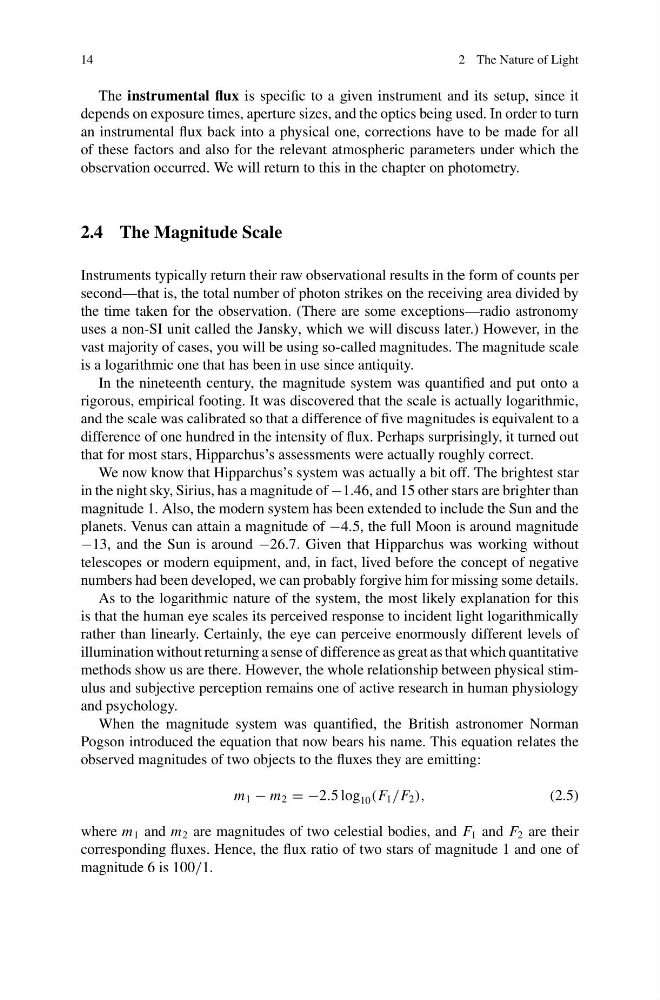
When the magnitude system was quantified, the British astronomer Norman
Pogson introduced the equation that now bears his name. This equation relates the
observed magnitudes of two objects to the fluxes they are emitting:
m 1 − m 2 = −2.5 log 10 (F 1 /F 2 ),
(2.5)
where m 1 and m 2 are magnitudes of two celestial bodies, and F 1 and F 2 are their
corresponding fluxes. Hence, the flux ratio of two stars of magnitude 1 and one of
magnitude 6 is 100/1.
2 The Nature of Light
The instrumental flux is specific to a given instrument and its setup, since it
depends on exposure times, aperture sizes, and the optics being used. In order to turn
an instrumental flux back into a physical one, corrections have to be made for all
of these factors and also for the relevant atmospheric parameters under which the
observation occurred. We will return to this in the chapter on photometry.
2.4 The Magnitude Scale
Instruments typically return their raw observational results in the form of counts per
second—that is, the total number of photon strikes on the receiving area divided by
the time taken for the observation. (There are some exceptions—radio astronomy
uses a non-SI unit called the Jansky, which we will discuss later.) However, in the
vast majority of cases, you will be using so-called magnitudes. The magnitude scale
is a logarithmic one that has been in use since antiquity.
In the nineteenth century, the magnitude system was quantified and put onto a
rigorous, empirical footing. It was discovered that the scale is actually logarithmic,
and the scale was calibrated so that a difference of five magnitudes is equivalent to a
difference of one hundred in the intensity of flux. Perhaps surprisingly, it turned out
that for most stars, Hipparchus’s assessments were actually roughly correct.
We now know that Hipparchus’s system was actually a bit off. The brightest star
in the night sky, Sirius, has a magnitude of −1.46, and 15 other stars are brighter than
magnitude 1. Also, the modern system has been extended to include the Sun and the
planets. Venus can attain a magnitude of −4.5, the full Moon is around magnitude
−13, and the Sun is around −26.7. Given that Hipparchus was working without
telescopes or modern equipment, and, in fact, lived before the concept of negative
numbers had been developed, we can probably forgive him for missing some details.
As to the logarithmic nature of the system, the most likely explanation for this
is that the human eye scales its perceived response to incident light logarithmically
rather than linearly. Certainly, the eye can perceive enormously different levels of
illumination without returning a sense of difference as great as that which quantitative
methods show us are there. However, the whole relationship between physical stimulus and subjective perception remains one of active research in human physiology
and psychology.
When the magnitude system was quantified, the British astronomer Norman
Pogson introduced the equation that now bears his name. This equation relates the
observed magnitudes of two objects to the fluxes they are emitting:
m 1 − m 2 = −2.5 log 10 (F 1 /F 2 ),
(2.5)
where m 1 and m 2 are magnitudes of two celestial bodies, and F 1 and F 2 are their
corresponding fluxes. Hence, the flux ratio of two stars of magnitude 1 and one of
magnitude 6 is 100/1.