

216
15 Radio Astronomy
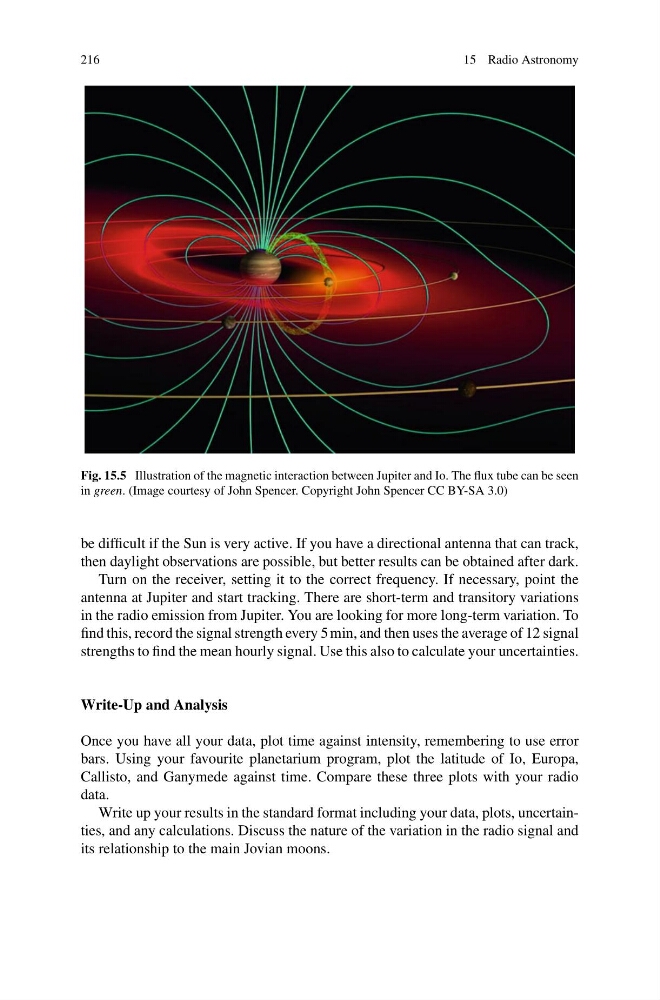
Fig. 15.5 Illustration of the magnetic interaction between Jupiter and Io. The flux tube can be seen
in green. (Image courtesy of John Spencer. Copyright John Spencer CC BY-SA 3.0)
be difficult if the Sun is very active. If you have a directional antenna that can track,
then daylight observations are possible, but better results can be obtained after dark.
Turn on the receiver, setting it to the correct frequency. If necessary, point the
antenna at Jupiter and start tracking. There are short-term and transitory variations
in the radio emission from Jupiter. You are looking for more long-term variation. To
find this, record the signal strength every 5 min, and then uses the average of 12 signal
strengths to find the mean hourly signal. Use this also to calculate your uncertainties.
Write-Up and Analysis
Once you have all your data, plot time against intensity, remembering to use error
bars. Using your favourite planetarium program, plot the latitude of Io, Europa,
Callisto, and Ganymede against time. Compare these three plots with your radio
data.
Write up your results in the standard format including your data, plots, uncertainties, and any calculations. Discuss the nature of the variation in the radio signal and
its relationship to the main Jovian moons.
15 Radio Astronomy
Fig. 15.5 Illustration of the magnetic interaction between Jupiter and Io. The flux tube can be seen
in green. (Image courtesy of John Spencer. Copyright John Spencer CC BY-SA 3.0)
be difficult if the Sun is very active. If you have a directional antenna that can track,
then daylight observations are possible, but better results can be obtained after dark.
Turn on the receiver, setting it to the correct frequency. If necessary, point the
antenna at Jupiter and start tracking. There are short-term and transitory variations
in the radio emission from Jupiter. You are looking for more long-term variation. To
find this, record the signal strength every 5 min, and then uses the average of 12 signal
strengths to find the mean hourly signal. Use this also to calculate your uncertainties.
Write-Up and Analysis
Once you have all your data, plot time against intensity, remembering to use error
bars. Using your favourite planetarium program, plot the latitude of Io, Europa,
Callisto, and Ganymede against time. Compare these three plots with your radio
data.
Write up your results in the standard format including your data, plots, uncertainties, and any calculations. Discuss the nature of the variation in the radio signal and
its relationship to the main Jovian moons.