

212
15 Radio Astronomy
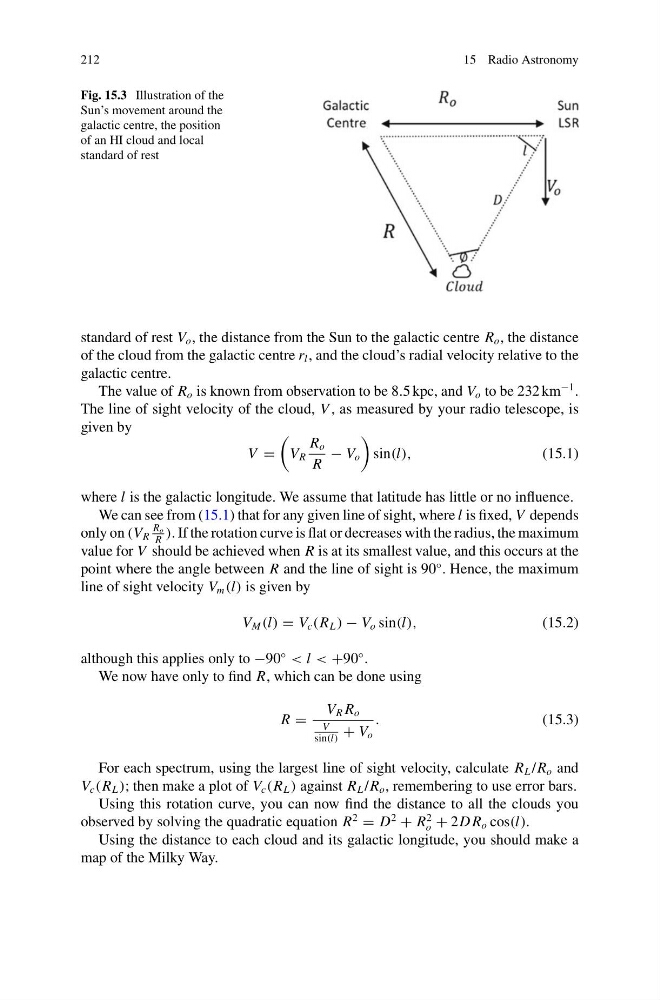
Fig. 15.3 Illustration of the
Sun’s movement around the
galactic centre, the position
of an HI cloud and local
standard of rest
standard of rest V o , the distance from the Sun to the galactic centre R o , the distance
of the cloud from the galactic centre r l , and the cloud’s radial velocity relative to the
galactic centre.
The value of R o is known from observation to be 8.5 kpc, and V o to be 232 km
−1 .
The line of sight velocity of the cloud, V , as measured by your radio telescope, is
given by
V =
V R
R o
R
− V o
sin(l),
(15.1)
where l is the galactic longitude. We assume that latitude has little or no influence.
We can see from (15.1) that for any given line of sight, where l is fixed, V depends
only on (V R
R o
R
). If the rotation curve is flat or decreases with the radius, the maximum
value for V should be achieved when R is at its smallest value, and this occurs at the
point where the angle between R and the line of sight is 90
◦ . Hence, the maximum
line of sight velocity V m (l) is given by
V M (l) = V c (R L ) − V o sin(l),
(15.2)
although this applies only to −90
◦
< l < +90
◦ .
We now have only to find R, which can be done using
R =
V R R o
V
sin(l)
+ V o
.
(15.3)
For each spectrum, using the largest line of sight velocity, calculate R L /R o and
V c (R L ); then make a plot of V c (R L ) against R L /R o , remembering to use error bars.
Using this rotation curve, you can now find the distance to all the clouds you
observed by solving the quadratic equation R
2
= D
2
+ R
2
o + 2D R o cos(l).
Using the distance to each cloud and its galactic longitude, you should make a
map of the Milky Way.
15 Radio Astronomy
Fig. 15.3 Illustration of the
Sun’s movement around the
galactic centre, the position
of an HI cloud and local
standard of rest
standard of rest V o , the distance from the Sun to the galactic centre R o , the distance
of the cloud from the galactic centre r l , and the cloud’s radial velocity relative to the
galactic centre.
The value of R o is known from observation to be 8.5 kpc, and V o to be 232 km
−1 .
The line of sight velocity of the cloud, V , as measured by your radio telescope, is
given by
V =
V R
R o
R
− V o
sin(l),
(15.1)
where l is the galactic longitude. We assume that latitude has little or no influence.
We can see from (15.1) that for any given line of sight, where l is fixed, V depends
only on (V R
R o
R
). If the rotation curve is flat or decreases with the radius, the maximum
value for V should be achieved when R is at its smallest value, and this occurs at the
point where the angle between R and the line of sight is 90
◦ . Hence, the maximum
line of sight velocity V m (l) is given by
V M (l) = V c (R L ) − V o sin(l),
(15.2)
although this applies only to −90
◦
< l < +90
◦ .
We now have only to find R, which can be done using
R =
V R R o
V
sin(l)
+ V o
.
(15.3)
For each spectrum, using the largest line of sight velocity, calculate R L /R o and
V c (R L ); then make a plot of V c (R L ) against R L /R o , remembering to use error bars.
Using this rotation curve, you can now find the distance to all the clouds you
observed by solving the quadratic equation R
2
= D
2
+ R
2
o + 2D R o cos(l).
Using the distance to each cloud and its galactic longitude, you should make a
map of the Milky Way.