

194
13 Solar Astronomy
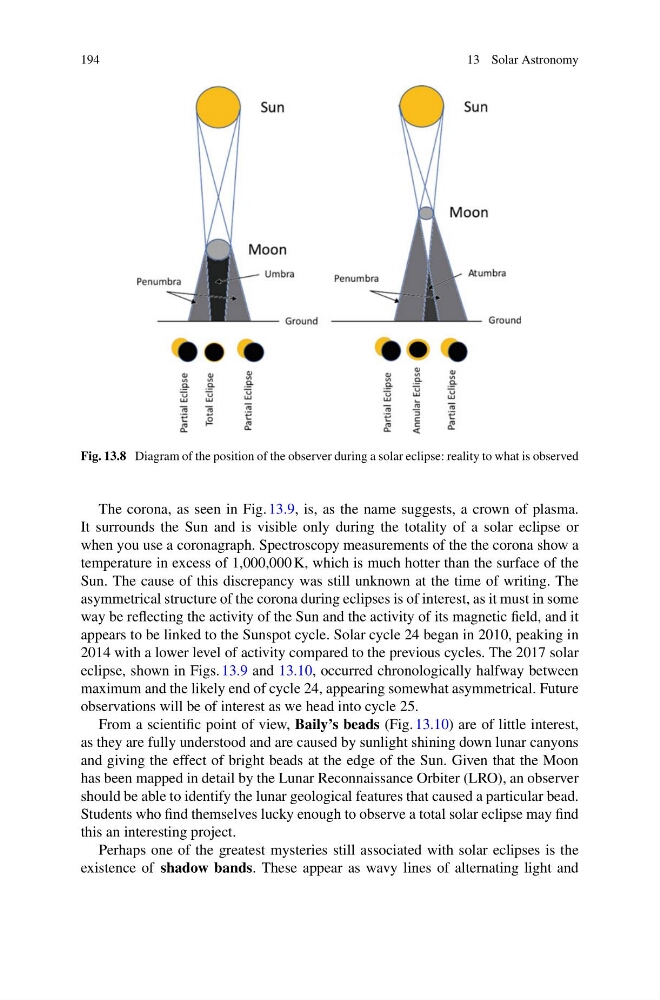
Fig. 13.8 Diagram of the position of the observer during a solar eclipse: reality to what is observed
The corona, as seen in Fig. 13.9, is, as the name suggests, a crown of plasma.
It surrounds the Sun and is visible only during the totality of a solar eclipse or
when you use a coronagraph. Spectroscopy measurements of the the corona show a
temperature in excess of 1,000,000 K, which is much hotter than the surface of the
Sun. The cause of this discrepancy was still unknown at the time of writing. The
asymmetrical structure of the corona during eclipses is of interest, as it must in some
way be reflecting the activity of the Sun and the activity of its magnetic field, and it
appears to be linked to the Sunspot cycle. Solar cycle 24 began in 2010, peaking in
2014 with a lower level of activity compared to the previous cycles. The 2017 solar
eclipse, shown in Figs. 13.9 and 13.10, occurred chronologically halfway between
maximum and the likely end of cycle 24, appearing somewhat asymmetrical. Future
observations will be of interest as we head into cycle 25.
From a scientific point of view, Baily’s beads (Fig. 13.10) are of little interest,
as they are fully understood and are caused by sunlight shining down lunar canyons
and giving the effect of bright beads at the edge of the Sun. Given that the Moon
has been mapped in detail by the Lunar Reconnaissance Orbiter (LRO), an observer
should be able to identify the lunar geological features that caused a particular bead.
Students who find themselves lucky enough to observe a total solar eclipse may find
this an interesting project.
Perhaps one of the greatest mysteries still associated with solar eclipses is the
existence of shadow bands. These appear as wavy lines of alternating light and
13 Solar Astronomy
Fig. 13.8 Diagram of the position of the observer during a solar eclipse: reality to what is observed
The corona, as seen in Fig. 13.9, is, as the name suggests, a crown of plasma.
It surrounds the Sun and is visible only during the totality of a solar eclipse or
when you use a coronagraph. Spectroscopy measurements of the the corona show a
temperature in excess of 1,000,000 K, which is much hotter than the surface of the
Sun. The cause of this discrepancy was still unknown at the time of writing. The
asymmetrical structure of the corona during eclipses is of interest, as it must in some
way be reflecting the activity of the Sun and the activity of its magnetic field, and it
appears to be linked to the Sunspot cycle. Solar cycle 24 began in 2010, peaking in
2014 with a lower level of activity compared to the previous cycles. The 2017 solar
eclipse, shown in Figs. 13.9 and 13.10, occurred chronologically halfway between
maximum and the likely end of cycle 24, appearing somewhat asymmetrical. Future
observations will be of interest as we head into cycle 25.
From a scientific point of view, Baily’s beads (Fig. 13.10) are of little interest,
as they are fully understood and are caused by sunlight shining down lunar canyons
and giving the effect of bright beads at the edge of the Sun. Given that the Moon
has been mapped in detail by the Lunar Reconnaissance Orbiter (LRO), an observer
should be able to identify the lunar geological features that caused a particular bead.
Students who find themselves lucky enough to observe a total solar eclipse may find
this an interesting project.
Perhaps one of the greatest mysteries still associated with solar eclipses is the
existence of shadow bands. These appear as wavy lines of alternating light and