

13.2 Solar Features
185
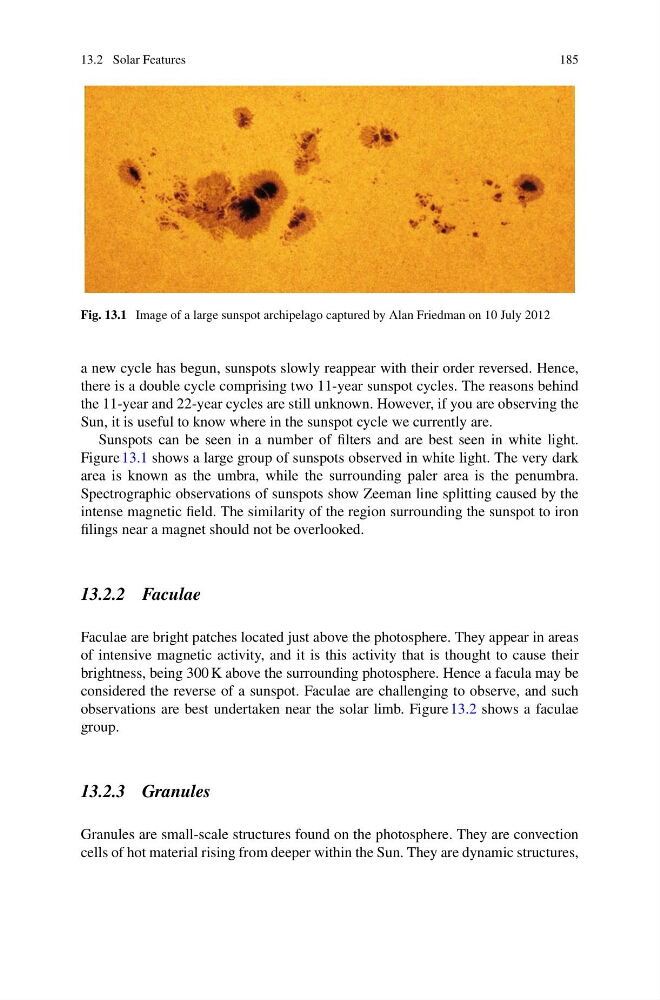
Fig. 13.1 Image of a large sunspot archipelago captured by Alan Friedman on 10 July 2012
a new cycle has begun, sunspots slowly reappear with their order reversed. Hence,
there is a double cycle comprising two 11-year sunspot cycles. The reasons behind
the 11-year and 22-year cycles are still unknown. However, if you are observing the
Sun, it is useful to know where in the sunspot cycle we currently are.
Sunspots can be seen in a number of filters and are best seen in white light.
Figure 13.1 shows a large group of sunspots observed in white light. The very dark
area is known as the umbra, while the surrounding paler area is the penumbra.
Spectrographic observations of sunspots show Zeeman line splitting caused by the
intense magnetic field. The similarity of the region surrounding the sunspot to iron
filings near a magnet should not be overlooked.
13.2.2 Faculae
Faculae are bright patches located just above the photosphere. They appear in areas
of intensive magnetic activity, and it is this activity that is thought to cause their
brightness, being 300 K above the surrounding photosphere. Hence a facula may be
considered the reverse of a sunspot. Faculae are challenging to observe, and such
observations are best undertaken near the solar limb. Figure 13.2 shows a faculae
group.
13.2.3 Granules
Granules are small-scale structures found on the photosphere. They are convection
cells of hot material rising from deeper within the Sun. They are dynamic structures,
185
Fig. 13.1 Image of a large sunspot archipelago captured by Alan Friedman on 10 July 2012
a new cycle has begun, sunspots slowly reappear with their order reversed. Hence,
there is a double cycle comprising two 11-year sunspot cycles. The reasons behind
the 11-year and 22-year cycles are still unknown. However, if you are observing the
Sun, it is useful to know where in the sunspot cycle we currently are.
Sunspots can be seen in a number of filters and are best seen in white light.
Figure 13.1 shows a large group of sunspots observed in white light. The very dark
area is known as the umbra, while the surrounding paler area is the penumbra.
Spectrographic observations of sunspots show Zeeman line splitting caused by the
intense magnetic field. The similarity of the region surrounding the sunspot to iron
filings near a magnet should not be overlooked.
13.2.2 Faculae
Faculae are bright patches located just above the photosphere. They appear in areas
of intensive magnetic activity, and it is this activity that is thought to cause their
brightness, being 300 K above the surrounding photosphere. Hence a facula may be
considered the reverse of a sunspot. Faculae are challenging to observe, and such
observations are best undertaken near the solar limb. Figure 13.2 shows a faculae
group.
13.2.3 Granules
Granules are small-scale structures found on the photosphere. They are convection
cells of hot material rising from deeper within the Sun. They are dynamic structures,