

12.3 Bias and Dark Noise
173
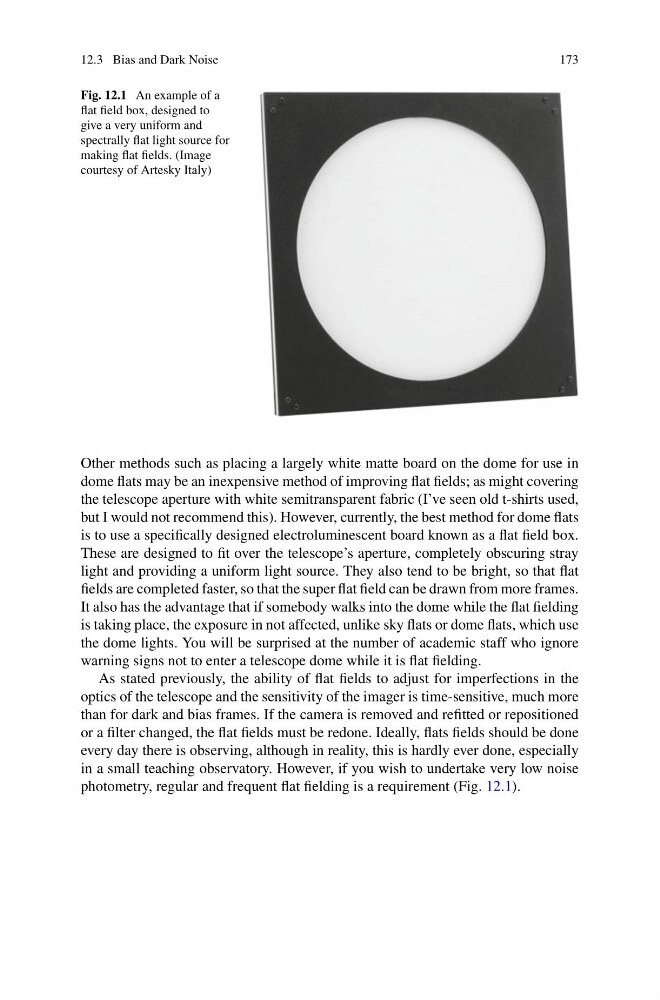
Fig. 12.1 An example of a
flat field box, designed to
give a very uniform and
spectrally flat light source for
making flat fields. (Image
courtesy of Artesky Italy)
Other methods such as placing a largely white matte board on the dome for use in
dome flats may be an inexpensive method of improving flat fields; as might covering
the telescope aperture with white semitransparent fabric (I’ve seen old t-shirts used,
but I would not recommend this). However, currently, the best method for dome flats
is to use a specifically designed electroluminescent board known as a flat field box.
These are designed to fit over the telescope’s aperture, completely obscuring stray
light and providing a uniform light source. They also tend to be bright, so that flat
fields are completed faster, so that the super flat field can be drawn from more frames.
It also has the advantage that if somebody walks into the dome while the flat fielding
is taking place, the exposure in not affected, unlike sky flats or dome flats, which use
the dome lights. You will be surprised at the number of academic staff who ignore
warning signs not to enter a telescope dome while it is flat fielding.
As stated previously, the ability of flat fields to adjust for imperfections in the
optics of the telescope and the sensitivity of the imager is time-sensitive, much more
than for dark and bias frames. If the camera is removed and refitted or repositioned
or a filter changed, the flat fields must be redone. Ideally, flats fields should be done
every day there is observing, although in reality, this is hardly ever done, especially
in a small teaching observatory. However, if you wish to undertake very low noise
photometry, regular and frequent flat fielding is a requirement (Fig. 12.1).
173
Fig. 12.1 An example of a
flat field box, designed to
give a very uniform and
spectrally flat light source for
making flat fields. (Image
courtesy of Artesky Italy)
Other methods such as placing a largely white matte board on the dome for use in
dome flats may be an inexpensive method of improving flat fields; as might covering
the telescope aperture with white semitransparent fabric (I’ve seen old t-shirts used,
but I would not recommend this). However, currently, the best method for dome flats
is to use a specifically designed electroluminescent board known as a flat field box.
These are designed to fit over the telescope’s aperture, completely obscuring stray
light and providing a uniform light source. They also tend to be bright, so that flat
fields are completed faster, so that the super flat field can be drawn from more frames.
It also has the advantage that if somebody walks into the dome while the flat fielding
is taking place, the exposure in not affected, unlike sky flats or dome flats, which use
the dome lights. You will be surprised at the number of academic staff who ignore
warning signs not to enter a telescope dome while it is flat fielding.
As stated previously, the ability of flat fields to adjust for imperfections in the
optics of the telescope and the sensitivity of the imager is time-sensitive, much more
than for dark and bias frames. If the camera is removed and refitted or repositioned
or a filter changed, the flat fields must be redone. Ideally, flats fields should be done
every day there is observing, although in reality, this is hardly ever done, especially
in a small teaching observatory. However, if you wish to undertake very low noise
photometry, regular and frequent flat fielding is a requirement (Fig. 12.1).