

166
11 Errors
that pixel includes light from the source and sky lines—which are not uniform. The
subtraction of the sky during the reduction process should remove most of this noise,
leaving just the shot noise. Binning can help to improve the signal-to-noise ratio. By
joining adjacent pixels, we increase the signal while, we hope, averaging out the noise
to some degree, as the error scales with
1
√
N
. However, as the signal intensity varies
across the spectrum, so does the signal-to-noise ratio. Therefore, the signal-to-noise
ratio of the spectrum is the mean pixel signal-to-noise ratio.
11.3.3 Working Out the Error Value
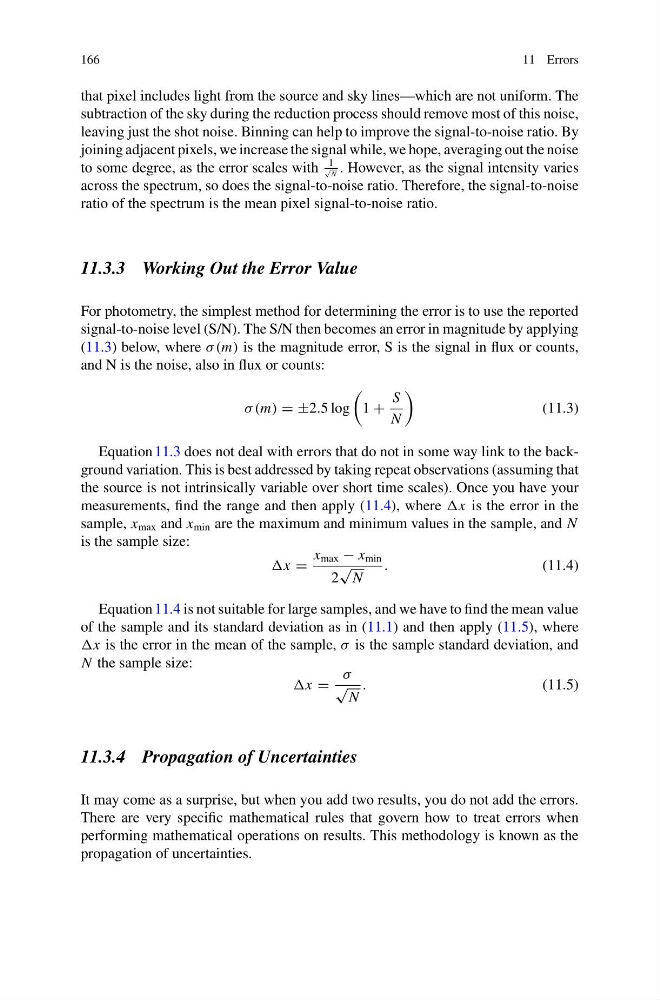
For photometry, the simplest method for determining the error is to use the reported
signal-to-noise level (S/N). The S/N then becomes an error in magnitude by applying
(11.3) below, where σ (m) is the magnitude error, S is the signal in flux or counts,
and N is the noise, also in flux or counts:
σ (m) = ±2.5 log
1 +
S
N
(11.3)
Equation 11.3 does not deal with errors that do not in some way link to the background variation. This is best addressed by taking repeat observations (assuming that
the source is not intrinsically variable over short time scales). Once you have your
measurements, find the range and then apply (11.4), where x is the error in the
sample, x max and x min are the maximum and minimum values in the sample, and N
is the sample size:
x =
x max − x min
2
√
N
.
(11.4)
Equation 11.4 is not suitable for large samples, and we have to find the mean value
of the sample and its standard deviation as in (11.1) and then apply (11.5), where
x is the error in the mean of the sample, σ is the sample standard deviation, and
N the sample size:
x =
σ
√
N
.
(11.5)
11.3.4 Propagation of Uncertainties
It may come as a surprise, but when you add two results, you do not add the errors.
There are very specific mathematical rules that govern how to treat errors when
performing mathematical operations on results. This methodology is known as the
propagation of uncertainties.
11 Errors
that pixel includes light from the source and sky lines—which are not uniform. The
subtraction of the sky during the reduction process should remove most of this noise,
leaving just the shot noise. Binning can help to improve the signal-to-noise ratio. By
joining adjacent pixels, we increase the signal while, we hope, averaging out the noise
to some degree, as the error scales with
1
√
N
. However, as the signal intensity varies
across the spectrum, so does the signal-to-noise ratio. Therefore, the signal-to-noise
ratio of the spectrum is the mean pixel signal-to-noise ratio.
11.3.3 Working Out the Error Value
For photometry, the simplest method for determining the error is to use the reported
signal-to-noise level (S/N). The S/N then becomes an error in magnitude by applying
(11.3) below, where σ (m) is the magnitude error, S is the signal in flux or counts,
and N is the noise, also in flux or counts:
σ (m) = ±2.5 log
1 +
S
N
(11.3)
Equation 11.3 does not deal with errors that do not in some way link to the background variation. This is best addressed by taking repeat observations (assuming that
the source is not intrinsically variable over short time scales). Once you have your
measurements, find the range and then apply (11.4), where x is the error in the
sample, x max and x min are the maximum and minimum values in the sample, and N
is the sample size:
x =
x max − x min
2
√
N
.
(11.4)
Equation 11.4 is not suitable for large samples, and we have to find the mean value
of the sample and its standard deviation as in (11.1) and then apply (11.5), where
x is the error in the mean of the sample, σ is the sample standard deviation, and
N the sample size:
x =
σ
√
N
.
(11.5)
11.3.4 Propagation of Uncertainties
It may come as a surprise, but when you add two results, you do not add the errors.
There are very specific mathematical rules that govern how to treat errors when
performing mathematical operations on results. This methodology is known as the
propagation of uncertainties.