

122
8 Imaging
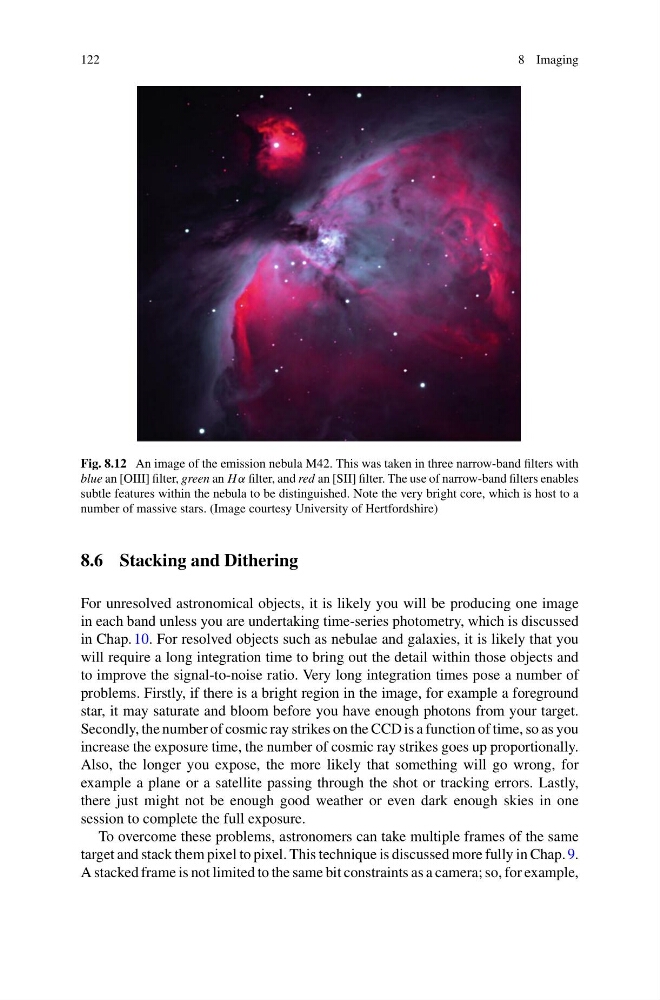
Fig. 8.12 An image of the emission nebula M42. This was taken in three narrow-band filters with
blue an [OIII] filter, green an H α filter, and red an [SII] filter. The use of narrow-band filters enables
subtle features within the nebula to be distinguished. Note the very bright core, which is host to a
number of massive stars. (Image courtesy University of Hertfordshire)
8.6 Stacking and Dithering
For unresolved astronomical objects, it is likely you will be producing one image
in each band unless you are undertaking time-series photometry, which is discussed
in Chap. 10. For resolved objects such as nebulae and galaxies, it is likely that you
will require a long integration time to bring out the detail within those objects and
to improve the signal-to-noise ratio. Very long integration times pose a number of
problems. Firstly, if there is a bright region in the image, for example a foreground
star, it may saturate and bloom before you have enough photons from your target.
Secondly, the number of cosmic ray strikes on the CCD is a function of time, so as you
increase the exposure time, the number of cosmic ray strikes goes up proportionally.
Also, the longer you expose, the more likely that something will go wrong, for
example a plane or a satellite passing through the shot or tracking errors. Lastly,
there just might not be enough good weather or even dark enough skies in one
session to complete the full exposure.
To overcome these problems, astronomers can take multiple frames of the same
target and stack them pixel to pixel. This technique is discussed more fully in Chap. 9.
A stacked frame is not limited to the same bit constraints as a camera; so, for example,
8 Imaging
Fig. 8.12 An image of the emission nebula M42. This was taken in three narrow-band filters with
blue an [OIII] filter, green an H α filter, and red an [SII] filter. The use of narrow-band filters enables
subtle features within the nebula to be distinguished. Note the very bright core, which is host to a
number of massive stars. (Image courtesy University of Hertfordshire)
8.6 Stacking and Dithering
For unresolved astronomical objects, it is likely you will be producing one image
in each band unless you are undertaking time-series photometry, which is discussed
in Chap. 10. For resolved objects such as nebulae and galaxies, it is likely that you
will require a long integration time to bring out the detail within those objects and
to improve the signal-to-noise ratio. Very long integration times pose a number of
problems. Firstly, if there is a bright region in the image, for example a foreground
star, it may saturate and bloom before you have enough photons from your target.
Secondly, the number of cosmic ray strikes on the CCD is a function of time, so as you
increase the exposure time, the number of cosmic ray strikes goes up proportionally.
Also, the longer you expose, the more likely that something will go wrong, for
example a plane or a satellite passing through the shot or tracking errors. Lastly,
there just might not be enough good weather or even dark enough skies in one
session to complete the full exposure.
To overcome these problems, astronomers can take multiple frames of the same
target and stack them pixel to pixel. This technique is discussed more fully in Chap. 9.
A stacked frame is not limited to the same bit constraints as a camera; so, for example,