

120
8 Imaging
8.5.3 Imaging Galaxies
In many ways, the challenges of imaging globular clusters apply to galaxies. Spiral
galaxies have bright cores comprising a dense congregation of old stars surrounded
by a thin disk of stars and gas with the spiral structure being delineated by the regions
where stars are forming. Elliptical Galaxies are no longer star-forming (or are doing
so at a very low rate) and have become virialised. In essence, this means that the
kinetic energy of the stars within the galaxy has become evenly distributed. There is
no disk, as with a spiral galaxy, just a dense ellipse of stars. Imaging elliptical galaxies
is just a matter of trying to keep the galaxy in the linear region of the CCD. Remember
that the most quoted magnitudes for galaxies are the integrated magnitude and not the
surface brightness, it is the former you need to use to determine the exposure time.
Spiral galaxies can have a considerable structure which is often very faint. This leads
to a dichotomy, as the nucleus is very bright necessitating a short exposure, whilst
the arms and dust lanes are faint and require a long exposure. In general, it is better to
stay within the linear range of the CCD but take multiple images and mathematically
manipulate them to bring out the structure. As spiral galaxies are star-forming they
can produce a considerable amount of H α emission which is limited to the location
of the star formation, i.e. in the arms. Hence, the arms tend to be brighter in H α than
the nucleus. The inclusion, thereto, of an H α filter when imaging can help delineate
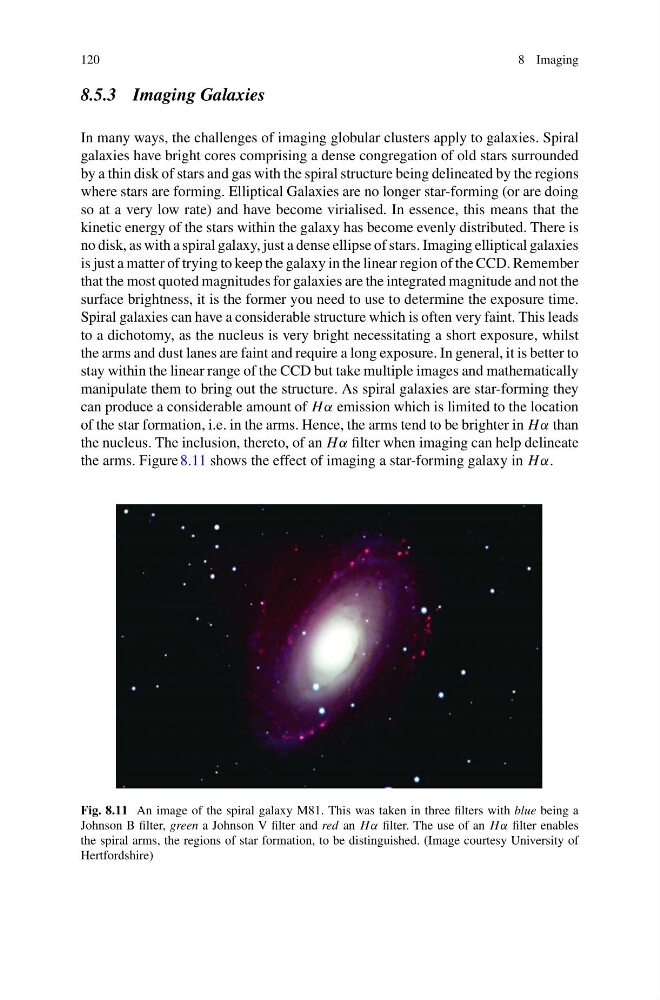
the arms. Figure 8.11 shows the effect of imaging a star-forming galaxy in H α.
Fig. 8.11 An image of the spiral galaxy M81. This was taken in three filters with blue being a
Johnson B filter, green a Johnson V filter and red an H α filter. The use of an H α filter enables
the spiral arms, the regions of star formation, to be distinguished. (Image courtesy University of
Hertfordshire)
8 Imaging
8.5.3 Imaging Galaxies
In many ways, the challenges of imaging globular clusters apply to galaxies. Spiral
galaxies have bright cores comprising a dense congregation of old stars surrounded
by a thin disk of stars and gas with the spiral structure being delineated by the regions
where stars are forming. Elliptical Galaxies are no longer star-forming (or are doing
so at a very low rate) and have become virialised. In essence, this means that the
kinetic energy of the stars within the galaxy has become evenly distributed. There is
no disk, as with a spiral galaxy, just a dense ellipse of stars. Imaging elliptical galaxies
is just a matter of trying to keep the galaxy in the linear region of the CCD. Remember
that the most quoted magnitudes for galaxies are the integrated magnitude and not the
surface brightness, it is the former you need to use to determine the exposure time.
Spiral galaxies can have a considerable structure which is often very faint. This leads
to a dichotomy, as the nucleus is very bright necessitating a short exposure, whilst
the arms and dust lanes are faint and require a long exposure. In general, it is better to
stay within the linear range of the CCD but take multiple images and mathematically
manipulate them to bring out the structure. As spiral galaxies are star-forming they
can produce a considerable amount of H α emission which is limited to the location
of the star formation, i.e. in the arms. Hence, the arms tend to be brighter in H α than
the nucleus. The inclusion, thereto, of an H α filter when imaging can help delineate
the arms. Figure 8.11 shows the effect of imaging a star-forming galaxy in H α.
Fig. 8.11 An image of the spiral galaxy M81. This was taken in three filters with blue being a
Johnson B filter, green a Johnson V filter and red an H α filter. The use of an H α filter enables
the spiral arms, the regions of star formation, to be distinguished. (Image courtesy University of
Hertfordshire)