

64
3 Analysis of Strain
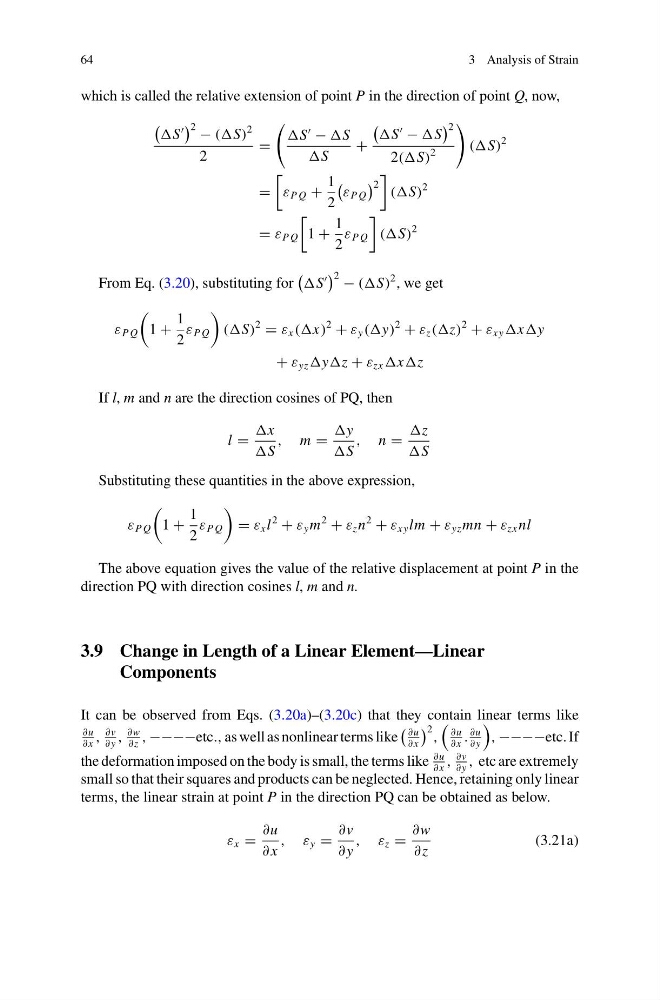
which is called the relative extension of point P in the direction of point Q, now,
S
2 − (S)
2
2
=
S
− S
S
+
S
− S
2
2(S)
2
(S)
2
=
ε P Q +
1
2
ε P Q
2
(S)
2
= ε P Q
1 +
1
2
ε P Q
(S)
2
From Eq. (3.20), substituting for
S
2 − (S)
2 , we get
ε P Q
1 +
1
2
ε P Q
(S)
2
= ε x (x)
2
+ ε y (y)
2
+ ε z (z)
2
+ ε xy xy
+ ε yz yz + ε zx xz
If l, m and n are the direction cosines of PQ, then
l =
x
S
, m =
y
S
, n =
z
S
Substituting these quantities in the above expression,
ε P Q
1 +
1
2
ε P Q
= ε x l
2
+ ε y m
2
+ ε z n
2
+ ε xy lm + ε yz mn + ε zx nl
The above equation gives the value of the relative displacement at point P in the
direction PQ with direction cosines l, m and n.
3.9 Change in Length of a Linear Element—Linear
Components
It can be observed from Eqs. (3.20a)–(3.20c) that they contain linear terms like
∂u
∂ x
,
∂v
∂ y
,
∂w
∂z
, −−−−etc., as well as nonlinear terms like
∂u
∂ x
2 ,
∂u
∂ x
.
∂u
∂ y
, −−−−etc. If
the deformation imposed on the body is small, the terms like
∂u
∂ x
,
∂v
∂ y
, etc are extremely
small so that their squares and products can be neglected. Hence, retaining only linear
terms, the linear strain at point P in the direction PQ can be obtained as below.
ε x =
∂u
∂ x
, ε y =
∂v
∂ y
, ε z =
∂w
∂z
(3.21a)
3 Analysis of Strain
which is called the relative extension of point P in the direction of point Q, now,
S
2 − (S)
2
2
=
S
− S
S
+
S
− S
2
2(S)
2
(S)
2
=
ε P Q +
1
2
ε P Q
2
(S)
2
= ε P Q
1 +
1
2
ε P Q
(S)
2
From Eq. (3.20), substituting for
S
2 − (S)
2 , we get
ε P Q
1 +
1
2
ε P Q
(S)
2
= ε x (x)
2
+ ε y (y)
2
+ ε z (z)
2
+ ε xy xy
+ ε yz yz + ε zx xz
If l, m and n are the direction cosines of PQ, then
l =
x
S
, m =
y
S
, n =
z
S
Substituting these quantities in the above expression,
ε P Q
1 +
1
2
ε P Q
= ε x l
2
+ ε y m
2
+ ε z n
2
+ ε xy lm + ε yz mn + ε zx nl
The above equation gives the value of the relative displacement at point P in the
direction PQ with direction cosines l, m and n.
3.9 Change in Length of a Linear Element—Linear
Components
It can be observed from Eqs. (3.20a)–(3.20c) that they contain linear terms like
∂u
∂ x
,
∂v
∂ y
,
∂w
∂z
, −−−−etc., as well as nonlinear terms like
∂u
∂ x
2 ,
∂u
∂ x
.
∂u
∂ y
, −−−−etc. If
the deformation imposed on the body is small, the terms like
∂u
∂ x
,
∂v
∂ y
, etc are extremely
small so that their squares and products can be neglected. Hence, retaining only linear
terms, the linear strain at point P in the direction PQ can be obtained as below.
ε x =
∂u
∂ x
, ε y =
∂v
∂ y
, ε z =
∂w
∂z
(3.21a)