

62
3 Analysis of Strain
Similarly,
v =
∂v
∂ x
x +
∂v
∂ y
y +
∂v
∂z
z
(3.18)
And
w =
∂w
∂ x
x +
∂w
∂ y
y +
∂w
∂z
z
(3.19)
The co-ordinates of Q
are, therefore,
Q
(x + x + u + u, y + y + v + v, z + z + w + w)
Before deformation, the segment PQ had components x, ,y and z along the
three axes.
After deformation, the segment P
Q
has components x +u, ,y +v and z +w
along the three axes.
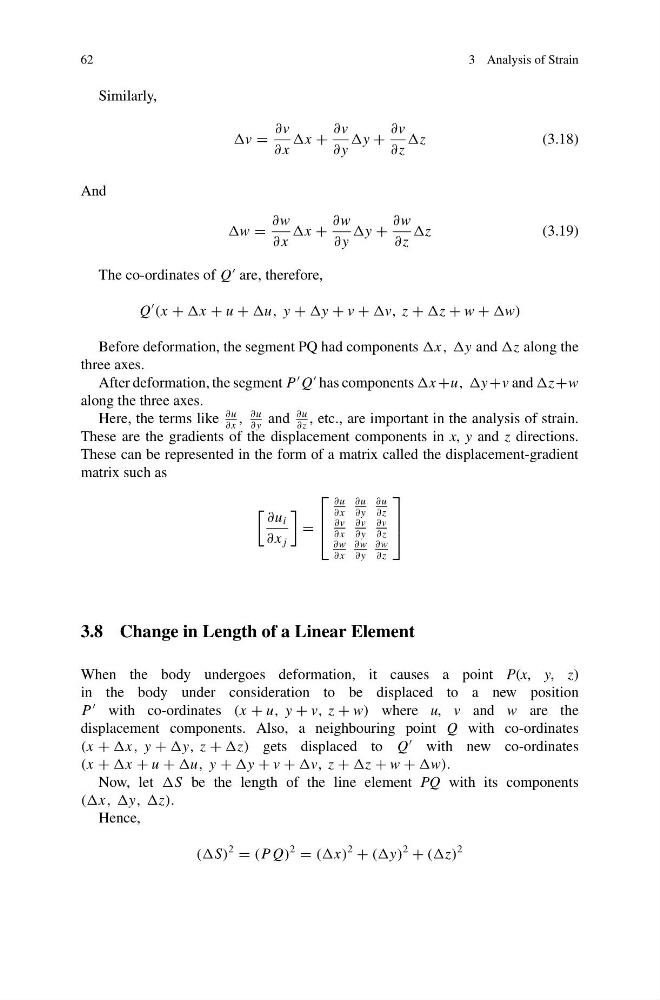
Here, the terms like
∂u
∂ x
,
∂u
∂ y
and
∂u
∂z
, etc., are important in the analysis of strain.
These are the gradients of the displacement components in x, y and z directions.
These can be represented in the form of a matrix called the displacement-gradient
matrix such as
∂u i
∂ x j
=
⎡
⎢
⎣
∂u
∂ x
∂u
∂ y
∂u
∂z
∂v
∂ x
∂v
∂ y
∂v
∂z
∂w
∂ x
∂w
∂ y
∂w
∂z
⎤
⎥
⎦
3.8 Change in Length of a Linear Element
When the body undergoes deformation, it causes a point P(x, y, z)
in the body under consideration to be displaced to a new position
P
with co-ordinates (x + u, y + v, z + w) where u, v and w are the
displacement components. Also, a neighbouring point Q with co-ordinates
(x + x, y + y, z + z) gets displaced to Q
with new co-ordinates
(x + x + u + u, y + y + v + v, z + z + w + w).
Now, let S be the length of the line element PQ with its components
(x, ,y, ,z).
Hence,
(S)
2
= (P Q)
2
= (x)
2
+ (y)
2
+ (z)
2
3 Analysis of Strain
Similarly,
v =
∂v
∂ x
x +
∂v
∂ y
y +
∂v
∂z
z
(3.18)
And
w =
∂w
∂ x
x +
∂w
∂ y
y +
∂w
∂z
z
(3.19)
The co-ordinates of Q
are, therefore,
Q
(x + x + u + u, y + y + v + v, z + z + w + w)
Before deformation, the segment PQ had components x, ,y and z along the
three axes.
After deformation, the segment P
Q
has components x +u, ,y +v and z +w
along the three axes.
Here, the terms like
∂u
∂ x
,
∂u
∂ y
and
∂u
∂z
, etc., are important in the analysis of strain.
These are the gradients of the displacement components in x, y and z directions.
These can be represented in the form of a matrix called the displacement-gradient
matrix such as
∂u i
∂ x j
=
⎡
⎢
⎣
∂u
∂ x
∂u
∂ y
∂u
∂z
∂v
∂ x
∂v
∂ y
∂v
∂z
∂w
∂ x
∂w
∂ y
∂w
∂z
⎤
⎥
⎦
3.8 Change in Length of a Linear Element
When the body undergoes deformation, it causes a point P(x, y, z)
in the body under consideration to be displaced to a new position
P
with co-ordinates (x + u, y + v, z + w) where u, v and w are the
displacement components. Also, a neighbouring point Q with co-ordinates
(x + x, y + y, z + z) gets displaced to Q
with new co-ordinates
(x + x + u + u, y + y + v + v, z + z + w + w).
Now, let S be the length of the line element PQ with its components
(x, ,y, ,z).
Hence,
(S)
2
= (P Q)
2
= (x)
2
+ (y)
2
+ (z)
2