

3.4 Components of Strain
57
3.4 Components of Strain
In a manner similar to the state of stress at any point in a body, as discussed in Chap. 2,
in order to specify the state of strain at any point, it becomes necessary to define it in
terms of relative movement of adjacent points located along the three orthogonal axes
at a point. For the sake of clarity, it is necessary to describe the relative movement
of adjacent points in terms of infinitesimal line segments connecting these points
to be the sides of an infinitesimal rectangular parallelepiped. Let this rectangular
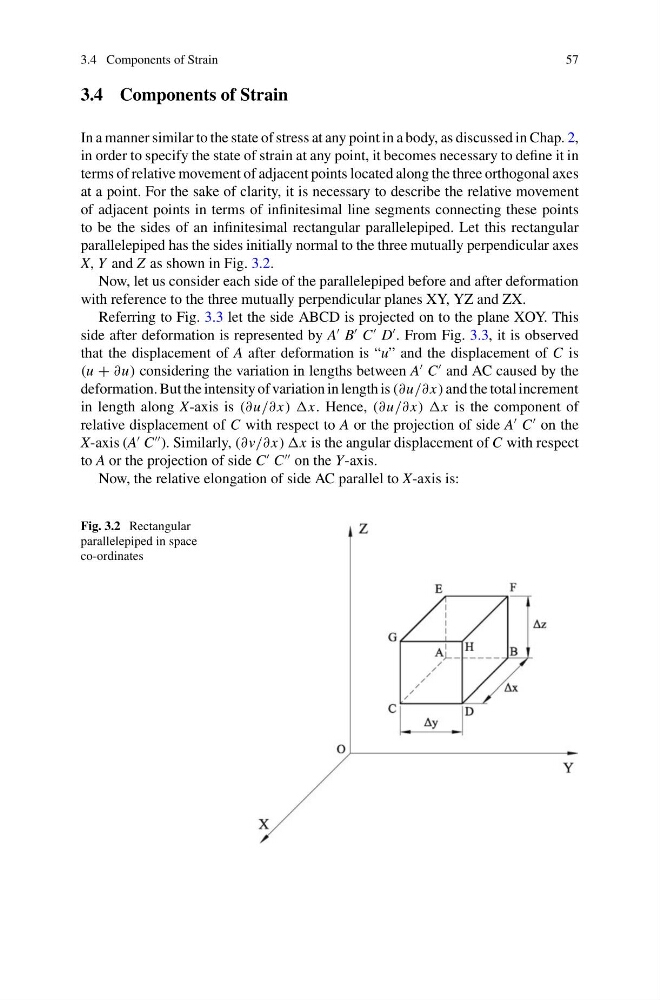
parallelepiped has the sides initially normal to the three mutually perpendicular axes
X, Y and Z as shown in Fig. 3.2.
Now, let us consider each side of the parallelepiped before and after deformation
with reference to the three mutually perpendicular planes XY, YZ and ZX.
Referring to Fig. 3.3 let the side ABCD is projected on to the plane XOY. This
side after deformation is represented by A
B
C
D
. From Fig. 3.3, it is observed
that the displacement of A after deformation is “u” and the displacement of C is
(u + ∂u) considering the variation in lengths between A
C
and AC caused by the
deformation. But the intensity of variation in length is (∂u/∂ x) and the total increment
in length along X-axis is (∂u/∂ x) )x. Hence, (∂u/∂ x) )x is the component of
relative displacement of C with respect to A or the projection of side A
C
on the
X-axis (A
C
). Similarly, (∂v/∂ x) )x is the angular displacement of C with respect
to A or the projection of side C
C
on the Y-axis.
Now, the relative elongation of side AC parallel to X-axis is:
Fig. 3.2 Rectangular
parallelepiped in space
co-ordinates
57
3.4 Components of Strain
In a manner similar to the state of stress at any point in a body, as discussed in Chap. 2,
in order to specify the state of strain at any point, it becomes necessary to define it in
terms of relative movement of adjacent points located along the three orthogonal axes
at a point. For the sake of clarity, it is necessary to describe the relative movement
of adjacent points in terms of infinitesimal line segments connecting these points
to be the sides of an infinitesimal rectangular parallelepiped. Let this rectangular
parallelepiped has the sides initially normal to the three mutually perpendicular axes
X, Y and Z as shown in Fig. 3.2.
Now, let us consider each side of the parallelepiped before and after deformation
with reference to the three mutually perpendicular planes XY, YZ and ZX.
Referring to Fig. 3.3 let the side ABCD is projected on to the plane XOY. This
side after deformation is represented by A
B
C
D
. From Fig. 3.3, it is observed
that the displacement of A after deformation is “u” and the displacement of C is
(u + ∂u) considering the variation in lengths between A
C
and AC caused by the
deformation. But the intensity of variation in length is (∂u/∂ x) and the total increment
in length along X-axis is (∂u/∂ x) )x. Hence, (∂u/∂ x) )x is the component of
relative displacement of C with respect to A or the projection of side A
C
on the
X-axis (A
C
). Similarly, (∂v/∂ x) )x is the angular displacement of C with respect
to A or the projection of side C
C
on the Y-axis.
Now, the relative elongation of side AC parallel to X-axis is:
Fig. 3.2 Rectangular
parallelepiped in space
co-ordinates