

2.12 Stress Components on an Arbitrary Plane
19
T z = τ xz l + τ yz m + σ z n
(2.24c)
The stress resultant on A is thus determined on the basis of known stresses
σ x , σ y , σ z , τ xy , τ yz , τ zx and a knowledge of the orientation of A.
Equations (2.24a), (2.24b) and (2.24c) are known as Cauchy’s stress formula.
These equations show that the nine rectangular stress components at point P will
enable one to determine the stress components on any arbitrary plane passing through
point P.
2.13 Stress Components on Oblique Plane (Stress
Transformation)
When the state or stress at a point is specified in terms of the six components with
reference to a given co-ordinate system, then for the same point, the stress components
with reference to another co-ordinate system obtained by rotating the original axes
can be determined using the direction cosines.
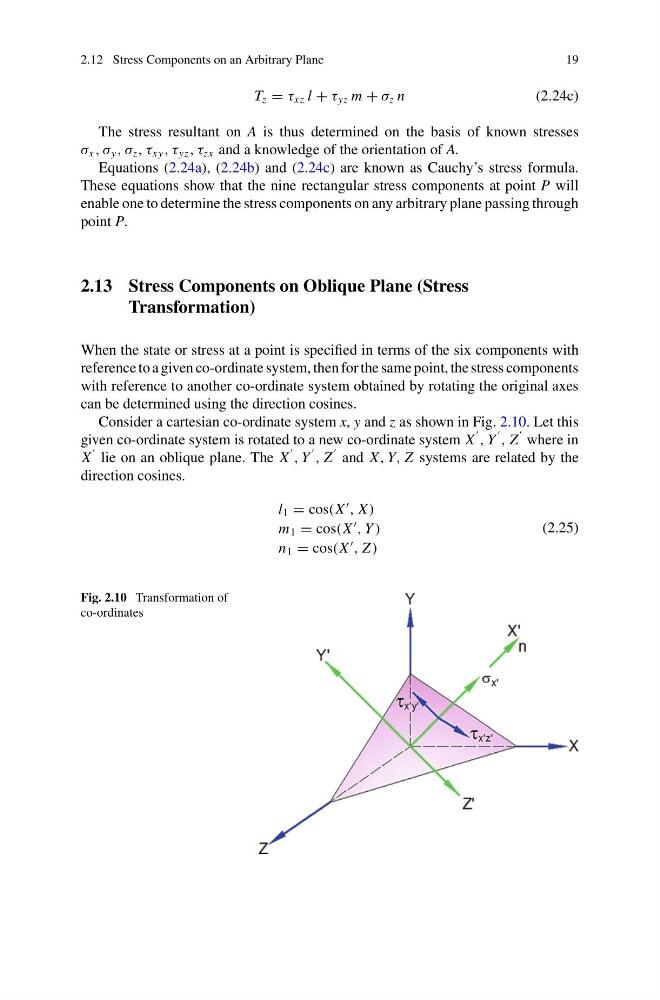
Consider a cartesian co-ordinate system x, y and z as shown in Fig. 2.10. Let this
given co-ordinate system is rotated to a new co-ordinate system X
, Y
, Z
where in
X
lie on an oblique plane. The X
, Y
, Z
and X, Y, Z systems are related by the
direction cosines.
l 1 = cos(X
, X )
m 1 = cos(X
, Y )
n 1 = cos(X
, Z )
(2.25)
Fig. 2.10 Transformation of
co-ordinates
19
T z = τ xz l + τ yz m + σ z n
(2.24c)
The stress resultant on A is thus determined on the basis of known stresses
σ x , σ y , σ z , τ xy , τ yz , τ zx and a knowledge of the orientation of A.
Equations (2.24a), (2.24b) and (2.24c) are known as Cauchy’s stress formula.
These equations show that the nine rectangular stress components at point P will
enable one to determine the stress components on any arbitrary plane passing through
point P.
2.13 Stress Components on Oblique Plane (Stress
Transformation)
When the state or stress at a point is specified in terms of the six components with
reference to a given co-ordinate system, then for the same point, the stress components
with reference to another co-ordinate system obtained by rotating the original axes
can be determined using the direction cosines.
Consider a cartesian co-ordinate system x, y and z as shown in Fig. 2.10. Let this
given co-ordinate system is rotated to a new co-ordinate system X
, Y
, Z
where in
X
lie on an oblique plane. The X
, Y
, Z
and X, Y, Z systems are related by the
direction cosines.
l 1 = cos(X
, X )
m 1 = cos(X
, Y )
n 1 = cos(X
, Z )
(2.25)
Fig. 2.10 Transformation of
co-ordinates