

8.4 Flamant’s Problem
275
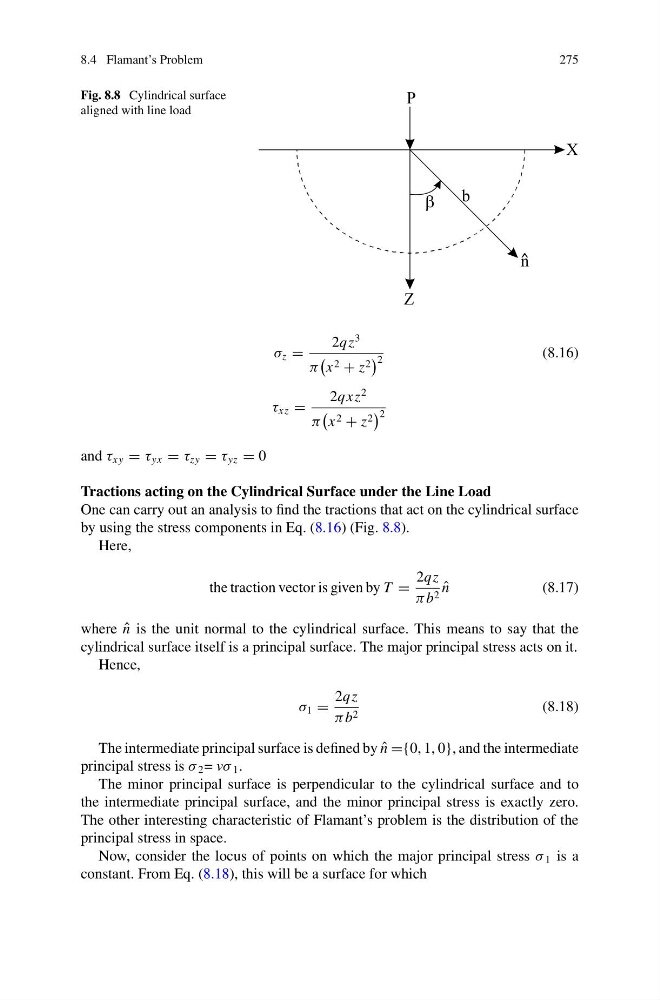
Fig. 8.8 Cylindrical surface
aligned with line load
σ z =
2qz
3
π
x 2 + z 2
2
(8.16)
τ xz =
2qxz
2
π
x 2 + z 2
2
and τ xy = τ yx = τ zy = τ yz = 0
Tractions acting on the Cylindrical Surface under the Line Load
One can carry out an analysis to find the tractions that act on the cylindrical surface
by using the stress components in Eq. (8.16) (Fig. 8.8).
Here,
the traction vector is given by T =
2qz
π b 2 ˆ
n
(8.17)
where ˆ
n is the unit normal to the cylindrical surface. This means to say that the
cylindrical surface itself is a principal surface. The major principal stress acts on it.
Hence,
σ 1 =
2qz
π b 2
(8.18)
The intermediate principal surface is defined by ˆ
n ={0, 1, 0}, and the intermediate
principal stress is σ 2 = vσ 1 .
The minor principal surface is perpendicular to the cylindrical surface and to
the intermediate principal surface, and the minor principal stress is exactly zero.
The other interesting characteristic of Flamant’s problem is the distribution of the
principal stress in space.
Now, consider the locus of points on which the major principal stress σ 1 is a
constant. From Eq. (8.18), this will be a surface for which
275
Fig. 8.8 Cylindrical surface
aligned with line load
σ z =
2qz
3
π
x 2 + z 2
2
(8.16)
τ xz =
2qxz
2
π
x 2 + z 2
2
and τ xy = τ yx = τ zy = τ yz = 0
Tractions acting on the Cylindrical Surface under the Line Load
One can carry out an analysis to find the tractions that act on the cylindrical surface
by using the stress components in Eq. (8.16) (Fig. 8.8).
Here,
the traction vector is given by T =
2qz
π b 2 ˆ
n
(8.17)
where ˆ
n is the unit normal to the cylindrical surface. This means to say that the
cylindrical surface itself is a principal surface. The major principal stress acts on it.
Hence,
σ 1 =
2qz
π b 2
(8.18)
The intermediate principal surface is defined by ˆ
n ={0, 1, 0}, and the intermediate
principal stress is σ 2 = vσ 1 .
The minor principal surface is perpendicular to the cylindrical surface and to
the intermediate principal surface, and the minor principal stress is exactly zero.
The other interesting characteristic of Flamant’s problem is the distribution of the
principal stress in space.
Now, consider the locus of points on which the major principal stress σ 1 is a
constant. From Eq. (8.18), this will be a surface for which