

270
8 Elastic Solutions in Geomechanics
σ z = −
3Pz
3
2π R 5
σ r =
P
2π
(1 − 2v)
R(R + z)
−
3r
2 z
R 5
σ θ =
P(1 − 2v)
2π
z
R 3 −
1
R(R + z)
τ r z = −
3P
2π
r z
2
R 5
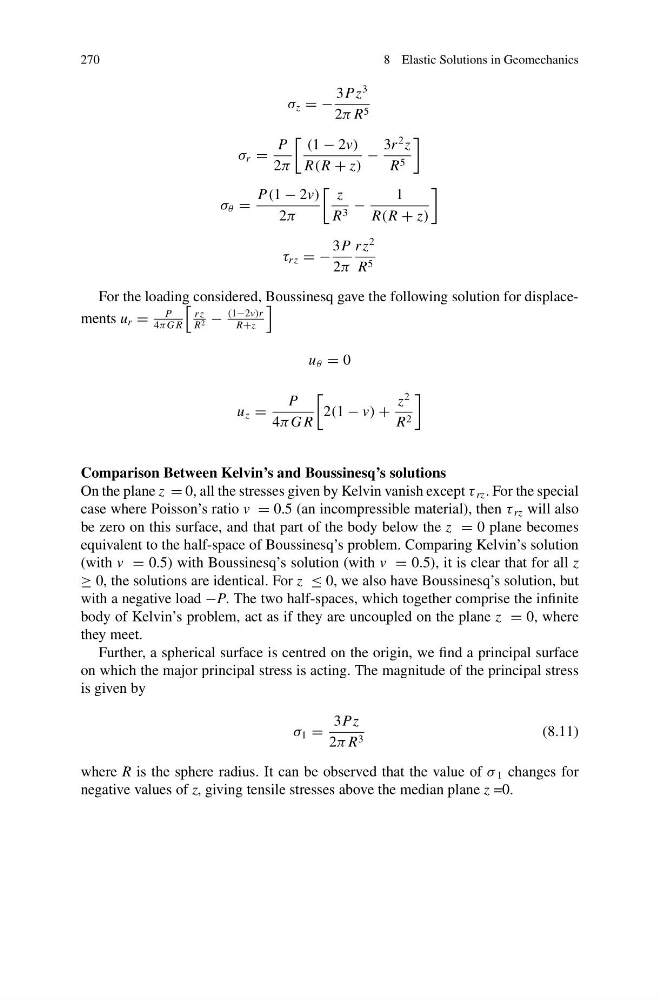
For the loading considered, Boussinesq gave the following solution for displacements u r =
P
4π G R
r z
R 2 −
(1−2v)r
R+z
u θ = 0
u z =
P
4π G R
2(1 − v) +
z
2
R 2
Comparison Between Kelvin’s and Boussinesq’s solutions
On the plane z = 0, all the stresses given by Kelvin vanish except τ rz . For the special
case where Poisson’s ratio v = 0.5 (an incompressible material), then τ rz will also
be zero on this surface, and that part of the body below the z = 0 plane becomes
equivalent to the half-space of Boussinesq’s problem. Comparing Kelvin’s solution
(with v = 0.5) with Boussinesq’s solution (with v = 0.5), it is clear that for all z
≥ 0, the solutions are identical. For z ≤ 0, we also have Boussinesq’s solution, but
with a negative load −P. The two half-spaces, which together comprise the infinite
body of Kelvin’s problem, act as if they are uncoupled on the plane z = 0, where
they meet.
Further, a spherical surface is centred on the origin, we find a principal surface
on which the major principal stress is acting. The magnitude of the principal stress
is given by
σ 1 =
3Pz
2π R 3
(8.11)
where R is the sphere radius. It can be observed that the value of σ 1 changes for
negative values of z, giving tensile stresses above the median plane z =0.
8 Elastic Solutions in Geomechanics
σ z = −
3Pz
3
2π R 5
σ r =
P
2π
(1 − 2v)
R(R + z)
−
3r
2 z
R 5
σ θ =
P(1 − 2v)
2π
z
R 3 −
1
R(R + z)
τ r z = −
3P
2π
r z
2
R 5
For the loading considered, Boussinesq gave the following solution for displacements u r =
P
4π G R
r z
R 2 −
(1−2v)r
R+z
u θ = 0
u z =
P
4π G R
2(1 − v) +
z
2
R 2
Comparison Between Kelvin’s and Boussinesq’s solutions
On the plane z = 0, all the stresses given by Kelvin vanish except τ rz . For the special
case where Poisson’s ratio v = 0.5 (an incompressible material), then τ rz will also
be zero on this surface, and that part of the body below the z = 0 plane becomes
equivalent to the half-space of Boussinesq’s problem. Comparing Kelvin’s solution
(with v = 0.5) with Boussinesq’s solution (with v = 0.5), it is clear that for all z
≥ 0, the solutions are identical. For z ≤ 0, we also have Boussinesq’s solution, but
with a negative load −P. The two half-spaces, which together comprise the infinite
body of Kelvin’s problem, act as if they are uncoupled on the plane z = 0, where
they meet.
Further, a spherical surface is centred on the origin, we find a principal surface
on which the major principal stress is acting. The magnitude of the principal stress
is given by
σ 1 =
3Pz
2π R 3
(8.11)
where R is the sphere radius. It can be observed that the value of σ 1 changes for
negative values of z, giving tensile stresses above the median plane z =0.