

266
8 Elastic Solutions in Geomechanics
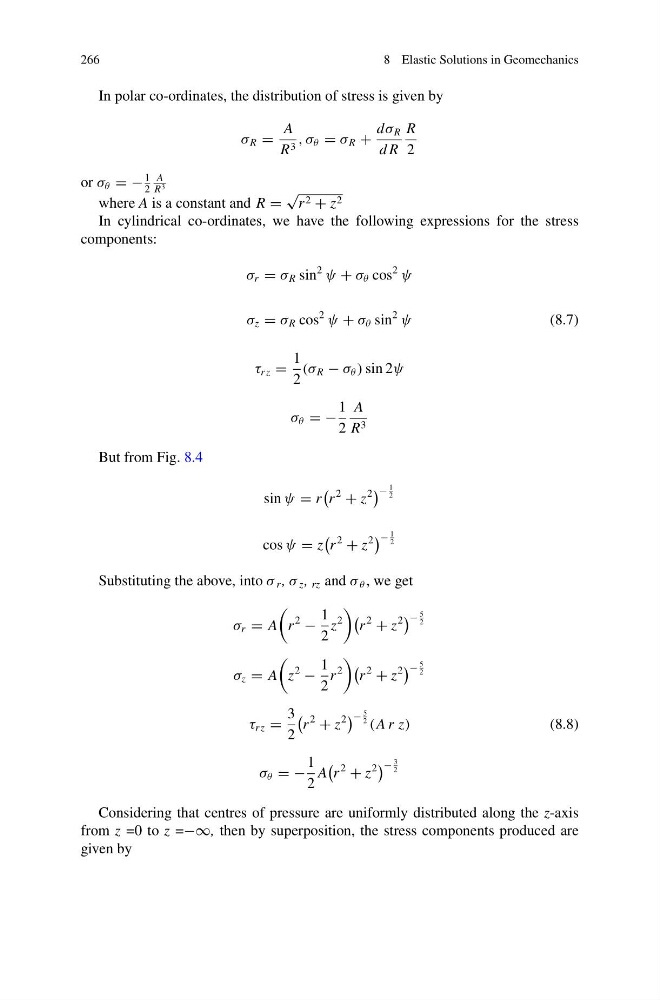
In polar co-ordinates, the distribution of stress is given by
σ R =
A
R 3 , σ θ = σ R +
dσ R
d R
R
2
or σ θ = −
1
2
A
R 3
where A is a constant and R =
√
r 2 + z 2
In cylindrical co-ordinates, we have the following expressions for the stress
components:
σ r = σ R sin
2
ψ + σ θ cos
2
ψ
σ z = σ R cos
2
ψ + σ θ sin
2
ψ
(8.7)
τ r z =
1
2
(σ R − σ θ ) sin 2ψ
σ θ = −
1
2
A
R 3
But from Fig. 8.4
sin ψ = r
r
2
+ z
2
−
1
2
cos ψ = z
r
2
+ z
2
−
1
2
Substituting the above, into σ r , σ z , rz and σ θ , we get
σ r = A
r
2
−
1
2
z
2
r
2
+ z
2
−
5
2
σ z = A
z
2
−
1
2
r
2
r
2
+ z
2
−
5
2
τ r z =
3
2
r
2
+ z
2
−
5
2
(A r z)
(8.8)
σ θ = −
1
2
A
r
2
+ z
2
−
3
2
Considering that centres of pressure are uniformly distributed along the z-axis
from z =0 to z =−∞, then by superposition, the stress components produced are
given by
8 Elastic Solutions in Geomechanics
In polar co-ordinates, the distribution of stress is given by
σ R =
A
R 3 , σ θ = σ R +
dσ R
d R
R
2
or σ θ = −
1
2
A
R 3
where A is a constant and R =
√
r 2 + z 2
In cylindrical co-ordinates, we have the following expressions for the stress
components:
σ r = σ R sin
2
ψ + σ θ cos
2
ψ
σ z = σ R cos
2
ψ + σ θ sin
2
ψ
(8.7)
τ r z =
1
2
(σ R − σ θ ) sin 2ψ
σ θ = −
1
2
A
R 3
But from Fig. 8.4
sin ψ = r
r
2
+ z
2
−
1
2
cos ψ = z
r
2
+ z
2
−
1
2
Substituting the above, into σ r , σ z , rz and σ θ , we get
σ r = A
r
2
−
1
2
z
2
r
2
+ z
2
−
5
2
σ z = A
z
2
−
1
2
r
2
r
2
+ z
2
−
5
2
τ r z =
3
2
r
2
+ z
2
−
5
2
(A r z)
(8.8)
σ θ = −
1
2
A
r
2
+ z
2
−
3
2
Considering that centres of pressure are uniformly distributed along the z-axis
from z =0 to z =−∞, then by superposition, the stress components produced are
given by