

238
7 Torsion of Prismatic Bars
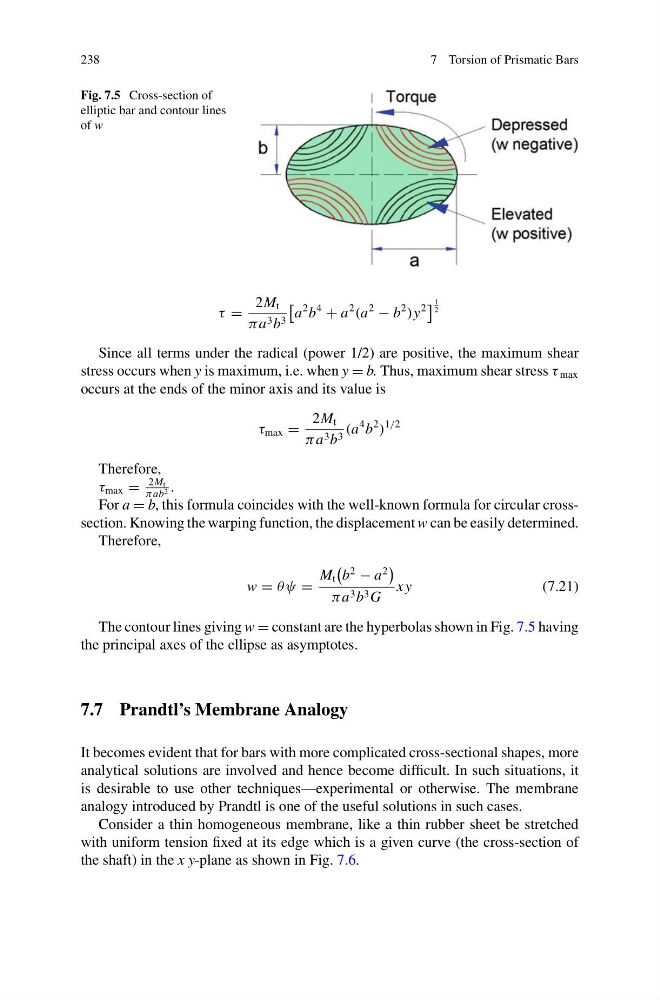
Fig. 7.5 Cross-section of
elliptic bar and contour lines
of w
τ =
2M t
πa 3 b 3
a
2 b
4
+ a
2
(a
2
− b
2
)y
2
1
2
Since all terms under the radical (power 1/2) are positive, the maximum shear
stress occurs when y is maximum, i.e. when y = b. Thus, maximum shear stress τ max
occurs at the ends of the minor axis and its value is
τ max =
2M t
πa 3 b 3 (a
4 b
2
)
1/2
Therefore,
τ max =
2M t
πab 2 .
For a = b, this formula coincides with the well-known formula for circular crosssection. Knowing the warping function, the displacement w can be easily determined.
Therefore,
w = θψ =
M t
b
2
− a
2
πa 3 b 3 G
x y
(7.21)
The contour lines giving w = constant are the hyperbolas shown in Fig. 7.5 having
the principal axes of the ellipse as asymptotes.
7.7 Prandtl’s Membrane Analogy
It becomes evident that for bars with more complicated cross-sectional shapes, more
analytical solutions are involved and hence become difficult. In such situations, it
is desirable to use other techniques—experimental or otherwise. The membrane
analogy introduced by Prandtl is one of the useful solutions in such cases.
Consider a thin homogeneous membrane, like a thin rubber sheet be stretched
with uniform tension fixed at its edge which is a given curve (the cross-section of
the shaft) in the x y-plane as shown in Fig. 7.6.
7 Torsion of Prismatic Bars
Fig. 7.5 Cross-section of
elliptic bar and contour lines
of w
τ =
2M t
πa 3 b 3
a
2 b
4
+ a
2
(a
2
− b
2
)y
2
1
2
Since all terms under the radical (power 1/2) are positive, the maximum shear
stress occurs when y is maximum, i.e. when y = b. Thus, maximum shear stress τ max
occurs at the ends of the minor axis and its value is
τ max =
2M t
πa 3 b 3 (a
4 b
2
)
1/2
Therefore,
τ max =
2M t
πab 2 .
For a = b, this formula coincides with the well-known formula for circular crosssection. Knowing the warping function, the displacement w can be easily determined.
Therefore,
w = θψ =
M t
b
2
− a
2
πa 3 b 3 G
x y
(7.21)
The contour lines giving w = constant are the hyperbolas shown in Fig. 7.5 having
the principal axes of the ellipse as asymptotes.
7.7 Prandtl’s Membrane Analogy
It becomes evident that for bars with more complicated cross-sectional shapes, more
analytical solutions are involved and hence become difficult. In such situations, it
is desirable to use other techniques—experimental or otherwise. The membrane
analogy introduced by Prandtl is one of the useful solutions in such cases.
Consider a thin homogeneous membrane, like a thin rubber sheet be stretched
with uniform tension fixed at its edge which is a given curve (the cross-section of
the shaft) in the x y-plane as shown in Fig. 7.6.