

2.5 Spherical and Deviatorial Stress Tensors
11
⎡
⎣
σ m 0 0
0 σ m 0
0 0 σ m
⎤
⎦
(2.6)
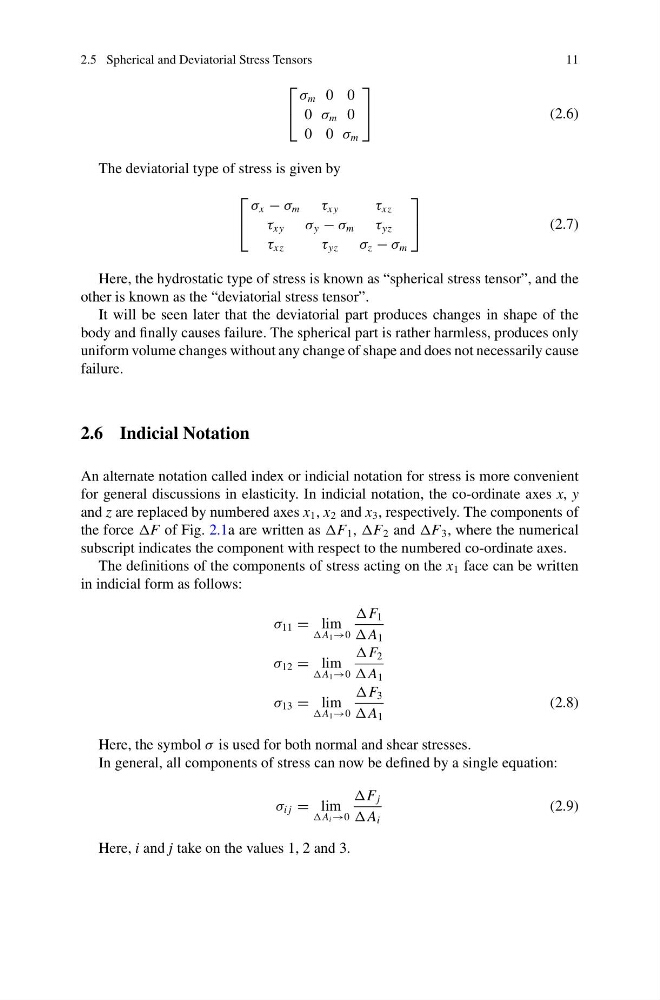
The deviatorial type of stress is given by
⎡
⎣
σ x − σ m τ xy
τ xz
τ xy σ y − σ m τ yz
τ xz
τ yz σ z − σ m
⎤
⎦
(2.7)
Here, the hydrostatic type of stress is known as “spherical stress tensor”, and the
other is known as the “deviatorial stress tensor”.
It will be seen later that the deviatorial part produces changes in shape of the
body and finally causes failure. The spherical part is rather harmless, produces only
uniform volume changes without any change of shape and does not necessarily cause
failure.
2.6 Indicial Notation
An alternate notation called index or indicial notation for stress is more convenient
for general discussions in elasticity. In indicial notation, the co-ordinate axes x, y
and z are replaced by numbered axes x 1 , x 2 and x 3 , respectively. The components of
the force F of Fig. 2.1a are written as F 1 , F 2 and F 3 , where the numerical
subscript indicates the component with respect to the numbered co-ordinate axes.
The definitions of the components of stress acting on the x 1 face can be written
in indicial form as follows:
σ 11 = lim
A 1 →0
F 1
A 1
σ 12 = lim
A 1 →0
F 2
A 1
σ 13 = lim
A 1 →0
F 3
A 1
(2.8)
Here, the symbol σ is used for both normal and shear stresses.
In general, all components of stress can now be defined by a single equation:
σ i j = lim
A i →0
F j
A i
(2.9)
Here, i and j take on the values 1, 2 and 3.
11
⎡
⎣
σ m 0 0
0 σ m 0
0 0 σ m
⎤
⎦
(2.6)
The deviatorial type of stress is given by
⎡
⎣
σ x − σ m τ xy
τ xz
τ xy σ y − σ m τ yz
τ xz
τ yz σ z − σ m
⎤
⎦
(2.7)
Here, the hydrostatic type of stress is known as “spherical stress tensor”, and the
other is known as the “deviatorial stress tensor”.
It will be seen later that the deviatorial part produces changes in shape of the
body and finally causes failure. The spherical part is rather harmless, produces only
uniform volume changes without any change of shape and does not necessarily cause
failure.
2.6 Indicial Notation
An alternate notation called index or indicial notation for stress is more convenient
for general discussions in elasticity. In indicial notation, the co-ordinate axes x, y
and z are replaced by numbered axes x 1 , x 2 and x 3 , respectively. The components of
the force F of Fig. 2.1a are written as F 1 , F 2 and F 3 , where the numerical
subscript indicates the component with respect to the numbered co-ordinate axes.
The definitions of the components of stress acting on the x 1 face can be written
in indicial form as follows:
σ 11 = lim
A 1 →0
F 1
A 1
σ 12 = lim
A 1 →0
F 2
A 1
σ 13 = lim
A 1 →0
F 3
A 1
(2.8)
Here, the symbol σ is used for both normal and shear stresses.
In general, all components of stress can now be defined by a single equation:
σ i j = lim
A i →0
F j
A i
(2.9)
Here, i and j take on the values 1, 2 and 3.