

236
7 Torsion of Prismatic Bars
d
dS
[(A + 1)x
2
− (A − 1)y
2
] = 0.
Integrating, we get
(1 + A)x
2
+ (1 − A)y
2
= constant.
This is of the form
x
2
a 2 +
y
2
b 2 = 1
These two are identical if
a
2
b 2 =
1 − A
1 + A
or
A =
b
2
− a
2
b 2 + a 2
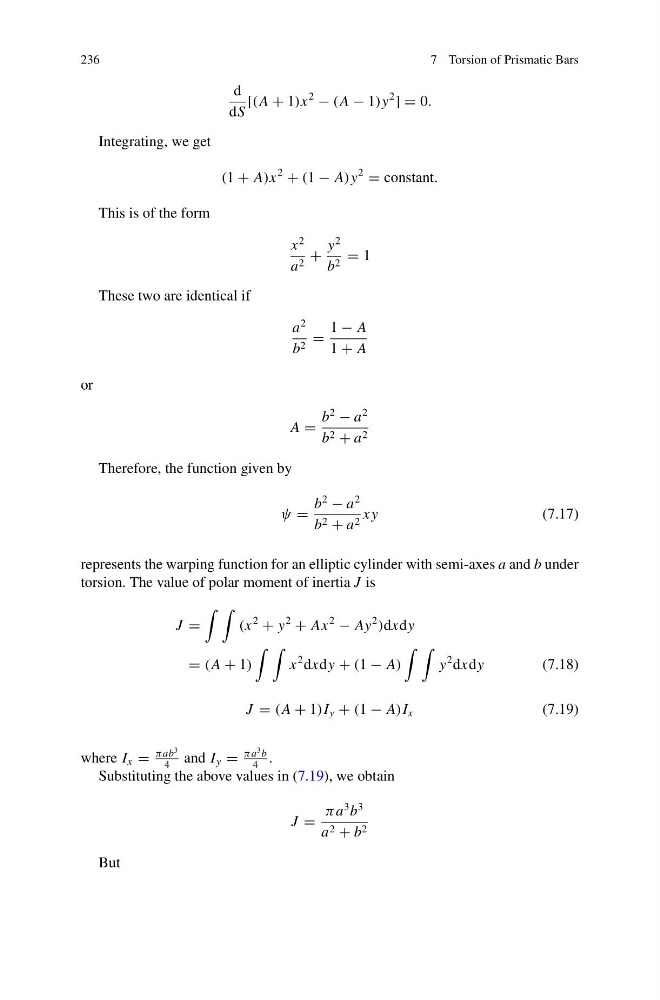
Therefore, the function given by
ψ =
b
2
− a
2
b 2 + a 2 x y
(7.17)
represents the warping function for an elliptic cylinder with semi-axes a and b under
torsion. The value of polar moment of inertia J is
J =
(x
2
+ y
2
+ Ax
2
− Ay
2
)dxdy
= (A + 1)
x
2 dxdy + (1 − A)
y
2 dxdy
(7.18)
J = (A + 1)I y + (1 − A)I x
(7.19)
where I x =
πab
3
4
and I y =
πa
3 b
4
.
Substituting the above values in (7.19), we obtain
J =
πa
3 b
3
a 2 + b 2
But
7 Torsion of Prismatic Bars
d
dS
[(A + 1)x
2
− (A − 1)y
2
] = 0.
Integrating, we get
(1 + A)x
2
+ (1 − A)y
2
= constant.
This is of the form
x
2
a 2 +
y
2
b 2 = 1
These two are identical if
a
2
b 2 =
1 − A
1 + A
or
A =
b
2
− a
2
b 2 + a 2
Therefore, the function given by
ψ =
b
2
− a
2
b 2 + a 2 x y
(7.17)
represents the warping function for an elliptic cylinder with semi-axes a and b under
torsion. The value of polar moment of inertia J is
J =
(x
2
+ y
2
+ Ax
2
− Ay
2
)dxdy
= (A + 1)
x
2 dxdy + (1 − A)
y
2 dxdy
(7.18)
J = (A + 1)I y + (1 − A)I x
(7.19)
where I x =
πab
3
4
and I y =
πa
3 b
4
.
Substituting the above values in (7.19), we obtain
J =
πa
3 b
3
a 2 + b 2
But